
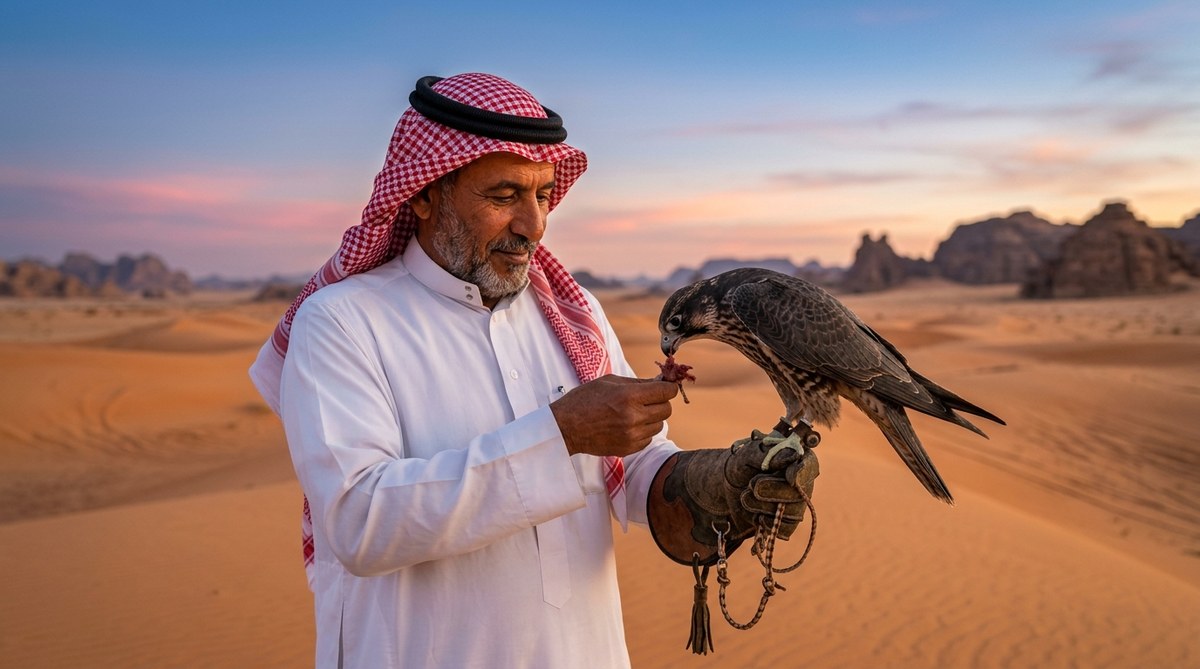
For over a thousand years, the bond between a falcon and its handler has defined the soul of the Arabian Peninsula. This is not a sport rooted in spectacle or competition alone. It is a relationship built on trust, patience, and a shared understanding of the desert. Falconry in Saudi Arabia predates written history, and today it stands as one of the most cherished cultural practices in the Kingdom. Whether you are a historian tracing the roots of Bedouin life or a traveler seeking authentic experiences, understanding this tradition opens a window into the heart of Saudi identity.
Falconry in Saudi Arabia is more than a hunting method; it is a living heritage recognized by UNESCO. From ancient Bedouin survival techniques to modern festivals and conservation efforts, this practice connects Saudis to their past while adapting to the present. Travelers can witness falconry at dedicated clubs, auctions, and annual events across the Kingdom.
Where Falconry Began in the Arabian Desert
The earliest evidence of falconry in the Arabian Peninsula dates back over 4,000 years. Bedouin tribes relied on falcons for survival in a harsh environment. These birds were not pets. They were hunting partners. A trained falcon could bring down a hare or a bustard, providing food for the tribe when resources were scarce.
The relationship between a Bedouin and his falcon was built on mutual respect. The bird was treated with care, fed well, and given the freedom to fly. In return, the falcon would return to the handler’s glove after a hunt. This partnership was not about domination. It was about cooperation.
Falconry in Saudi Arabia was also a measure of status. owning a fine falcon, especially a prized species like the peregrine or the saker, signaled wealth and refinement. Poets celebrated the bird’s speed and grace. Tribal leaders gifted falcons as a sign of honor.
UNESCO Recognition and Cultural Significance
In 2016, UNESCO inscribed falconry on its Representative List of the Intangible Cultural Heritage of Humanity. This recognition was shared by 24 countries, including Saudi Arabia. It confirmed what Saudis have always known: falconry is not a dying art. It is a living tradition that continues to evolve.
The UNESCO designation helped protect the practice and encouraged younger generations to take interest. Today, falconry in Saudi Arabia is taught in dedicated schools and clubs. Children learn to handle birds from a young age. They are taught the ethics of hunting, the importance of conservation, and the patience required to train a raptor.
This cultural significance runs deep. During National Day celebrations, falconry displays are a highlight. The bird is a symbol of pride, freedom, and the enduring spirit of the desert.
Species Favored by Saudi Falconers
Not all falcons are suited for the Arabian climate. Saudi falconers favor species that can withstand the heat and the vast open terrain. Here are the most common types:
| Species | Native Range | Typical Weight | Best For |
|---|---|---|---|
| Saker Falcon | Central Asia to Arabia | 800 1200 grams | Large game like bustards |
| Peregrine Falcon | Global | 500 900 grams | Speed and agility |
| Lanner Falcon | Africa, Middle East | 500 800 grams | Versatile hunting |
| Gyrfalcon | Arctic regions | 1000 1600 grams | Rare and prestigious |
| Hybrid Falcons | Bred in captivity | Varies | Custom traits for performance |
The saker falcon is the most traditional choice. It is hardy, reliable, and well adapted to the desert. Peregrines are valued for their incredible speed, reaching over 240 miles per hour in a dive. Hybrid falcons, bred in captivity, combine the best traits of different species.
“A falcon does not obey commands. It chooses to return. That choice is the greatest honor a handler can earn.” This sentiment, shared by veteran falconer Hasher Al-Otaibi, captures the essence of the bond between bird and handler.
The Training Process: From Capture to Flight
Training a falcon requires patience, knowledge, and a gentle touch. The process has changed little over the centuries. Today, modern tools like GPS trackers and telemetry help, but the core principles remain the same.
-
Acquisition or Hatching Falcons are either captured during migration or bred in captivity. Captive breeding is now preferred for conservation reasons. The bird must be young, ideally less than one year old.
-
Manning This is the taming phase. The falcon wears a hood called a burqa. The handler carries the bird on the glove for hours each day. The goal is to desensitize the bird to human presence. The handler speaks softly, moves slowly, and offers food from the glove.
-
Weight Management Falconry relies on weight control. A hungry falcon is motivated to hunt. The bird is weighed daily. If it is too light, it may fly away. If it is too heavy, it may not respond. The handler adjusts the diet accordingly.
-
Lure Training A lure (a piece of meat attached to a line) is swung in circles. The falcon is released and must chase the lure. This mimics a real hunt. The handler rewards the bird with food each time it catches the lure.
-
Free Flight and Return The falcon is flown without a tether. It must return to the glove on command. This is the most challenging step. Trust is everything. If the bird does not return, it may be lost.
-
Hunting Practice The falcon is taken into the field. It learns to target live game. The handler uses a dog or a decoy to flush out prey. The falcon strikes, and the handler rewards it with a portion of the kill.
Modern falconers also use telemetry devices to track the bird’s location. This technology has reduced the number of lost birds significantly.
Common Mistakes New Falconers Make
Even experienced handlers make errors. Here are the most common pitfalls and how to avoid them.
| Mistake | Why It Happens | How to Avoid |
|---|---|---|
| Overfeeding | Handler wants to bond with bird | Follow a strict feeding schedule based on weight |
| Underestimating flight time | Bird loses fitness | Fly the bird daily, even for short sessions |
| Using loud voices | Startles the falcon | Speak softly and move calmly |
| Skipping hood training | Bird stays stressed | Use the hood daily from day one |
| Not checking for illness | Delayed treatment | Observe droppings, appetite, and feather condition |
| Ignoring molting season | Bird needs rest | Reduce training during molt (summer months) |
Falconry in Saudi Arabia is a discipline. It requires study, mentorship, and a willingness to learn from mistakes.
The Saudi Falcon Club and Malham Festival
If you want to see falconry in action, head to the Saudi Falcon Club in Malham, north of Riyadh. This is the heart of the modern falconry community in the Kingdom. The club hosts the annual International Saudi Falcons and Hunting Exhibition, one of the largest events of its kind in the world.
At the exhibition, you can:
- Watch live hunting demonstrations
- See rare falcon species up close
- Attend auctions where top birds sell for tens of thousands of dollars
- Meet falconers from over 40 countries
- Learn about conservation and breeding programs
The 2026 edition of the exhibition is expected to draw over 400 exhibitors and thousands of visitors. It is a celebration of tradition, innovation, and international friendship.
For travelers, the club offers guided tours. You can hold a falcon on your gloved hand, feel its talons grip your arm, and understand the weight of this living heritage. It is an unforgettable experience.
Conservation and Ethical Falconry
Saudi Arabia has invested heavily in falcon conservation. The Kingdom operates breeding centers that release birds into the wild. This helps maintain wild populations, especially for species like the saker and peregrine.
Capture quotas are strictly regulated. Wild falcons can only be taken during specific months. Violators face heavy fines. The Saudi Falcon Club works with international organizations to track migration patterns and combat illegal trapping.
Ethical falconry also means respecting the game. Hunters are taught to take only what they need. The bustard, once a common target, is now protected in many areas. Falconers have shifted to smaller game like houbara bustard (farmed for conservation) and hare.
The result is a sustainable tradition that honors the past while protecting the future.
Where to Experience Falconry in Saudi Arabia as a Tourist
You do not need to be a falconer to appreciate this art. Several locations offer visitor experiences.
- Saudi Falcon Club (Malham) Open year round for tours. Check their calendar for special events.
- AlUla Some desert camps offer falconry demonstrations as part of cultural tours. This pairs well with the ancient Nabatean tombs.
- Riyadh Season The annual entertainment festival often includes falconry displays.
- Souk Okaz This heritage festival near Taif features traditional arts, including falconry.
- Edge of the World Private tour operators sometimes include a falconry stop on desert safaris.
If you plan to attend an event, book ahead. Falconry demonstrations are popular, especially during cooler months from November to March.
To make the most of your trip, consider reading our guide on 15 Hidden Gems in Saudi Arabia That Most Tourists Never Discover to find lesser known destinations where you might encounter this tradition.
Falconry and Saudi Hospitality
One of the most beautiful aspects of falconry in Saudi Arabia is how it connects to the culture of generosity. If you visit a falconer’s home, you will likely be offered Saudi coffee (qahwa) and dates. The falcon may be brought out for you to see. The handler will explain the bird’s history, its name, and its personality.
This is not a performance. It is an invitation into a way of life. The falconer is proud of his bird, and he wants to share that pride with you.
Accept the offer. Sit on the floor cushions. Drink the coffee. Ask questions. The stories you hear will stay with you long after you leave.
“When the falcon lands on your glove for the first time, you are no longer a visitor. You are part of the circle.” This is what a Bedouin elder once told me. I did not fully understand it until I felt the bird’s heart beating against my hand.
Planning Your Visit for Falconry Events
If you are traveling specifically for falconry, timing matters. The best months are October through February. The weather is mild, and the major events happen during this window.
Here is a simple checklist for your planning:
- Visa Most nationalities can apply for an e-visa online. It takes about 10 minutes. Make sure your passport has at least six months of validity.
- Flights Riyadh is the main gateway. Saudia and Flynas offer domestic connections to smaller cities.
- Accommodation Book near Malham or in northern Riyadh for easy access to the Falcon Club. Luxury hotels like the Four Seasons or Ritz Carlton are popular.
- Transport Ride sharing apps like Uber and Careem work well. For Malham, you will need a car or a private driver.
- Clothing Dress modestly. Loose, light fabrics for day time, a jacket for evening. Comfortable shoes are a must.
For help navigating entry requirements, see our guide on How to Apply for Your Saudi Arabia E-Visa in Under 10 Minutes.
The Language of Falconry
Learning a few terms can enrich your experience. Here are key words used by Saudi falconers.
| Term | Meaning |
|---|---|
| Saqr | Falcon (especially the saker) |
| Burqa | Leather hood placed over the bird’s head |
| Mankal | A perch where the falcon rests |
| Waqar | The process of calling the bird back |
| Talab | The hunting pursuit |
| Hurr | A wild born falcon (as opposed to captive bred) |
| Jir | The jesses (leather straps on the legs) |
Using these words with a falconer will earn you respect. It shows that you have taken the time to understand their world.
Why Falconry Matters in 2026
In an era of technology and urbanization, falconry in Saudi Arabia is a reminder that some things cannot be digitized. The bond between a human and a bird is tactile, emotional, and deeply personal. It requires presence. It demands patience.
For Saudis, falconry is a connection to their ancestors. It is a way of saying, “We remember who we are.” For travelers, it is a rare opportunity to witness a tradition that has survived empires, oil booms, and global change.
The Kingdom is opening its doors to the world. Falconry is one of the first things visitors should see. It is authentic. It is beautiful. And it is waiting for you.
A Living Heritage Worth Preserving
Falconry in Saudi Arabia is not a relic. It is a living practice that continues to adapt and thrive. From the Bedouin camps of the Empty Quarter to the air conditioned halls of the Saudi Falcon Club, the bond between falcon and handler endures.
If you visit the Kingdom, take the time to see this tradition firsthand. Stand in the desert at dawn. Watch the falcon climb into the sky. Wait for it to return. When it lands on the glove, you will understand why this art has survived for thousands of years.
For more cultural experiences to add to your itinerary, check out our guide on 10 Saudi Coffee Traditions Every Visitor Should Experience. And if you are planning a longer trip, our Ultimate 7-Day Itinerary Combining Riyadh, AlUla, and the Edge of the World can help you structure your journey around the Kingdom’s highlights.
The falcon is waiting. Go meet it.