
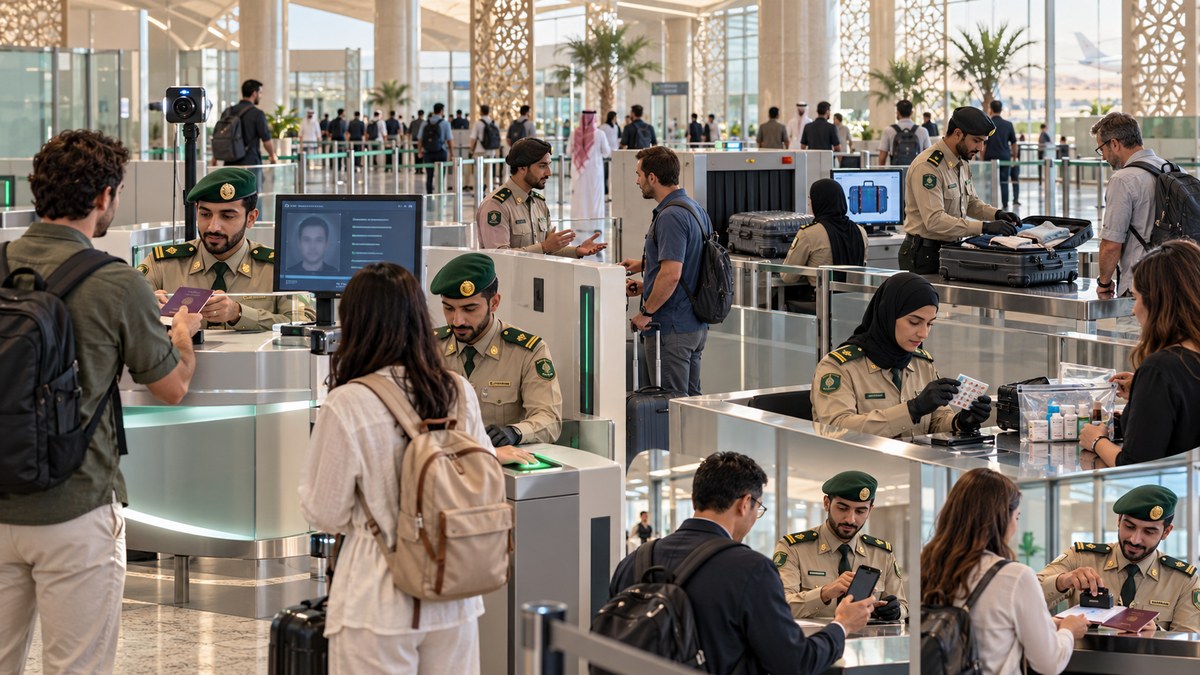
Your plane lands at King Khalid International Airport in Riyadh. You have your passport ready. Your e-visa is confirmed on your phone. You feel prepared. Then you walk toward the immigration counters and realize you have no idea what happens next.
That feeling is common. The Saudi Arabia border control experience is different from what most Western travelers expect. It is not complicated. It is just unfamiliar. A few things happen at customs and immigration that no one warns you about, and knowing them beforehand can save you from awkward pauses and unnecessary stress.
Saudi border control in 2026 is modern and efficient, but first-time visitors often get caught off guard by the mandatory iris scan, the strict baggage scanner for religious items, and the lack of alcohol or pork allowances. Prepare your documents, dress modestly even at the airport, and expect a fingerprint scan. The whole process takes 15 to 30 minutes if you are ready.
What Happens the Moment You Step Off the Plane
The Saudi Arabia border control experience starts before you reach the immigration hall. As you walk from the jet bridge, you will notice uniformed officers directing passengers into separate lanes. There are lanes for Saudi nationals, GCC citizens, and visitors. Follow the signs for visitors or non-Saudi travelers.
You will pass through a pre-screening area where officers glance at your passport and may ask where you are staying. This is not the main immigration check. It is a triage step that helps direct traffic. Stay calm. A simple answer like “Riyadh for tourism” is enough.
After that, you walk toward the main immigration hall. This is where the real process begins.
The Four-Step Immigration Process You Will Go Through
Every traveler goes through the same sequence at Saudi border control. Here is what happens step by step.
-
Document presentation and visa validation — Hand your passport to the immigration officer. They will scan the barcode on your visa or e-visa confirmation. If you applied through the online portal, make sure your e-visa is either printed or saved on your phone. Officers in 2026 accept digital copies, but a printed backup is safer.
-
Fingerprint scanning — You will place your left thumb on a small scanner, then your right thumb. Some officers ask for all ten fingers. This is standard. Your fingerprints are checked against national and international databases. Do not be surprised if the officer gestures for you to press harder. The scanner can be finicky.
-
Iris scan — A camera with a ring of blue light will be positioned at eye level. You look directly into it for about five seconds. The iris scan is mandatory for all foreign visitors. It is used for identity verification and is linked to the Saudi biometric database. Take off sunglasses or glasses before you step up.
-
Exit stamp and smile — Once the officer is satisfied, they stamp your passport and hand it back. Some officers say “Welcome to Saudi Arabia.” Others just nod. Either way, you are in.
What They Check at Customs After Immigration
After you collect your luggage, you enter the customs hall. Saudi customs officers are professional and thorough. They are looking for specific items.
-
Religious materials — Any non-Islamic religious books, pamphlets, or symbols can be confiscated. Bibles are technically allowed for personal use, but proselytizing materials are not. If you carry a Bible, keep it in your bag and do not display it.
-
Alcohol and pork — Both are illegal in Saudi Arabia. Customs officers use X-ray scanners and sometimes dogs. If they find alcohol in your luggage, it will be confiscated. You may be fined or questioned. Do not try to bring it in.
-
Medication — Prescription drugs are allowed with a doctor’s note. Controlled substances like strong painkillers require advance approval from the Saudi Ministry of Health. If you bring medication without documentation, it will be held at customs.
-
Drones — Consumer drones require a permit from the Saudi General Authority of Civil Aviation. Without a permit, your drone will be confiscated. Some travelers have had their drones held for months. Leave it at home unless you have the paperwork.
The Baggage Scanner: What Triggers a Secondary Search
Customs officers watch the X-ray monitor for dense clusters and organic shapes. If something looks suspicious, they pull your bag for a physical search.
| Item Type | Likely to trigger a search? | What to do |
|---|---|---|
| Electronics (laptop, tablet) | No, unless multiple devices | Keep them in your carry-on |
| Powders (protein, spices) | Yes, if over 350 grams | Declare them at the counter |
| Large amounts of cash | Yes, over 60,000 SAR (~$16,000) | Declare it on the form |
| Books with Arabic script | No, unless they look religious | Keep them accessible for inspection |
| Food items (dates, nuts) | No, unless it is meat or dairy | Check Saudi import lists first |
| Vapes and e-cigarettes | Yes, they are banned | Leave them at home |
If you are pulled for a secondary search, stay cooperative. The officers are doing their job. Arguing will only slow you down.
Why the Iris Scan Catches Travelers Off Guard
Most first-time visitors do not expect an iris scan. It is not part of the standard immigration process in the United States or Europe. But in Saudi Arabia, it has been a requirement for years.
The scan takes only a few seconds. You stand still, look into the camera, and wait for a beep. If you wear contact lenses, you do not need to remove them. If you have eye surgery scheduled, the scan still works. The system reads the unique pattern of your iris, not the surface of your eye.
One thing to note: if you refuse the iris scan, you will not be allowed entry. It is not optional.
The Dress Code at Border Control
Saudi Arabia does not require foreign women to wear an abaya in 2026. But the border control area is still a conservative space. Officers expect travelers to dress modestly.
- Cover your shoulders and knees.
- Avoid ripped jeans or very tight clothing.
- Men should not wear sleeveless shirts or shorts above the knee.
If you arrive in a tank top and mini skirt, an officer may ask you to cover up before proceeding. It is rare, but it happens. Save yourself the hassle and dress for the culture.
What Happens If Your Visa Has an Issue
Sometimes a visa does not scan correctly. Maybe the name is misspelled. Maybe the passport number does not match. Maybe the visa was issued for a different point of entry.
If the officer cannot validate your visa, you will be directed to a secondary processing area. This is a separate room near the immigration counters. You will wait while an immigration supervisor reviews your case.
- If it is a minor typo, they will correct it and let you through.
- If your visa is invalid or expired, you may be denied entry and placed on the next flight back.
To avoid this, double-check your visa details before you travel. If you are unsure about the process, read our guide on how to apply for your Saudi Arabia e-visa in under 10 minutes.
The Question Most Tourists Are Asked
Immigration officers in Saudi Arabia often ask one question that catches tourists off guard: “Where is your mahram?”
A mahram is a male guardian. For years, women could not enter Saudi Arabia without one. That rule changed in 2019. Women can now travel alone for tourism.
But some older officers still ask the question out of habit. If you are a solo female traveler, simply say “I am a tourist. I am traveling alone.” The officer will nod and proceed. Do not panic. It is a routine question, not a denial.
How Long the Whole Process Really Takes
The Saudi Arabia border control experience is efficient. From the moment you step into the immigration line to the moment you exit customs, you can expect:
- 5 to 10 minutes in the immigration queue during off-peak hours
- 15 to 20 minutes during busy periods like weekends or holidays
- 30 to 45 minutes if your flight arrives at the same time as multiple other international flights
King Khalid Airport in Riyadh and King Abdulaziz Airport in Jeddah both have modern systems. The bottleneck is rarely the officers. It is the number of travelers ahead of you.
“The key to a smooth Saudi border crossing is preparation. Have your visa confirmation ready. Know your hotel address. And never argue with a customs officer. They have the final say.” — former immigration liaison officer, Riyadh
What to Do If You Are Flagged for a Secondary Inspection
Secondary inspections happen for several reasons. Your name might match one on a watchlist. Your luggage might contain an item that looks suspicious on the X-ray. Or you might be randomly selected.
If you are flagged:
- Stay calm. Do not raise your voice.
- Follow the officer to the inspection room.
- Answer questions honestly.
- Do not offer bribes. This is a serious offense.
Most secondary inspections end within 15 minutes. The officer checks your documents, asks where you are staying, and lets you go.
Entering by Land or Sea: Does the Process Differ?
If you enter Saudi Arabia by land from Bahrain, Kuwait, or the UAE, the border control process is similar but less formal. You drive up to a booth, hand over your passport, and the officer checks your visa. You may be asked to step out of the car for a fingerprint scan.
At the King Fahd Causeway between Bahrain and Saudi Arabia, the process is faster because the causeway has dedicated lanes for tourists. If you are planning a road trip, check our guide on entering Saudi Arabia by land: border crossing requirements for drivers.
Sea entry at ports like Jeddah Islamic Port follows the same immigration and customs rules as airports. The only difference is the pace. Ports tend to be slower.
Common Mistakes That Slow Down Your Border Crossing
Even experienced travelers make these errors. Avoid them.
- Forgetting to print your visa confirmation. Digital copies work, but if your phone dies or the network is down, you will wait.
- Packing prohibited items in checked luggage. Customs officers scan everything.
- Not knowing your hotel name or address. Officers sometimes ask. Have it written down.
- Wearing sunglasses or a hat during the iris scan. You will be asked to remove them.
- Acting nervous or evasive. Officers notice body language. Be relaxed and direct.
What Happens After You Clear Border Control
Once you are through customs, you enter the arrivals hall. This is where you can exchange currency, buy a local SIM card, or arrange transportation. The arrivals area is well marked.
If you are flying into Riyadh or Jeddah, you will find ride-sharing apps like Uber and Careem readily available. Taxis are also available but cost more.
Before you leave the airport, take a moment to check that your passport has the entry stamp. Some officers forget to stamp it. If you leave Saudi Arabia without an entry stamp, you may face questions at departure.
Your First Steps Inside Saudi Arabia
Now you are officially in the Kingdom. The border control experience is behind you. What comes next is the real adventure.
Saudi Arabia in 2026 is a country of contrasts. You can walk through the ancient streets of Al-Balad in Jeddah, stand at the edge of the world near Riyadh, or dive into the coral reefs of the Red Sea. The country has opened up to tourism in a way that seemed impossible a decade ago.
If you want to make the most of your trip, start with a well planned itinerary. Our ultimate 7-day itinerary combining Riyadh, AlUla, and the Edge of the World is a great place to start.
Wrapping Up Your Arrival Experience
The Saudi Arabia border control experience is straightforward once you know what to expect. The iris scan is the part that surprises most people. The fingerprint scanner is standard. The customs check is thorough but fair.
Pack your documents. Dress modestly. Leave the alcohol and pork at home. Answer questions clearly.
That is all it takes to walk through Saudi immigration without a hitch. Now you can focus on the part that matters: experiencing one of the most fascinating travel destinations in the world.