
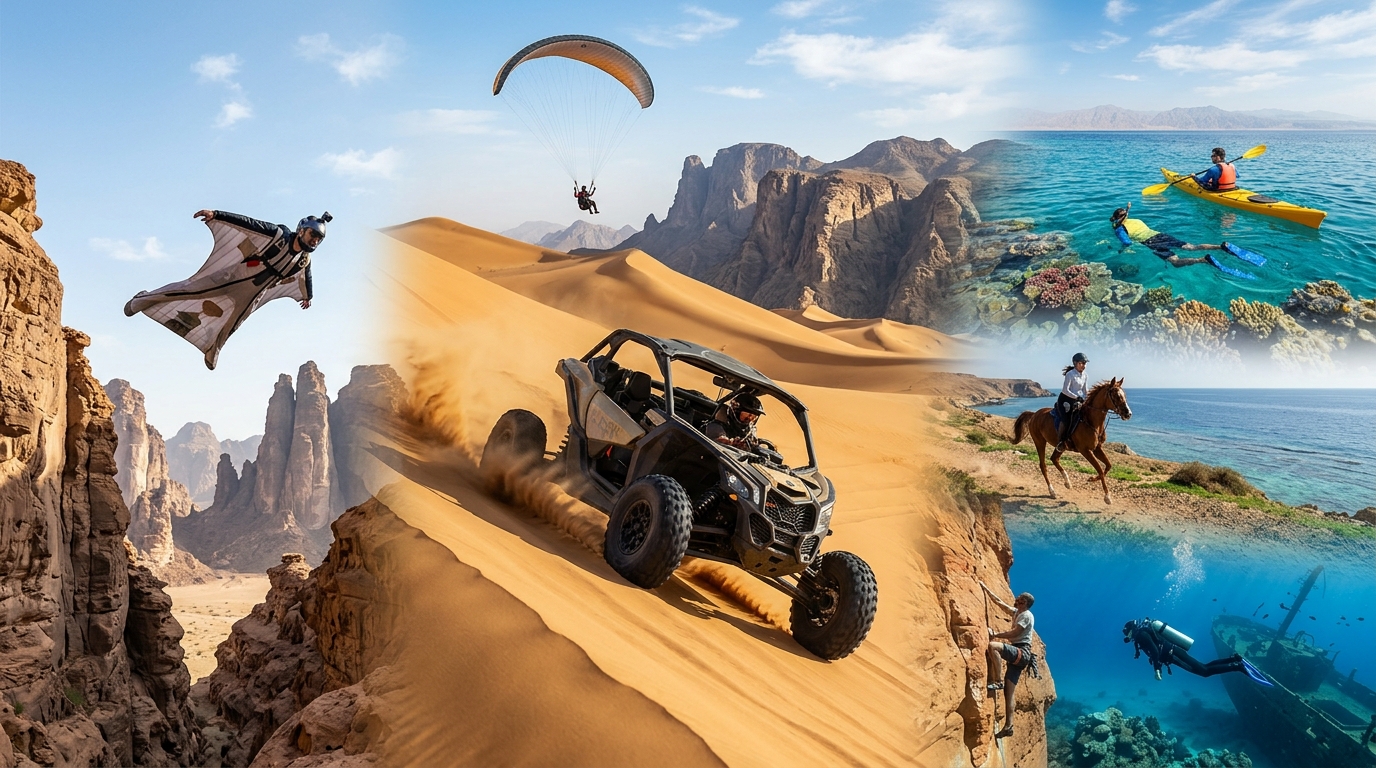
Saudi Arabia is rewriting the rules of Middle Eastern adventure travel. The kingdom that once kept its borders tightly closed now welcomes thrill seekers to some of the most extreme landscapes on Earth. You can sandboard down dunes taller than skyscrapers, freedive alongside whale sharks in pristine coral reefs, and paraglide over mountain villages that have existed for centuries.
The country’s dramatic geography creates opportunities for adrenaline experiences you simply can’t replicate elsewhere. Where else can you climb volcanic rock formations in the morning and kitesurf crystal clear waters by afternoon?
Saudi Arabia offers adventure sports ranging from sandboarding the [Empty Quarter](https://en.wikipedia.org/wiki/Rub%27_al_Khali)’s towering dunes to cage diving with sharks in the Red Sea. The kingdom’s diverse terrain includes volcanic fields for rock climbing, mountain ranges for paragliding, and coastal areas for kitesurfing. Most activities require permits or licensed operators, and the cooler months from October through March provide optimal conditions for outdoor adventures.
Sandboarding the Empty Quarter’s Monster Dunes
The Rub’ al Khali, or Empty Quarter, contains some of the tallest sand dunes on the planet. Some reach heights exceeding 250 meters.
That’s taller than a 70-story building.
Sandboarding here feels nothing like snowboarding. The sand creates different friction, requiring you to lean back further and adjust your weight distribution constantly. The boards themselves are specially waxed to handle the fine desert sand.
Most operators run trips from November through February when daytime temperatures stay below 30°C. Summer sandboarding is technically possible but genuinely dangerous, with sand surface temperatures reaching 70°C.
Where to go:
- Shaybah area near the UAE border (tallest dunes)
- Liwa border region (most accessible from major cities)
- Uruq Bani Ma’arid protected area (combines dunes with wildlife viewing)
Tours typically include dune bashing in 4×4 vehicles, which serves as both transportation and its own adrenaline rush. Drivers navigate near-vertical dune faces at angles that seem impossible.
You’ll need to book through licensed operators. Solo sandboarding in the Empty Quarter is not just prohibited but genuinely life-threatening due to navigation challenges and extreme isolation.
Cage Diving with Oceanic Whitetip Sharks
The Red Sea hosts one of the world’s healthiest populations of oceanic whitetip sharks. These apex predators grow up to three meters long and have a well-deserved reputation for curiosity around divers.
Cage diving operations run from specific liveaboard boats that travel to offshore sites where whitetips congregate. You’ll descend in a reinforced aluminum cage while crew members use legal attractants to bring sharks close.
The experience differs completely from cage diving in other locations. Red Sea visibility often exceeds 30 meters, meaning you’ll see sharks approaching from far away. The water temperature stays comfortable year-round, typically between 24-28°C.
“The oceanic whitetips in Saudi waters show different behavior than populations elsewhere. They’re bolder, more investigative, and they’ll circle the cage for extended periods. It’s not a quick flyby.” – Marine biologist at King Abdullah University
Most operators require at least an Open Water diving certification, though some accept strong swimmers with comprehensive safety briefings. Dives last 30-45 minutes, with most trips including multiple cage sessions.
The season runs year-round, but March through May offers the best shark activity. If you want to extend your underwater adventures, check out the ultimate guide to Red Sea diving in Saudi Arabia for more dive sites.
Rock Climbing Volcanic Formations in Harrat Khaybar
Harrat Khaybar is a volcanic field covering over 14,000 square kilometers. The landscape looks genuinely alien, with black basalt formations, crater cones, and lava tubes creating climbing routes that don’t exist anywhere else.
The rock is sharp. Volcanic basalt has texture that shreds regular climbing shoes in days. You’ll need approach shoes with reinforced rubber and extra pairs if you’re planning multiple days.
Popular climbing areas:
- Jabal Bayda white volcano (mixed terrain with both volcanic and sedimentary rock)
- Crater rim routes on Jabal Qidr (exposed climbs with 360-degree views)
- Lava tube entrances near Al Ula (bouldering and short technical climbs)
The climbing here is largely undeveloped. You won’t find bolted sport routes or established guidebooks. Most ascents require traditional climbing skills, with climbers placing their own protection.
Temperature management is critical. Winter mornings can start near freezing, then climb to 25°C by noon. Summer climbing is only viable at dawn, before the black rock becomes too hot to touch.
Several adventure tour companies now offer guided climbing trips with all equipment provided. Solo climbing is legal but not recommended unless you have extensive experience with route finding and self-rescue.
Paragliding the Asir Mountain Range
The Asir Mountains in southwestern Saudi Arabia rise over 3,000 meters and create thermal conditions that paragliders dream about. The region’s unique geography produces reliable afternoon thermals from October through April.
Launch sites sit at elevations where you’re literally above the clouds. You’ll take off from mountain peaks and soar over terraced farms, ancient stone villages, and valleys filled with juniper forests.
Flight durations regularly exceed two hours when thermals are strong. Some pilots report gaining over 1,000 meters of altitude on good days, allowing cross-country flights of 50+ kilometers.
The town of Abha serves as the main base for paragliding operations. Several schools offer tandem flights for beginners and full certification courses for those wanting to fly solo.
What makes Asir different:
- Consistent thermals with minimal turbulence
- Landing zones at multiple elevations
- Year-round flying season (though summer brings afternoon storms)
- Mountain villages that provide cultural experiences between flights
Weather changes fast in mountain environments. Morning flights often face calm conditions, while afternoons bring strong thermals that can challenge even experienced pilots. Most schools won’t fly beginners after 2 PM during peak thermal season.
You’ll need to arrange permits through your tour operator. The region is still developing its adventure tourism infrastructure, so booking at least two weeks ahead is smart. For more on what makes this region special, read about why the Asir region should be your next Saudi adventure destination.
Kitesurfing the Red Sea Coast
Saudi Arabia’s Red Sea coastline stretches over 1,800 kilometers, with dozens of spots offering world-class kitesurfing conditions. The combination of consistent wind, flat water lagoons, and complete absence of crowds creates conditions that European kitesurfers pay thousands to access.
Yanbu and Umluj are emerging as the premier kitesurfing destinations. Both offer shallow lagoons protected by offshore reefs, creating butter-flat water even when wind speeds hit 25 knots.
The wind patterns are remarkably consistent. From November through March, thermal winds build by 11 AM and blow 15-25 knots until sunset. You can literally set your watch by it.
Gear considerations:
- 9-12m kites handle most conditions
- Reef booties are mandatory (urchins and sharp coral)
- Wetsuit tops for winter mornings (water drops to 22°C)
- Backup equipment recommended (nearest kite shops are in Jeddah)
Several beach camps now cater specifically to kitesurfers, offering equipment storage, launch assistance, and rescue boat support. The infrastructure is basic compared to established destinations like Egypt or Greece, but that’s part of the appeal.
You’ll share the water with almost nobody. Weekdays often mean having entire lagoons to yourself.
The coast also offers excellent conditions for wing foiling, with several spots providing the shallow water and steady wind that foilers need for progression.
Via Ferrata Routes in AlUla
AlUla recently opened the Arabian Peninsula’s first via ferrata routes. These protected climbing paths use fixed cables, ladders, and bridges to let non-climbers access vertical terrain safely.
The routes traverse sandstone cliffs overlooking ancient Nabataean tombs and rock formations that have stood for millennia. You’ll clip into steel cables and traverse exposed cliff faces with hundreds of meters of air below your feet.
Three routes currently operate, ranging from beginner to advanced:
| Route Name | Duration | Elevation Gain | Technical Difficulty |
|---|---|---|---|
| Sunrise Trail | 2 hours | 150m | Beginner friendly |
| Canyon Crossing | 3.5 hours | 280m | Intermediate |
| Summit Challenge | 5 hours | 450m | Advanced fitness required |
All routes require booking through authorized operators who provide helmets, harnesses, and safety briefings. Guides accompany every group and manage the cable systems.
The experience combines physical challenge with cultural immersion. You’ll climb past ancient inscriptions, traverse ledges where desert foxes make their homes, and finish with views across archaeological sites that date back 2,000 years.
Age restrictions apply. Most routes require participants to be at least 12 years old and meet minimum fitness standards. The advanced route includes sections where you’re supporting your full body weight on your arms.
Operating season runs October through April. Summer temperatures make the routes unsafe, with metal equipment becoming too hot to touch and heat exhaustion risks becoming severe.
Dune Bashing and Desert Racing Experiences
Professional dune bashing in Saudi Arabia operates at a completely different level than tourist desert safaris elsewhere. Drivers undergo certification programs and vehicles are built specifically for extreme desert driving.
The experience involves navigating massive dunes at high speed, often catching air off dune crests and sliding down faces at angles exceeding 45 degrees. It’s part rally driving, part roller coaster, entirely thrilling.
Preparation steps for a desert racing experience:
- Book with operators who use roll-caged vehicles with five-point harnesses
- Schedule trips for early morning or late afternoon to avoid peak heat
- Take motion sickness medication if you’re prone to car sickness
- Wear closed-toe shoes and avoid loose clothing that could catch on equipment
- Bring action cameras with chest mounts (handheld filming is impossible)
Some operators now offer passenger rides in actual rally vehicles driven by professional racers. These experiences reach speeds over 150 km/h across open desert and include jumps that get all four wheels off the ground.
The Empty Quarter offers the most extreme terrain, but areas closer to Riyadh and Jeddah provide excellent dune bashing without the multi-day commitment. Many operators combine dune bashing with sandboarding and traditional Bedouin camp experiences.
Safety standards have improved dramatically in recent years. Reputable operators maintain their vehicles meticulously and employ drivers with thousands of hours of desert experience. Still, this remains an extreme activity with real risks.
For those planning extended desert adventures, learning about how to survive and thrive on a multi-day desert safari in the Empty Quarter will help you prepare properly.
Planning Your Adventure Sports Trip
Timing matters enormously for adventure sports in Saudi Arabia. The country’s extreme temperature variations make some activities genuinely dangerous during certain months.
Optimal seasons by activity:
- Desert sports (sandboarding, dune bashing): November to February
- Water sports (kitesurfing, diving): October to May
- Mountain activities (paragliding, climbing): October to April
- Via ferrata routes: October to April only
Most adventure sports require booking through licensed operators. The Saudi government regulates extreme activities carefully, and attempting them independently can result in fines or deportation.
Before you go, make sure you understand the visa requirements by checking how to apply for your Saudi Arabia e-visa in under 10 minutes. The process is straightforward, but you’ll want your paperwork sorted before booking expensive adventure packages.
Budget expectations vary widely. Basic sandboarding day trips start around $150 per person. Multi-day liveaboard diving trips with shark cage experiences run $1,500-2,500. Paragliding tandem flights cost $200-300. Via ferrata routes range from $100-250 depending on difficulty and duration.
Equipment rental is included with most tours, but serious participants often prefer bringing their own gear. Airlines serving Saudi Arabia generally accommodate sports equipment, though you’ll want to confirm baggage policies for items like kitesurf boards or climbing gear.
Travel insurance that covers adventure sports is essential. Standard policies often exclude activities like cage diving or paragliding. Specialized adventure travel insurance costs more but provides coverage you’ll desperately need if something goes wrong.
Common Mistakes Adventure Travelers Make
| Mistake | Why It’s Problematic | Better Approach |
|---|---|---|
| Visiting in summer months | Heat makes most outdoor activities dangerous | Plan trips between October and April |
| Booking budget operators | Safety standards vary dramatically | Pay more for established companies with proper insurance |
| Underestimating sun exposure | Desert sun causes severe burns in under 30 minutes | Use SPF 50+, reapply every hour, wear protective clothing |
| Skipping travel insurance | Medical evacuation from remote areas costs $50,000+ | Buy comprehensive adventure sports coverage |
| Ignoring cultural guidelines | Can result in denied access to activities | Research dress codes and behavior expectations |
Physical preparation matters more than most travelers expect. Paragliding requires you to run downhill while carrying 15kg of equipment. Via ferrata routes demand sustained arm strength. Even “passive” activities like dune bashing can exhaust you through constant bracing against g-forces.
Start training at least a month before your trip. Focus on cardiovascular fitness and core strength. If you’re planning climbing or via ferrata routes, add pull-ups and dead hangs to build grip strength.
Hydration needs in Saudi Arabia’s climate are extreme. You’ll need 4-6 liters of water daily during active pursuits, more in summer months. Dehydration symptoms appear faster than you expect and can turn dangerous within hours.
Many adventure locations sit far from medical facilities. The nearest hospital to some Empty Quarter dune bashing sites is over 200 kilometers away. Operators carry first aid equipment and satellite communication, but you’re responsible for disclosing any medical conditions that could become problematic.
Making the Most of Your Adrenaline Journey
Saudi Arabia’s adventure sports scene is still young. You’re visiting during a unique window where infrastructure is developing but crowds haven’t arrived yet.
That means you’ll often have world-class locations almost to yourself. It also means you need to be more self-sufficient than you would be in established adventure destinations.
Bring backup supplies of anything you can’t live without. Spare contact lenses, prescription medications, favorite energy bars. You won’t find specialty outdoor stores in most Saudi cities.
Consider combining adventure activities with cultural experiences. The same trip that includes sandboarding can also feature visits to traditional Bedouin camps. Diving trips often stop at coastal villages where you can experience authentic Saudi hospitality. The Asir region offers both paragliding and hidden gems in Saudi Arabia that most tourists never discover.
Weather can change plans instantly. Desert storms, unexpected wind shifts, or temperature extremes might cancel activities with little notice. Build flexibility into your itinerary and consider booking extra days for your highest-priority activities.
The adventure tourism industry in Saudi Arabia is professionalizing rapidly. Operators who were running informal trips three years ago now maintain international safety certifications and modern equipment. Still, standards vary. Read recent reviews, ask detailed questions about safety protocols, and trust your instincts if something feels off.
Your Next Steps Toward Saudi Adventure
The kingdom’s transformation into an adventure destination is happening right now. New routes, new operators, and new possibilities appear constantly.
Start by identifying which activities match your skill level and interests. Be honest about your physical fitness and experience. A tandem paragliding flight or guided via ferrata route makes more sense than attempting solo desert navigation if you’re new to extreme sports.
Book your core activities first, then build the rest of your trip around them. Weather-dependent sports like kitesurfing and paragliding benefit from having multiple days available in case conditions aren’t ideal.
Connect with operators directly to ask questions about group sizes, equipment quality, and guide experience. The best companies welcome detailed questions and provide thorough answers.
Saudi Arabia’s adventure sports scene rewards those who do their homework, respect the extreme environment, and come prepared for genuine wilderness experiences. The country offers adrenaline rushes you genuinely can’t find elsewhere, in landscapes that will redefine what you thought possible in the Middle East.
Pack your sense of adventure along with your sunscreen. The kingdom is ready for you.