
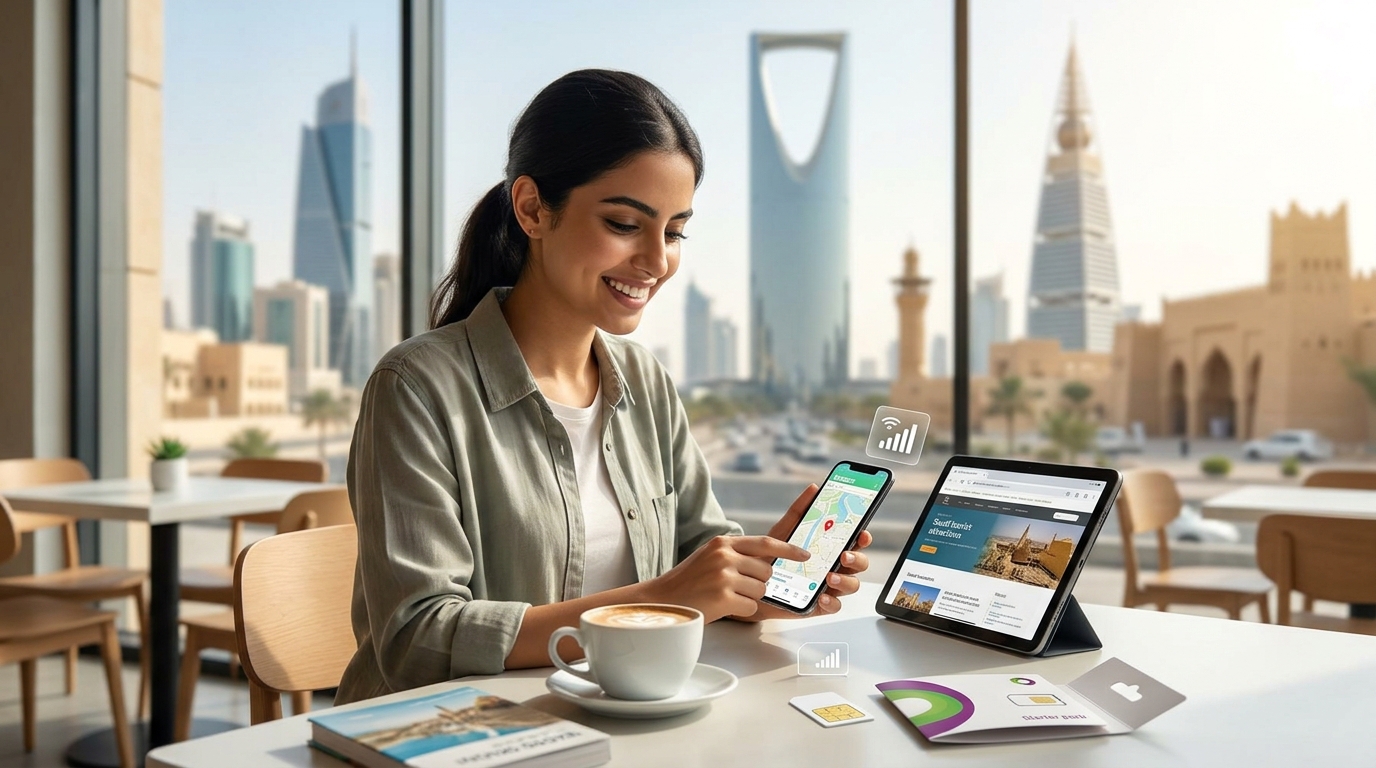
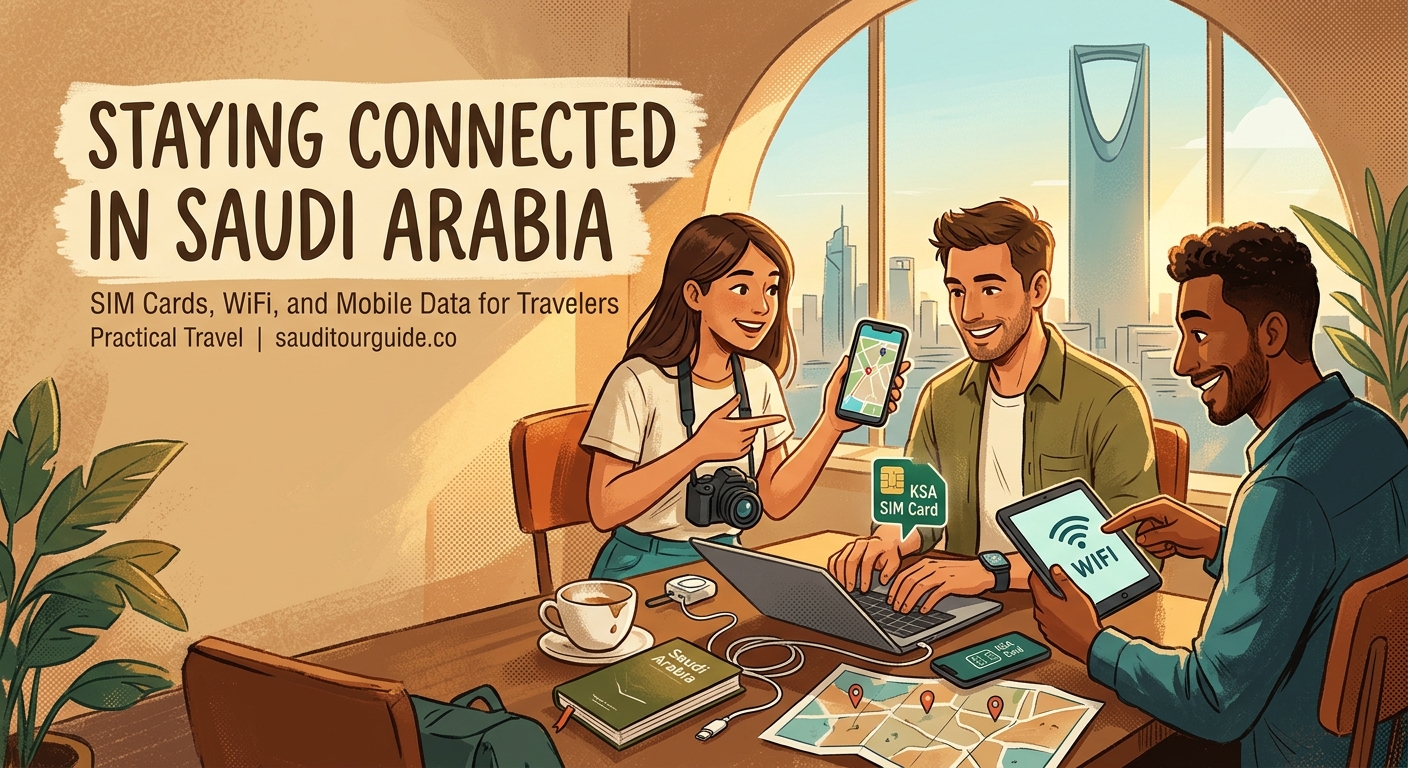
Landing in Saudi Arabia without a solid connectivity plan is like trying to navigate the Empty Quarter without a map. You’ll need mobile data to book rides, translate Arabic signs, access digital maps, and share those stunning AlUla sunset photos in real time.
The good news? Getting a Saudi Arabia SIM card for travelers is easier than most people think. The Kingdom’s telecom infrastructure rivals any Western nation, with excellent 5G coverage in major cities and reliable 4G across most tourist destinations.
Travelers can choose between physical SIM cards from three major carriers (STC, Mobily, Zain), eSIM options for compatible devices, or portable WiFi devices. Tourist SIM packages start around 100 SAR for 30 days with generous data allowances. Airport kiosks offer immediate activation, while eSIM can be activated before arrival. All options provide excellent coverage across major cities and tourist routes, with 5G available in Riyadh, Jeddah, and growing areas.
Your three main connectivity options in Saudi Arabia
Physical SIM cards remain the most popular choice for international visitors. You’ll find official carrier stores at every major airport, in shopping malls, and throughout city centers.
eSIM technology offers the fastest setup if your phone supports it. You can purchase and activate before your flight even lands.
Portable WiFi devices work well for groups or families traveling together. One device can connect multiple phones, tablets, and laptops simultaneously.
Each option has distinct advantages depending on your travel style, duration, and device compatibility.
Saudi Arabia’s three major mobile networks
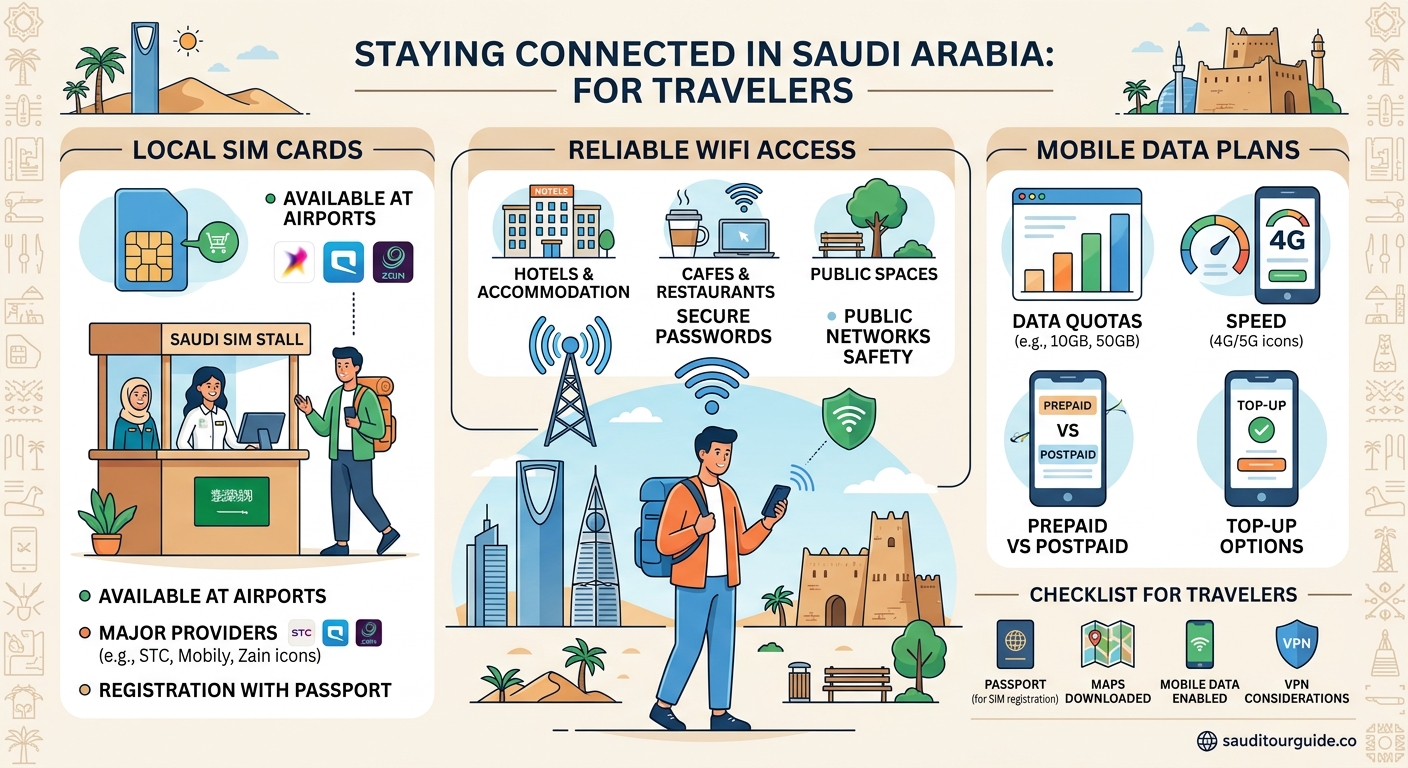
STC (Saudi Telecom Company) holds the largest market share and offers the most extensive coverage nationwide. Their network reaches remote areas better than competitors, making them ideal for travelers planning road trips along the Red Sea coast or visits to hidden gems outside major cities.
Mobily provides competitive pricing and strong urban coverage. Their tourist packages often include generous social media data allowances, perfect for Instagram enthusiasts documenting their journey.
Zain focuses on value offerings with straightforward pricing. They’ve invested heavily in 5G infrastructure across Riyadh and Jeddah.
All three carriers offer tourist-specific packages with similar features. The main differences come down to coverage in specific regions and promotional offers at the time of purchase.
How to buy a SIM card at Saudi airports
Getting connected the moment you clear customs makes everything easier. Here’s the step-by-step process:
-
Look for official carrier kiosks immediately after exiting the baggage claim area at King Khalid International Airport (Riyadh), King Abdulaziz International Airport (Jeddah), or other major entry points.
-
Present your passport and provide a local address (your hotel name and location works perfectly).
-
Choose a tourist package based on your data needs and trip duration.
-
Wait 5 to 10 minutes while staff activate your SIM and verify the connection.
-
Keep your receipt and the SIM card packaging, which includes your new Saudi phone number and customer service contacts.
The entire process rarely takes longer than 15 minutes, even during busy periods. Airport staff speak English and handle dozens of tourist activations daily.
Most carriers charge between 100 and 200 SAR for tourist packages valid for 30 days. These typically include 20GB to unlimited data, local calls, and international calling credits.
Always verify that your phone is unlocked before traveling. Locked devices won’t accept foreign SIM cards regardless of carrier. Contact your home provider at least two weeks before departure if you’re unsure about your phone’s lock status.
Tourist SIM packages worth considering
Here’s what you’ll typically find across the three major carriers:
| Package Type | Data Allowance | Validity | Typical Price | Best For |
|---|---|---|---|---|
| Basic Tourist | 20GB | 30 days | 100-120 SAR | Light users, short trips |
| Standard Tourist | 50GB | 30 days | 150-180 SAR | Most travelers |
| Premium Tourist | 100GB or unlimited | 30 days | 200-250 SAR | Heavy streamers, remote workers |
| Weekly Pass | 10-15GB | 7 days | 50-70 SAR | Weekend visitors |
Data doesn’t expire at midnight like Cinderella’s carriage. If you purchase a 30-day package, you get the full duration regardless of when you activate it.
Social media apps often come with unlimited or bonus data in many packages. WhatsApp, Instagram, Snapchat, and TikTok usage may not count against your main data allowance.
Setting up eSIM before you travel
eSIM eliminates the physical card entirely. Your phone downloads a digital profile that functions identically to a traditional SIM.
Compatible devices include iPhone XS and newer, Samsung Galaxy S20 and newer, Google Pixel 3 and newer, and most flagship phones released after 2019. Check your phone’s specifications if you’re uncertain.
Several international eSIM providers offer Saudi Arabia coverage:
- Airalo provides Saudi-specific eSIM plans starting at $8 for 1GB valid for 7 days, scaling up to $42 for 20GB valid for 30 days.
- Nomad offers competitive rates with plans beginning around $10 for 1GB.
- Holafly specializes in unlimited data eSIM for around $50 per week.
Purchase and installation happen entirely through apps. Download the provider’s app, select Saudi Arabia, choose your package, complete payment, and scan the QR code provided. Your eSIM activates automatically upon landing when your phone connects to the local network.
The main advantage? You keep your home SIM active simultaneously. Your phone can receive calls and texts on your regular number while using Saudi data for internet access.
Coverage across popular tourist destinations
Network quality varies significantly depending on where you’re headed. Here’s the reality on the ground:
Riyadh and Jeddah enjoy full 5G coverage from all three carriers. You’ll get excellent speeds throughout both cities, including inside shopping malls, restaurants, and hotels.
AlUla has strong 4G coverage near the main archaeological sites and in the town center. Signal weakens in remote desert areas between major attractions.
The Asir region maintains reliable coverage in Abha and along main highways. Mountain areas between towns can experience spotty connections, though popular hiking destinations typically have adequate signal.
Tabuk and the northern regions offer consistent coverage along the main routes. Remote areas may require STC for the most reliable connection.
Edge of the World and similar desert excursions operate outside reliable coverage zones. Download offline maps before heading out.
Red Sea coastal areas maintain strong signals near developed beaches and resorts. Coverage extends several kilometers offshore for boating and diving trips near popular sites.
What about portable WiFi devices?
Rental WiFi hotspots make sense for specific travel situations. A single device can connect 5 to 10 devices simultaneously, perfect for families or small groups.
You’ll find rental counters at airports alongside SIM card vendors. Daily rates run between 30 and 50 SAR, with weekly packages offering better value around 200 SAR.
Battery life typically lasts 6 to 8 hours of continuous use. Carry a portable charger for full-day excursions.
The main drawback? You need to keep the device with you constantly. Splitting up means someone loses internet access. Physical SIM cards offer more flexibility for independent exploration.
Free WiFi availability across Saudi Arabia
Don’t rely on free WiFi as your primary connectivity method. Coverage is inconsistent and security questionable.
Most hotels provide complimentary WiFi with acceptable speeds for basic browsing and messaging. Upload speeds often lag, making photo backups frustratingly slow.
Shopping malls typically offer free WiFi, though connection quality varies. Expect to re-authenticate every hour or so.
Coffee shops and restaurants increasingly provide WiFi, but many require purchases and provide access codes on receipts.
Public WiFi at airports works reliably in terminal areas. Speed throttling kicks in after 30 to 60 minutes of use.
Common mistakes that waste money and data
Leaving mobile data roaming enabled on your home SIM while using a local SIM or eSIM can trigger unexpected charges. Disable roaming completely in your phone settings before departure.
Automatic app updates consume massive amounts of data unnecessarily. Change your app store settings to “update over WiFi only” before your trip.
Streaming video in high definition burns through data allowances fast. Netflix, YouTube, and similar apps default to HD when connected to fast networks. Manually select standard definition in app settings.
Cloud photo backup services like Google Photos and iCloud Photos sync continuously over cellular data unless configured otherwise. Disable automatic backup or restrict to WiFi only.
Background app refresh allows apps to update content even when you’re not actively using them. Disable this feature for all non-essential apps to conserve data.
Topping up when you run low
Running out of data mid-trip doesn’t mean hunting for a physical store. All three carriers offer multiple recharge methods:
- Mobile apps (STC, Mobily, and Zain each have English-language apps)
- USSD codes (dial specific numbers to access recharge menus)
- Retailer locations (grocery stores, gas stations, and convenience shops sell top-up cards)
- Online portals accessible through any web browser
Top-up amounts start as low as 20 SAR and scale up to 200 SAR or more. Data packages can be added separately from call credit.
Most packages allow you to check remaining data by dialing a short code or through the carrier app. Set a reminder to check every few days so you’re never caught without connectivity.
Documents you’ll need for activation
Passport requirements apply universally across all carriers. Your passport serves as your primary identification and must be valid for the duration of your stay.
Tourist visa confirmation helps expedite the process, though most airport kiosks can verify your visa status electronically. Having your visa documentation readily accessible speeds things up.
Hotel booking confirmation or a local address satisfies regulatory requirements. The address doesn’t need to be permanent. Your first night’s accommodation works perfectly fine.
Some carriers may request an email address for sending activation confirmations and account information. Use an email you can access internationally.
Network speed expectations
5G networks in major cities regularly deliver 200 to 400 Mbps download speeds. That’s faster than most home broadband connections.
4G LTE throughout tourist areas typically provides 20 to 80 Mbps, more than sufficient for navigation, social media, video calls, and streaming.
3G fallback exists in remote areas but feels painfully slow for modern app usage. Basic messaging and map loading still function, but forget about uploading photos or streaming anything.
Indoor coverage inside hotels, malls, and restaurants generally matches outdoor performance in urban areas. Thick concrete construction in some older buildings can weaken signals.
Using your Saudi number effectively
Your new Saudi phone number becomes active immediately upon SIM insertion. Share it with your hotel, tour operators, and anyone you’re meeting locally.
WhatsApp automatically detects the new number when you insert the SIM. You can use WhatsApp with your home number by enabling dual SIM features on compatible phones or by using WhatsApp Web.
International calls back home get expensive on standard tourist packages. Use WhatsApp, FaceTime, or similar apps over data instead. Most packages include generous or unlimited data for messaging apps.
Local calls within Saudi Arabia are included in most tourist packages or charged at minimal rates. Calling restaurants for reservations, tour companies for bookings, or hotels for information won’t impact your budget.
Comparing costs against international roaming
International roaming from Western carriers typically costs $10 to $15 per day for limited data. A two-week trip could run $140 to $210 just for basic connectivity.
A Saudi tourist SIM card or eSIM costing 150 to 200 SAR (roughly $40 to $53) provides 30 days of generous data, local calls, and better coverage than roaming agreements often deliver.
The math becomes even more favorable for longer stays. Multi-week itineraries benefit enormously from local SIM cards versus daily roaming charges.
Special considerations for business travelers
Extended stays may require different package types. Monthly plans offer better value than tourist packages for trips exceeding 30 days.
Corporate accounts exist but require Saudi business registration. Individual tourist packages work fine for business visitors on short assignments.
VoIP services like Zoom, Microsoft Teams, and Skype function normally on Saudi networks. No special permissions or configurations needed.
Tethering and hotspot features work on tourist SIM cards, allowing you to share your phone’s connection with laptops and tablets. Check your specific package terms, as some carriers limit hotspot data separately from phone data.
Making the right choice for your trip
Short visits under one week favor eSIM for convenience and speed of setup. You’ll pay slightly more per gigabyte but save time and hassle.
Two to four week trips get the best value from physical SIM cards purchased at the airport. The broader package selection and better pricing justify the minimal setup time.
Group travel works well with either individual SIM cards for each person or a portable WiFi device shared among the group. Individual SIMs provide more flexibility but cost more total. A shared device saves money but requires coordination.
Tech-heavy travelers working remotely or uploading lots of content should spring for premium unlimited packages. The peace of mind alone justifies the extra 50 to 100 SAR.
Budget-conscious visitors can survive on basic packages supplemented by hotel WiFi for heavy tasks like photo backups and video streaming.
Staying connected beyond the major cities
Remote destinations require extra planning. Download offline maps for Google Maps or Maps.me before leaving areas with reliable coverage.
Translation apps like Google Translate offer offline language packs. Download Arabic before your trip so you can translate signs and menus without connectivity.
Important contact numbers should be saved locally on your phone, not just in cloud-based contact lists. Hotel numbers, emergency services, and tour operator contacts need to be accessible offline.
Portable battery packs become essential when traveling to areas with limited coverage. Your phone burns through battery faster when searching for signal.
Your connectivity sorted before you land
Getting a Saudi Arabia SIM card for travelers doesn’t require advanced planning or technical expertise. The infrastructure works smoothly, prices remain reasonable, and coverage extends to virtually every tourist destination worth visiting.
Purchase at the airport if you want immediate connectivity and don’t mind 10 minutes of setup time. Choose eSIM if your phone supports it and you prefer handling everything digitally before departure. Consider portable WiFi only if you’re traveling as a group and want to simplify device management.
Whichever route you choose, you’ll stay connected throughout your Saudi adventure, from navigating Jeddah’s historic streets to sharing photos from your Red Sea diving expedition. Your Saudi number will work the moment you need it, keeping you connected to maps, translation tools, ride-hailing apps, and everything else that makes modern travel manageable.