

Saudi Arabia opened to tourists just a few years ago, and travelers still wonder if this kingdom fits their budget. The good news? You can visit for less than you think, or splurge on luxury if that’s your style.
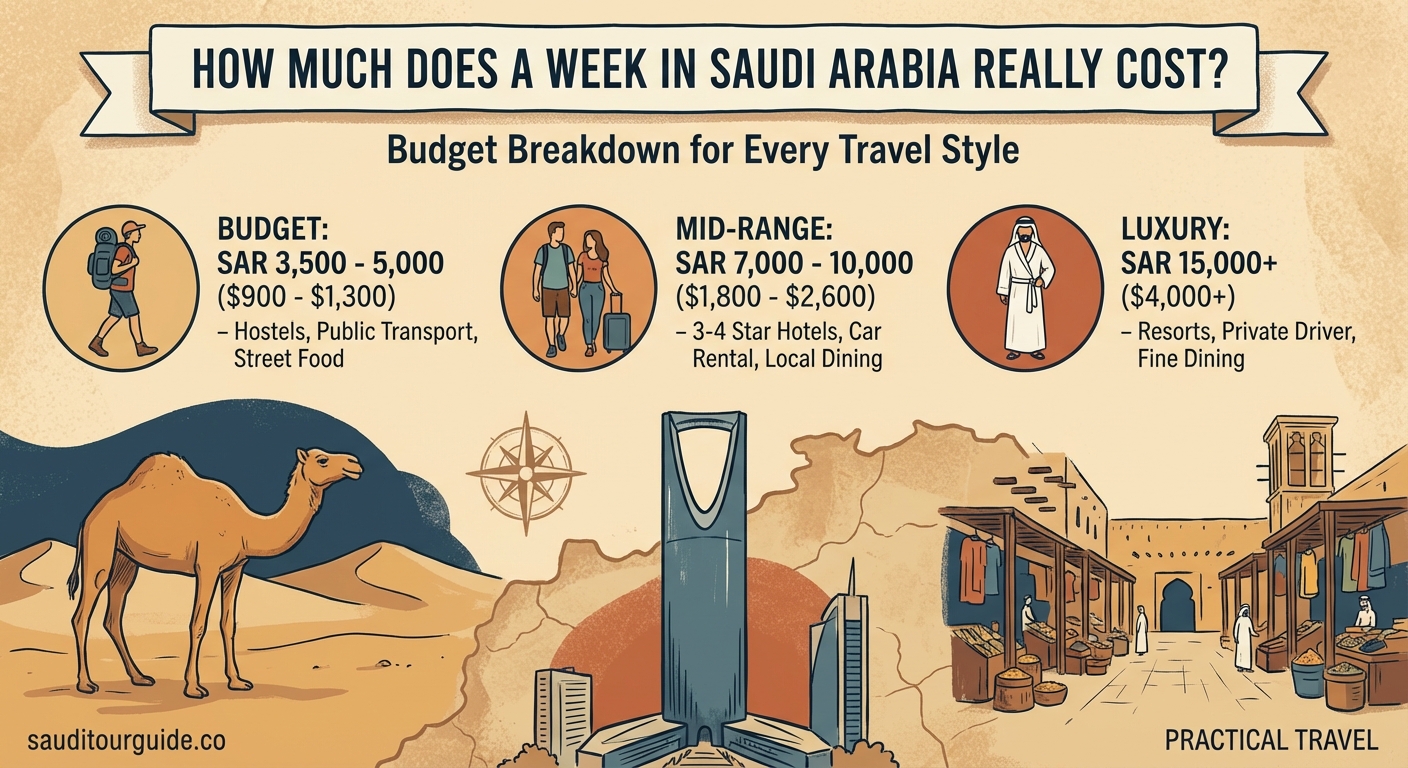
A week in Saudi Arabia costs between $800 and $3,500 per person depending on your travel style. Budget travelers spend around $115 daily, mid-range visitors pay $200-300, and luxury seekers invest $500+ per day. Flights, accommodation, and transportation make up 70% of total expenses, while visa fees add a flat $135 to every trip.
Breaking Down Your Saudi Arabia Trip Budget
Understanding how much does a trip to Saudi Arabia cost starts with separating fixed expenses from variable ones. Fixed costs include your visa and flights. Variable costs depend entirely on your choices for hotels, meals, and activities.
The Saudi tourist visa costs $135 for most nationalities and remains valid for one year with multiple entries. This fee stays the same whether you visit for three days or three weeks.
Flights represent your biggest variable. Prices swing wildly based on your departure city, season, and booking timing.
From North America, expect $600 to $1,200 round trip during shoulder season. European travelers often find deals between $300 and $700. Asian visitors enjoy the lowest fares, sometimes under $400 from major hubs.
Peak season runs from November through March when temperatures drop to comfortable levels. Flights during this window cost 30-40% more than summer bookings.
Accommodation Costs Across Different Budgets
Hotels in Saudi Arabia range from affordable chains to opulent five-star properties that rival anything in Dubai.
Budget Options ($30-60 per night)
– Local hotel chains like Narcissus and Millennia
– International budget brands (Ibis, Holiday Inn Express)
– Clean, functional rooms with breakfast included
– Usually located 15-20 minutes from city centers
Mid-Range Choices ($80-150 per night)
– Marriott, Hilton, and Radisson properties
– Central locations near attractions
– Pools, gyms, and business facilities
– Often better value than budget options when factoring in location
Luxury Experiences ($200-800 per night)
– Ritz-Carlton, Four Seasons, and boutique hotels
– Premium locations in Riyadh, Jeddah, and AlUla
– World-class service and amenities
– Some properties offer cultural experiences and desert excursions
Riyadh tends to run 10-15% cheaper than Jeddah for equivalent quality. AlUla commands premium rates due to limited inventory and high demand around archaeological sites.
Booking directly through hotel websites often yields better rates than third-party platforms, especially for extended stays.
Daily Food Expenses That Fit Every Budget
Saudi food culture offers incredible variety at every price point. Street food and local restaurants serve authentic meals for a fraction of international chain prices.
A traditional Saudi breakfast of ful, falafel, and fresh bread costs $3-5 at neighborhood spots. The same meal at a hotel buffet runs $20-30.
Here’s what you’ll spend on meals per day:
| Budget Level | Breakfast | Lunch | Dinner | Daily Total |
|---|---|---|---|---|
| Budget | $3-5 | $5-8 | $8-12 | $16-25 |
| Mid-Range | $8-12 | $12-20 | $20-35 | $40-67 |
| Luxury | $15-25 | $25-45 | $50-100 | $90-170 |
Local restaurants called “matabikh” serve generous portions of rice, grilled meats, and vegetables for $8-15 per person. These family-run spots offer the most authentic experience and best value.
International chains like McDonald’s, Starbucks, and KFC charge similar prices to Western countries. A Big Mac meal costs around $7.
Supermarkets stock familiar brands at reasonable prices. Self-catering travelers can prepare meals for $5-10 per day.
Pro tip from seasoned travelers: Eat your main meal at lunch when many restaurants offer set menus at 30-40% below dinner prices. Save money and experience how locals dine.
Transportation Costs Within Saudi Cities
Getting around Saudi cities costs less than most travelers expect, thanks to ride-sharing apps and improving public transit.
Uber and Careem (Local Ride-Sharing)
These apps dominate urban transportation. Prices remain remarkably affordable:
– Short city trips (3-5 km): $2-4
– Cross-city journeys (15-20 km): $8-12
– Airport transfers: $15-25 depending on city
Drivers accept cash or card through the app. Tipping isn’t expected but appreciated.
Public Transportation
Riyadh’s metro opened recently with six lines covering major attractions. Single rides cost $0.50-1.30 based on distance. Day passes run around $4.
Jeddah lacks metro service but operates bus routes for $0.50 per trip. Routes can be confusing for visitors, making ride-sharing more practical.
Rental Cars
Daily rates start at $25 for economy cars and climb to $80 for SUVs. Gas costs roughly $0.60 per liter, making driving economical for groups.
International driving permits work alongside your home license. Traffic in Riyadh and Jeddah can be intense during rush hours.
Intercity Travel
Saudi Arabia’s size means long distances between major cities:
– Riyadh to Jeddah flight: $60-120 (90 minutes)
– Same route by bus: $20-30 (10 hours)
– High-speed rail Riyadh to Dammam: $25-40 (3.5 hours)
Flying makes sense for time-conscious travelers. Buses work well for budget-focused visitors who don’t mind longer journeys.
Activity and Attraction Expenses
Saudi Arabia mixes free cultural sites with paid experiences that range from affordable to premium.
Free Attractions
– Historic Jeddah’s Al-Balad district
– Riyadh’s Diriyah Gate (exterior and public areas)
– Corniche waterfronts in Jeddah and Dammam
– Public beaches along the Red Sea
– Traditional souqs in every major city
Paid Experiences
Museum entry fees run $5-15 per person. The National Museum in Riyadh charges around $13 and offers comprehensive Saudi history across eight halls.
Desert tours represent the biggest activity expense:
– Half-day desert safari: $60-100 per person
– Full-day AlUla tour with lunch: $150-250
– Multi-day desert camping: $300-600
– Edge of the World day trip: $80-120
Cultural experiences like traditional coffee ceremonies, henna painting, and cooking classes cost $30-80 per person.
Water activities along the Red Sea coast include:
– Snorkeling trips: $40-70
– Scuba diving (certified): $80-150
– Boat tours: $50-100
– Beach club day passes: $30-60
Sample Budgets for Different Travel Styles
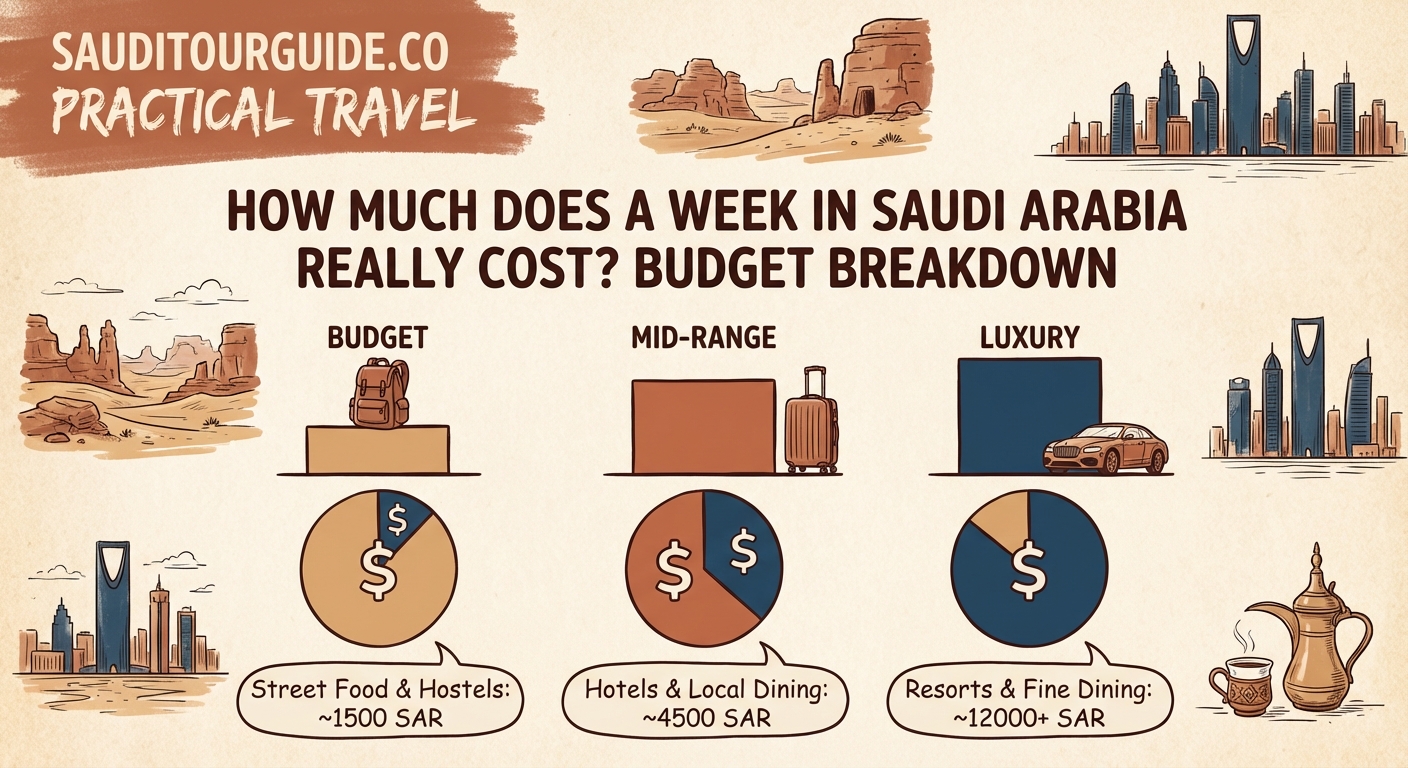
Let’s break down what a week in Saudi Arabia costs based on three common travel approaches.
Budget Traveler (7 Days): $800-950 Total
- Flights: $400 (off-season, advance booking)
- Visa: $135
- Accommodation: $280 (budget hotel, $40/night)
- Food: $140 ($20/day, local restaurants)
- Transportation: $70 (ride-sharing, public transit)
- Activities: $100 (free sites plus two paid tours)
- Miscellaneous: $50 (souvenirs, snacks)
This budget requires advance planning and willingness to use local transport. You’ll eat where Saudis eat and stay in functional rather than fancy hotels.
Mid-Range Traveler (7 Days): $1,800-2,200 Total
- Flights: $600 (shoulder season)
- Visa: $135
- Accommodation: $700 (comfortable hotel, $100/night)
- Food: $350 ($50/day, mix of local and international)
- Transportation: $200 (ride-sharing, one rental car day)
- Activities: $400 (multiple tours and experiences)
- Miscellaneous: $150 (shopping, extras)
This range offers comfort without extravagance. You’ll stay in recognizable hotel brands, eat varied meals, and join organized tours.
Luxury Traveler (7 Days): $3,500-6,000+ Total
- Flights: $1,200 (business class or peak season)
- Visa: $135
- Accommodation: $2,100 (luxury hotel, $300/night)
- Food: $700 ($100/day, fine dining)
- Transportation: $400 (private drivers, premium car rental)
- Activities: $1,000 (private tours, exclusive experiences)
- Miscellaneous: $500 (high-end shopping, spa treatments)
Luxury travelers enjoy five-star properties, private guides, and VIP experiences. This budget includes the best hotels, restaurants, and personalized service.
Money-Saving Strategies That Actually Work
Smart travelers cut costs without sacrificing experience by following these proven approaches:
Book Accommodation Strategically
Hotels in Saudi Arabia often run promotions during summer months (June through August) when domestic travel slows. Rates drop 40-50% compared to winter.
Loyalty programs matter here. Major chains operate dozens of properties across the kingdom, making point accumulation worthwhile.
Time Your Visit Wisely
Shoulder seasons (April-May and September-October) offer the sweet spot of reasonable weather and lower prices. Flights cost less, hotels offer deals, and attractions feel less crowded.
Avoid visiting during Hajj season when accommodation prices in Jeddah and Makkah spike dramatically.
Eat Like a Local
Your food budget shrinks dramatically when you skip hotel restaurants and international chains. Local spots serve better food at one-third the price.
Shawarma stands offer filling meals for $3-4. Traditional restaurants serve family-style platters that easily feed two people for $15-20.
Use Ride-Sharing Apps Exclusively
Regular taxis cost 2-3 times more than Uber or Careem for identical trips. Apps also eliminate language barriers and pricing negotiations.
Split rides with travel companions to cut per-person costs even further.
Book Tours Directly
Tour operators charge 20-30% less when you book directly through their websites or WhatsApp rather than through hotel concierges or third-party platforms.
Group tours cost significantly less than private experiences. A group desert tour runs $60-80 while private versions start at $200.
Hidden Costs and Unexpected Expenses
Several expenses catch first-time visitors off guard. Planning for these prevents budget surprises.
Communication Costs
Local SIM cards cost $15-30 for tourist packages with data. Airport kiosks charge premium rates, so buy SIM cards at city shops for better deals.
International roaming from Western carriers often costs $10-15 per day, adding $70-105 to a week-long trip.
Tipping Culture
Saudi Arabia doesn’t have strong tipping expectations, but hospitality workers appreciate gratuity:
– Restaurant servers: 10% for good service
– Hotel porters: $2-3 per bag
– Drivers: Round up to nearest $5
– Tour guides: $10-20 per day
Budget an extra $50-100 per week for tips.
Dress Code Compliance
Women need modest clothing covering shoulders and knees. Men should avoid shorts in traditional areas.
If you arrive unprepared, buying appropriate clothing costs $30-80 at local shops. Pack correctly to avoid this expense.
Travel Insurance
Comprehensive coverage costs $40-80 per week depending on age and coverage limits. This protects against medical emergencies, trip cancellations, and lost belongings.
Saudi Arabia requires proof of health insurance for visa applications, making this a necessary rather than optional expense.
Regional Price Variations Across Saudi Cities
Costs fluctuate based on which cities you visit. Understanding regional differences helps optimize your budget.
Riyadh (Capital City)
Hotels and restaurants target business travelers, offering good value for quality. Competition keeps prices reasonable.
Attractions concentrate in specific districts, reducing transportation costs between sites.
Jeddah (Red Sea Coast)
Beach access and coastal location drive prices 10-20% higher than Riyadh for equivalent services.
Seafood restaurants and water activities add unique expenses not found in inland cities.
AlUla (Archaeological Region)
Limited hotel inventory means higher accommodation costs. Budget options barely exist, with most properties starting at $150 per night.
Tours to Hegra and other sites require guides, adding $100-200 per day to budgets.
Dammam and Eastern Province
Often overlooked by tourists, the Eastern Province offers the kingdom’s best value. Hotels cost 20-30% less than Riyadh for similar quality.
Fewer organized tours mean more independent exploration, which cuts costs but requires more planning.
Comparing Saudi Arabia to Regional Destinations
Understanding how Saudi costs stack up against neighboring countries helps set realistic expectations.
Dubai and Abu Dhabi run 30-40% more expensive than Saudi cities for equivalent experiences. A mid-range Dubai hotel costing $180 per night matches a $120 Saudi property in quality.
Jordan offers similar pricing to Saudi Arabia for accommodation and food, but activities cost more due to established tourism infrastructure and entrance fees at sites like Petra.
Egypt significantly undercuts Saudi prices, with budget travelers spending 50-60% less for comparable experiences.
Oman’s costs align closely with Saudi Arabia, though Oman offers more budget accommodation options in tourist areas.
Planning Your Budget Timeline
Creating a realistic budget requires understanding when to book what.
6-8 Months Before Travel
- Research flight prices and set alerts
- Apply for Saudi tourist visa ($135)
- Book accommodation if traveling during peak season (November-March)
3-4 Months Before Travel
- Purchase flights when prices hit acceptable levels
- Reserve popular tours and experiences
- Arrange travel insurance ($40-80)
1 Month Before Travel
- Book remaining accommodation
- Plan daily itineraries to estimate transportation costs
- Notify credit card companies of travel dates
Upon Arrival
- Purchase local SIM card ($15-30)
- Download Uber and Careem apps
- Exchange small amount of cash for emergencies ($100-200)
Making Your Saudi Budget Work for You
How much does a trip to Saudi Arabia cost? The real answer depends entirely on your choices and priorities.
A solo budget traveler spending one week can manage on $800-950 total. Couples splitting costs reduce per-person expenses by 30-40% on accommodation and transportation. Families benefit from connecting rooms and group tour discounts.
The key to successful budgeting lies in honest assessment of your travel style. Don’t force yourself into budget accommodation if you value comfort. Equally, don’t overspend on luxury hotels if you’ll barely use the room.
Saudi Arabia rewards travelers who plan ahead, eat local food, and use ride-sharing apps. These simple choices cut costs dramatically while enhancing cultural immersion.
Start by determining your total available budget, subtract fixed costs like flights and visa, then allocate remaining funds across accommodation, food, and activities based on your priorities. This approach ensures you spend money on experiences that matter most to you rather than defaulting to generic tourist patterns.
The kingdom offers remarkable value compared to regional destinations, especially for travelers willing to step outside familiar comfort zones and embrace local experiences.