
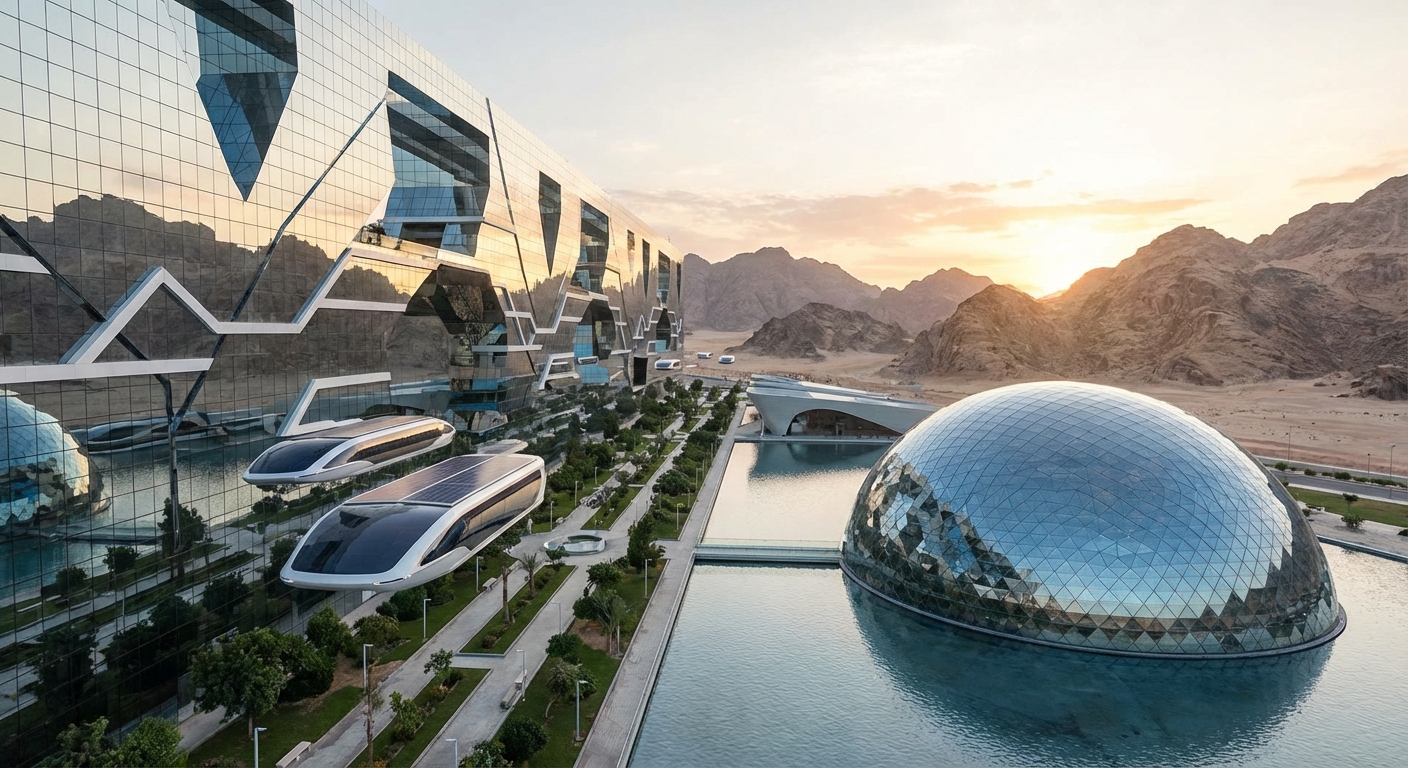
Saudi Arabia is building a city from scratch in the desert. Not just any city, but a $500 billion experiment in how humans might live in the future. NEOM represents the most ambitious construction project on Earth right now, and it’s changing faster than headlines can keep up.
NEOM is a planned megacity in northwest Saudi Arabia covering 26,500 square kilometers. The project includes The Line, a 170-kilometer linear city, plus coastal developments, mountain resorts, and industrial zones. Originally announced in 2017 with a $500 billion budget, the project has scaled back some targets while construction continues on priority phases including Sindalah Island and sections of The Line.
What NEOM Actually Means
NEOM comes from two parts: “neo” meaning new in Greek, and “M” representing “mustaqbal,” the Arabic word for future. Crown Prince Mohammed bin Salman announced the project in October 2017 as part of Saudi Vision 2030, the kingdom’s plan to reduce oil dependency.
The location matters. NEOM sits in Tabuk Province along the Red Sea coast, stretching inland toward Jordan and Egypt. This puts it at the crossroads of three continents, with 40% of the world’s population within a six-hour flight.
The scale is hard to grasp. At 26,500 square kilometers, NEOM is larger than Slovenia and about the size of Belgium. For comparison, that’s 33 times bigger than New York City.
The Line Changes Everything About Cities
The Line is NEOM’s most talked-about component. Imagine a mirrored skyscraper 500 meters tall, 200 meters wide, and 170 kilometers long. The original vision called for nine million residents living in a vertical city with no cars, no roads, and no carbon emissions.
Here’s how it was supposed to work. Residents would access everything they need within a five-minute walk. High-speed rail running underneath the structure would connect end to end in 20 minutes. The entire city would run on renewable energy.
The reality has shifted. In 2024, reports indicated the 2030 target dropped from housing 1.5 million people to just 300,000. Construction is focusing on a 2.4-kilometer initial section rather than the full 170-kilometer span.
But work continues. Excavation has created massive trenches visible from space. Steel and concrete are going into the ground. Thousands of workers are on site daily.
Breaking Down NEOM’s Major Components
NEOM isn’t just The Line. The project includes multiple distinct zones, each with different purposes.
Sindalah is a luxury island resort opening in 2024. It covers 840,000 square meters and will feature a yacht marina, hotels, and beach clubs. This is NEOM’s first completed section, designed to attract wealthy tourists and prove the project can deliver.
Trojena is a year-round mountain destination in the Sarawat Mountains. Plans include an outdoor ski resort with artificial snow, luxury hotels, and the 2029 Asian Winter Games. Construction started in 2022.
Oxagon is the industrial and logistics hub. This floating structure on the Red Sea will house manufacturing, innovation labs, and a port. The octagonal design gives it the name.
The Line remains the centerpiece, even with scaled-back targets. It represents the boldest rethinking of urban design in the entire project.
Here’s how these zones compare:
| Zone | Primary Purpose | Key Feature | Status |
|---|---|---|---|
| Sindalah | Luxury tourism | Yacht marina and resorts | Opening 2024 |
| Trojena | Mountain resort | Ski slopes and winter sports | Under construction |
| Oxagon | Industry and logistics | Floating port city | Early phase |
| The Line | Residential living | 170km linear city | Initial section underway |
The Technology Behind the Vision
NEOM promises technology that doesn’t fully exist yet. That’s part of what makes it controversial and fascinating.
Artificial intelligence will run city operations. Sensors throughout The Line would monitor everything from air quality to crowd flow, adjusting systems in real time. No traffic lights needed when there are no cars.
Robot density will exceed human density in some areas. Automated systems would handle construction, maintenance, delivery, and security. The project aims to become a testing ground for companies developing autonomous systems.
Renewable energy will power everything. Solar farms and wind turbines are planned across NEOM’s desert terrain. Green hydrogen production is a major focus, with NEOM positioned to become a global exporter.
Cloud seeding and desalination will provide water. The Red Sea offers unlimited saltwater, but turning it into drinking water at scale requires massive energy, which ties back to the renewable power infrastructure.
“NEOM is not just about building a city. It’s about prototyping solutions for problems humanity will face globally in the next 50 years.” — NEOM Project Leadership
What’s Really Happening on the Ground
Construction progress is visible but uneven. Satellite imagery shows The Line’s excavation trenches cutting through the desert. Foundation work is underway on several structures.
Worker camps house tens of thousands of laborers. These temporary cities include housing, medical facilities, and recreation areas. Reports indicate over 100,000 workers across all NEOM sites.
Environmental concerns have emerged. The project site includes habitats for endangered species and migration routes for birds. Conservation groups have raised questions about impact assessments.
Local communities faced displacement. The Huwaitat tribe lived in areas designated for NEOM. Relocation efforts have been controversial, with human rights organizations documenting concerns about the process.
Budget realities are forcing priorities. The original $500 billion price tag hasn’t changed officially, but spending is being staged. Early phases get full funding while later sections await proof of concept.
How NEOM Fits Into Saudi Arabia’s Future
Vision 2030 drives everything. Saudi Arabia wants to reduce oil revenue from 50% of GDP to much less. Tourism, technology, and renewable energy need to replace petroleum income.
NEOM is the flagship. Other megaprojects include Qiddiya (entertainment), the Red Sea Project (tourism), and Diriyah Gate (culture). But NEOM gets the most attention and the biggest budget.
Foreign investment is critical. Saudi Arabia is courting international companies with tax breaks, regulatory freedom, and promises of a business-friendly environment. NEOM operates under different laws than the rest of Saudi Arabia.
The timeline keeps shifting. Original targets had The Line partially occupied by 2025. Current estimates push meaningful residential occupancy to 2030 or beyond for initial sections.
Practical Steps to Follow NEOM’s Development
If you’re tracking this project for professional or investment reasons, here’s how to stay informed:
-
Monitor official NEOM announcements through their website and social media channels. They release construction updates, job postings, and partnership announcements regularly.
-
Watch for Saudi government statements during Vision 2030 progress reports. These typically happen quarterly and include budget allocations.
-
Track satellite imagery through services like Google Earth or commercial providers. The scale of construction makes changes visible from space.
-
Follow regional news outlets based in Saudi Arabia and the Gulf. They often break stories before international media picks them up.
-
Pay attention to contractor announcements. Major construction firms, technology companies, and consultancies working on NEOM often publicize their involvement.
Who’s Actually Building This
The project involves hundreds of companies from dozens of countries. Here are the major players:
- NEOM Company is the master developer, wholly owned by Saudi Arabia’s Public Investment Fund
- Bechtel is handling program management for The Line
- AECOM provides design and engineering services
- Parsons is working on infrastructure planning
- Local Saudi contractors are handling much of the actual construction
International architects have contributed designs. Morphosis, Coop Himmelb(l)au, and other prominent firms have presented concepts for various NEOM zones.
Technology partnerships include companies like:
– Siemens for smart infrastructure
– Air Products for green hydrogen facilities
– EDF for renewable energy systems
– Multiple AI and robotics firms for automation
The Challenges Nobody’s Solved Yet
Some problems don’t have clear solutions. The Line’s design creates engineering puzzles that have never been attempted at this scale.
Vertical transportation is one. Moving people up and down in a 500-meter-tall building is solved technology. But moving them efficiently along 170 kilometers while also going up and down? That’s new.
Climate control in a glass and steel structure in the desert is another. Summer temperatures in Tabuk Province exceed 40°C (104°F). Keeping the interior comfortable without massive energy use requires innovation.
Water and waste management at this density needs new approaches. Traditional city infrastructure spreads horizontally. The Line’s vertical concentration changes everything about utilities.
Social questions remain unanswered. Will people actually want to live in a 200-meter-wide building? How do you create neighborhoods and community in such an unusual form? These aren’t engineering problems, they’re human ones.
What This Means for Visitors and Investors
Tourism opportunities are coming first. Sindalah’s 2024 opening will let people experience part of NEOM before residential sections are ready. Luxury hospitality is the entry point.
Investment zones are operating now. Companies can establish regional headquarters in NEOM with special economic zone benefits. Some international firms have already set up operations.
Job opportunities span every industry. NEOM is hiring everyone from construction workers to AI researchers. The project website lists thousands of open positions at any given time.
Real estate details remain vague. How people will buy, rent, or access housing in The Line hasn’t been fully explained. The initial phase will likely house workers and early adopters before opening to general residents.
Here’s what different groups should watch for:
- Tech professionals: AI, robotics, and clean energy roles are expanding fastest
- Construction specialists: Massive demand for skilled trades and project managers
- Hospitality workers: Hotels and tourism infrastructure need staffing
- Investors: Special economic zones offer tax advantages and ownership structures
- Researchers: Universities and innovation labs are being established
Separating Hype From Reality
Media coverage swings between extremes. Some outlets present NEOM as an impossible fantasy. Others treat every announcement as guaranteed fact.
The truth sits in between. Parts of NEOM are absolutely being built. Sindalah is real and opening soon. Trojena has visible construction progress. The Line’s foundations are going into the ground.
But timelines have slipped. Budgets have been reprioritized. The scope has narrowed from original announcements. That’s normal for megaprojects, but it means taking new claims with appropriate skepticism.
Comparing to historical megaprojects helps calibrate expectations. Dubai’s Palm Islands took over a decade. China’s new cities often sit partially empty for years before filling up. Brazil’s capital Brasília took four years of intense construction but decades to fully develop.
NEOM is attempting something more ambitious than any of those. A 10 to 20-year timeline for meaningful completion seems more realistic than the aggressive early targets.
Why This Project Matters Beyond Saudi Arabia
Urban planning is watching closely. If The Line works, it could influence how cities grow worldwide. Linear cities solve some problems traditional circular cities create.
Climate technology needs testing grounds. NEOM’s renewable energy and green hydrogen ambitions could accelerate development of systems needed globally.
Construction innovation will spread. New techniques developed for NEOM’s challenges will become available to other projects. That’s how megaprojects often justify their costs.
Geopolitical shifts follow economic ones. If Saudi Arabia successfully diversifies away from oil, it changes Middle Eastern power dynamics and global energy markets.
Where NEOM Stands Right Now
As of 2025, NEOM is firmly in the construction phase. It’s past pure planning but far from completion.
Sindalah represents the first tangible result visitors can experience. Its opening proves NEOM can finish something, which matters for credibility.
The Line’s scaled-back 2030 targets are more achievable. Building a 2.4-kilometer section housing 300,000 people is still massive, but it’s not impossible.
Funding continues to flow. Saudi Arabia’s Public Investment Fund has deep pockets and political will behind the project. Budget constraints are slowing things down, not stopping them.
International participation remains strong. Despite controversies, major companies continue signing contracts and sending staff to work on NEOM.
Making Sense of Saudi Arabia’s Biggest Bet
NEOM is easier to understand as an experiment than a city. Saudi Arabia is testing whether money, technology, and political will can create entirely new ways of living.
Some parts will succeed. Others will fail or transform into something different than originally imagined. That’s how ambitious projects work.
For tech enthusiasts, NEOM offers a real-world laboratory for ideas that usually stay theoretical. For urban planners, it’s a case study in progress. For investors, it’s a high-risk, high-reward opportunity. For skeptics, it’s a reminder that grand visions often meet hard realities.
The project is real. Billions are being spent. Thousands are working. Structures are rising. But the final form will likely look different than the renderings suggest.
Keep watching. NEOM’s story is still being written, and the next few years will determine whether this becomes a model for future cities or a cautionary tale about ambition outpacing practicality.