
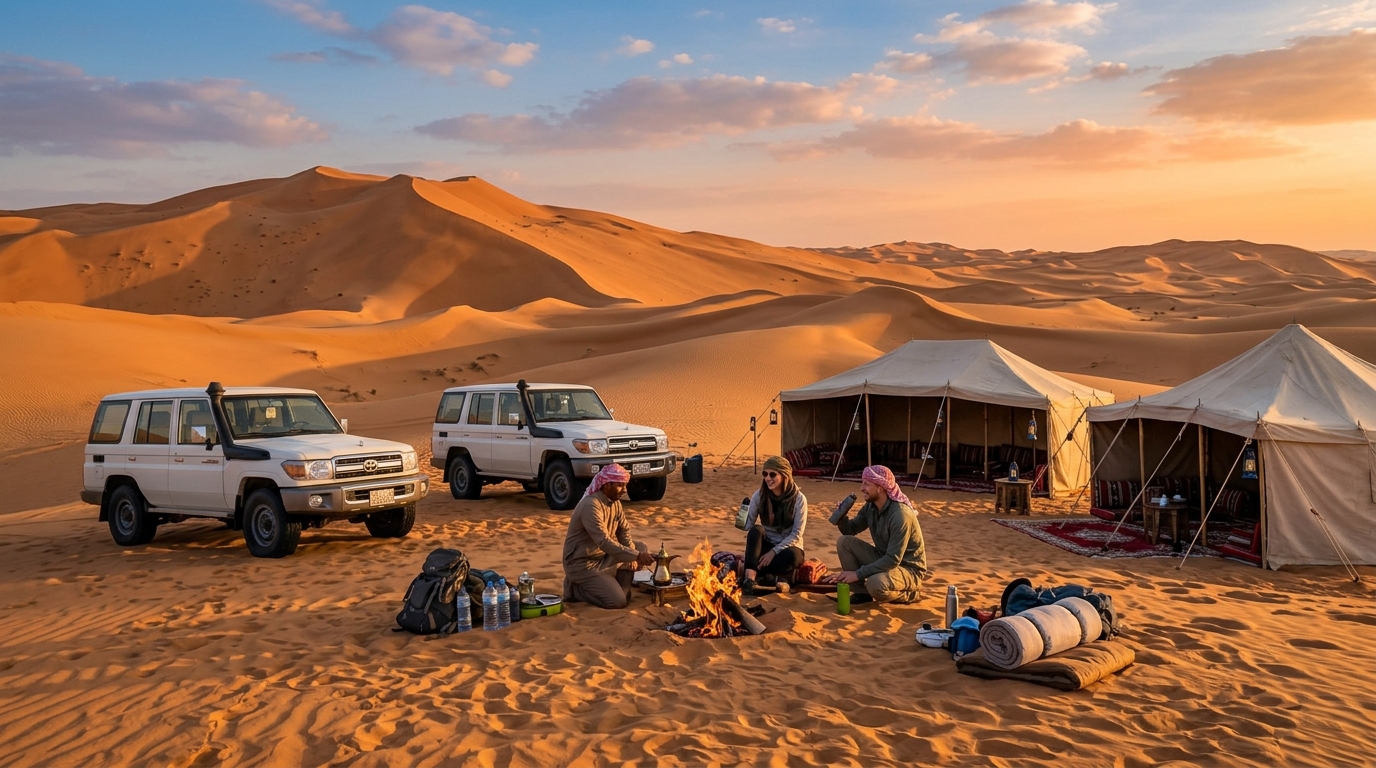
The Empty Quarter stretches across 250,000 square miles of unforgiving sand, making it the largest continuous sand desert on Earth. Temperatures can swing from 122°F during the day to near freezing at night. One wrong turn, one miscalculation with your water supply, and what started as an adventure becomes a survival situation. But thousands of travelers safely cross this magnificent wilderness every year because they prepare properly and respect the environment.
Surviving the Empty Quarter requires meticulous preparation across five critical areas: water management (minimum 1 gallon per person daily), navigation redundancy (GPS plus traditional methods), heat protection strategies, emergency communication systems, and physical conditioning. Success depends on treating the desert with respect, never traveling alone, and building safety margins into every calculation. Most incidents occur from underestimating distances or overestimating personal resilience in extreme conditions.
Water is Your Primary Currency
In the Empty Quarter, water determines everything. Your route, your rest stops, your emergency protocols, all revolve around hydration.
Calculate 1 gallon per person per day as your baseline. That’s for drinking only. Add another half gallon for cooking and basic hygiene. Then double it. The extra capacity isn’t paranoia, it’s insurance against delays, vehicle breakdowns, or helping other travelers in distress.
Store water in multiple containers. If one cracks or a cap fails, you haven’t lost everything. Metal jerry cans work better than plastic in extreme heat. Wrap them in reflective material and keep them shaded inside your vehicle.
Check your water every morning and evening. Mark each container with tape to track consumption. If you’re using more than planned, adjust your itinerary immediately. Pushing forward on low reserves is how people get into serious trouble.
“The desert doesn’t care about your schedule. I’ve seen experienced guides turn back two days into a five-day trek because water consumption ran 20% higher than expected. They’re still here to tell that story.” – Ahmed Al-Otaibi, Empty Quarter expedition leader
Navigation Requires Triple Redundancy
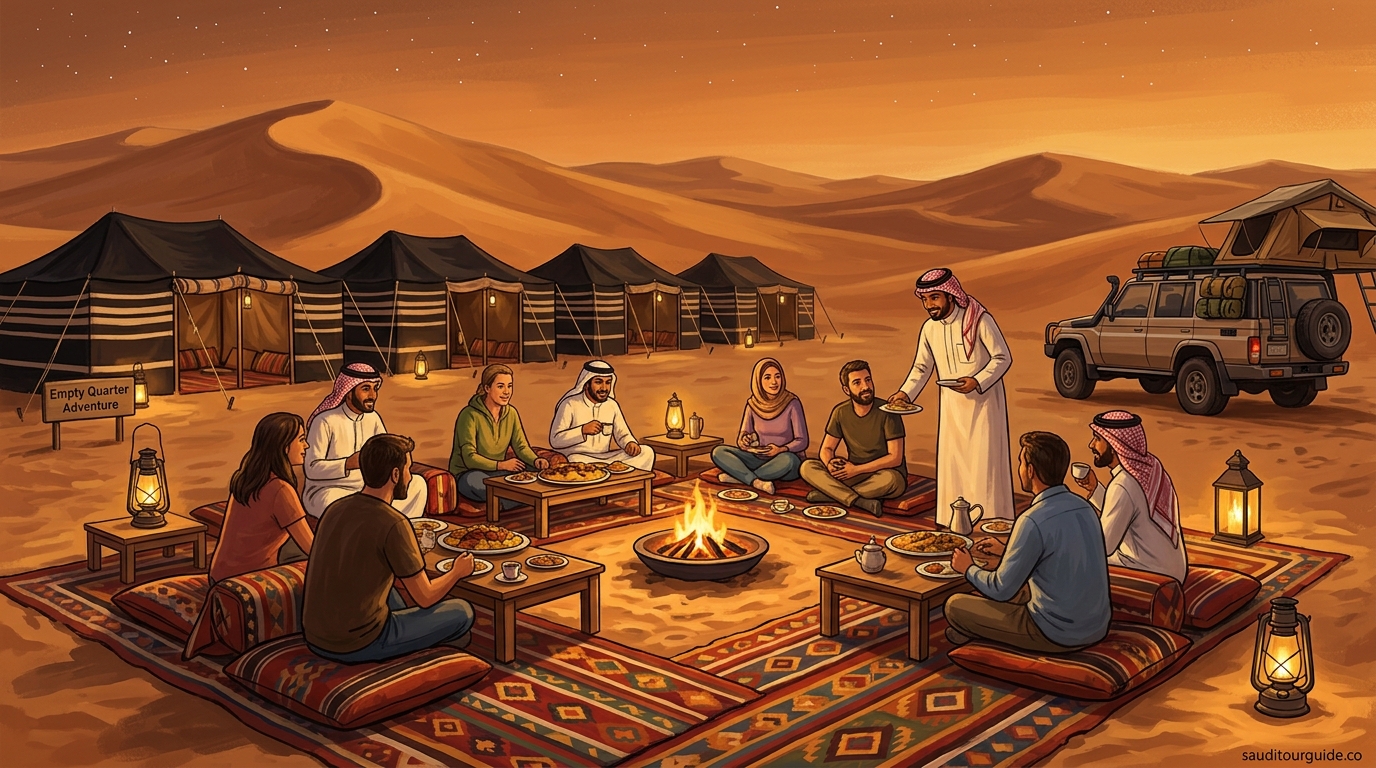
Sand dunes shift. Landmarks disappear. GPS satellites occasionally lose signal in deep valleys between massive dunes.
Your navigation system needs three independent layers:
- Primary GPS device with detailed offline maps downloaded before departure
- Smartphone with backup navigation apps and portable battery pack
- Traditional compass and paper maps in waterproof cases
Learn to read dune formations. Prevailing winds create predictable patterns. The slip face (steeper side) typically faces away from the wind direction. In the Empty Quarter, this usually means southeast.
Mark waypoints every 30 minutes during travel. If you need to backtrack, you’ll have a clear trail. Take photos of distinctive dune formations from multiple angles. These visual references help confirm your position when electronic devices disagree.
Never rely on vehicle tracks. Wind erases them within hours. What looks like a well-traveled route might be three days old and leading nowhere useful.
Heat Management Starts Before Dawn
The sun in the Empty Quarter isn’t just hot, it’s weaponized. Proper heat management means working with the desert’s natural rhythm, not against it.
Travel during the coolest hours. Start moving at first light, around 5:30 AM. Stop by 11 AM when temperatures peak. Rest in shade until 4 PM, then continue until sunset. This schedule cuts your heat exposure by 60%.
Create shade wherever you stop. A proper shade structure drops the temperature underneath by 20-30 degrees. Carry a large tarp (minimum 12×12 feet) and collapsible poles. Park your vehicle to block the sun and extend the tarp from the roof rack.
Dress in loose, light-colored cotton that covers your skin completely. Exposed skin loses moisture faster and burns easily. A traditional shemagh (headscarf) protects your neck and face while allowing air circulation. Tourists often make the mistake of wearing minimal clothing, thinking it will keep them cooler. It doesn’t.
| Heat Strategy | Works | Doesn’t Work |
|---|---|---|
| Clothing | Loose, light layers covering skin | Tank tops and shorts |
| Hydration timing | Small amounts every 15 minutes | Large amounts when thirsty |
| Activity schedule | Dawn and dusk travel | Midday pushing through |
| Shade creation | Tarp plus vehicle positioning | Sitting in closed vehicle |
| Cooling method | Damp cloth on pulse points | Pouring water over head |
Your Vehicle Becomes Your Lifeline
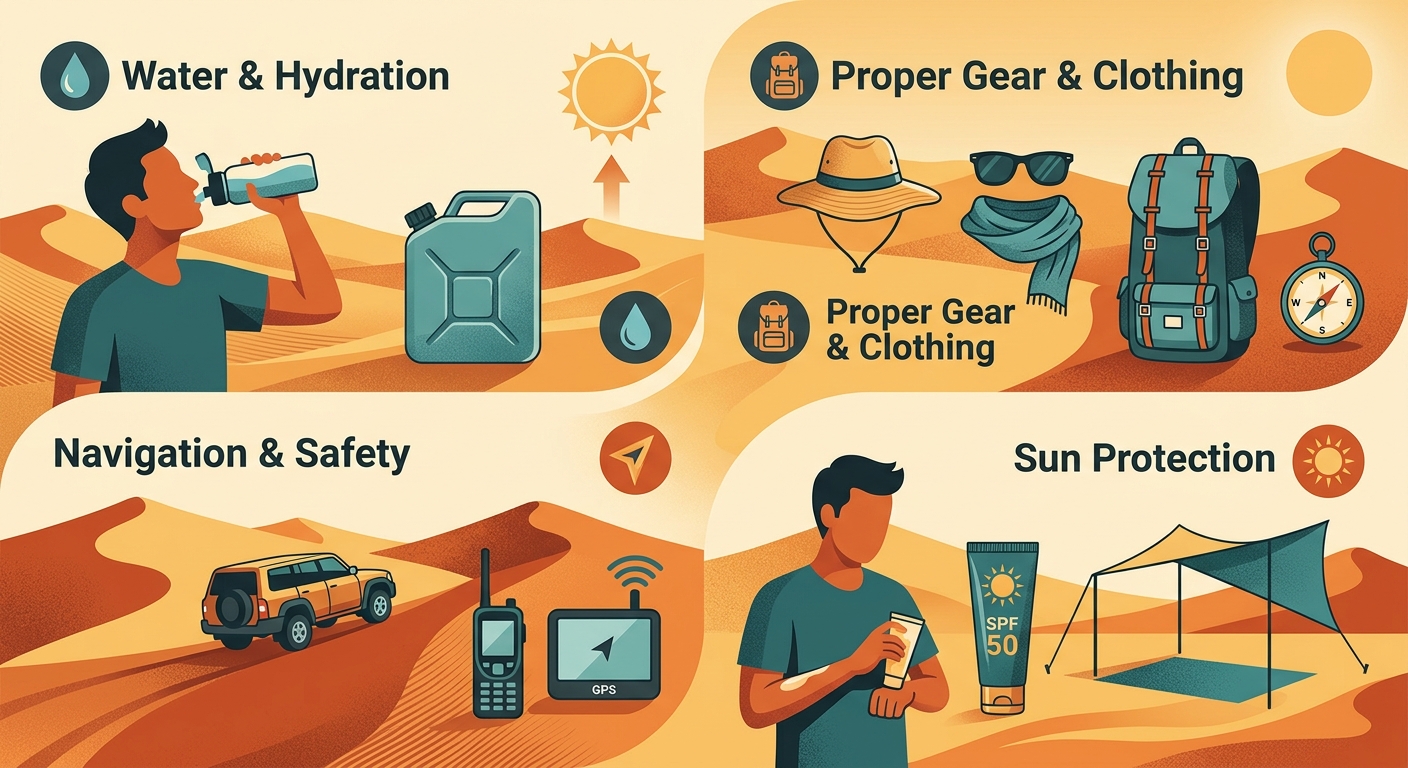
In the Empty Quarter, your 4×4 is shelter, navigation platform, and emergency beacon all in one. It needs preparation that goes far beyond a normal road trip.
Reduce tire pressure to 15-18 PSI before entering soft sand. This increases your footprint and prevents getting stuck. Carry a portable compressor to reinflate when you return to hard surfaces.
Pack recovery gear and know how to use it before you need it:
- Sand ladders (two minimum)
- Heavy-duty tow straps rated for your vehicle weight
- Shovel with a wide blade
- Tire repair kit and full-size spare
- Engine oil and coolant (desert heat accelerates consumption)
- Fuel filters (sand gets everywhere)
Check your engine bay every evening. Look for loose hoses, leaking fluids, or sand buildup around the air filter. Small problems become catastrophic when you’re 100 miles from the nearest settlement.
Carry fuel for 150% of your planned distance. The Empty Quarter has zero fuel stations. Running out isn’t an inconvenience, it’s a life-threatening emergency.
Communication Systems Need Backup Plans
Cell service doesn’t exist in the Empty Quarter. Your phone becomes useful only for its offline functions: camera, GPS, and pre-downloaded information.
Satellite communication is mandatory, not optional. A satellite messenger device costs $300-400 and requires a monthly subscription. That investment could save your life. These devices send your GPS coordinates to emergency contacts and allow two-way text messaging when everything else fails.
Register your expedition with local authorities before departure. Provide your route, timeline, and emergency contacts. If you don’t check in as scheduled, they’ll know where to start looking.
Travel with at least one other vehicle. Two is better. If one breaks down, the other provides rescue capability. Solo desert travel is gambling with your life.
Establish communication schedules. Check in with your group every two hours during travel. If someone misses a check-in, you’ll know within 120 minutes, not at the end of the day.
Physical Preparation Starts Weeks Before Departure
The Empty Quarter tests your body in ways normal life doesn’t. Heat, dehydration, physical exertion in soft sand, these combine to exhaust even fit travelers.
Build your heat tolerance gradually. If you live in a cool climate, spend time in saunas or hot yoga classes for three weeks before departure. Your body needs to adapt to sweating efficiently and regulating temperature under stress.
Practice walking in sand. Find local beaches or dunes and hike for 30-60 minutes. Sand walking uses different muscle groups and requires more energy than solid ground. Your calves and ankles need conditioning.
Stay hydrated in the weeks before your trip. Chronic dehydration is common in modern life. Arriving in the desert already behind on fluids puts you at immediate disadvantage.
Sleep matters more than you think. Desert travel is mentally demanding. Navigation decisions, equipment management, constant environmental monitoring, all require sharp thinking. Arrive well-rested and maintain good sleep hygiene during the expedition.
Emergency Protocols Save Lives
Hope for the best, plan for the worst. Every Empty Quarter expedition needs clear emergency procedures established before departure.
Create a written emergency plan that covers:
- Medical emergencies (injury, heat stroke, dehydration)
- Vehicle breakdown beyond field repair
- Becoming lost or disoriented
- Sandstorm protocols
- Running low on water or fuel
Carry a comprehensive first aid kit. Include supplies for treating burns, dehydration, cuts, and sprains. Take a wilderness first aid course before your trip. The nearest hospital might be 200 miles away.
Know the signs of heat exhaustion versus heat stroke. Heat exhaustion means heavy sweating, weakness, and nausea. Rest in shade and hydrate. Heat stroke means confusion, lack of sweating, and altered consciousness. This is a medical emergency requiring immediate cooling and evacuation.
If you get stuck or lost, stay with your vehicle. It’s visible from the air and provides shelter. A person wandering in the desert is nearly impossible to spot. Your vehicle is a beacon that search teams can find.
The Right Season Makes Everything Easier
Timing your Empty Quarter expedition around weather patterns dramatically improves your safety margin.
November through February offers the best conditions. Daytime temperatures range from 70-85°F. Nights get cold (sometimes below freezing), but cold is manageable. Heat kills.
March and October are transitional months. Possible but less comfortable. Temperatures start climbing into the 90s.
Avoid April through September completely unless you’re on a professionally guided expedition with extensive support. Summer temperatures regularly exceed 120°F. Even experienced desert travelers consider these months too dangerous for recreational trips.
Weather in the Empty Quarter can change rapidly. Sandstorms appear with little warning. If visibility drops below 30 feet, stop immediately. Park with your back to the wind, turn off your engine, and wait it out. Trying to navigate in zero visibility leads to accidents and disorientation.
Cultural Preparation Matters
The Empty Quarter sits within Saudi Arabia, and respecting local customs isn’t just polite, it’s legally required.
Obtain proper permits before entering restricted areas. Some sections of the Empty Quarter require special authorization. Check current regulations well before your departure date. The process for getting your Saudi visa is straightforward, but desert permits may require additional steps.
Dress appropriately when passing through settlements. While deep in the desert, practical clothing takes priority. But when interacting with local communities, modest dress codes apply.
Learn basic Arabic phrases. “Maa salama” (goodbye), “shukran” (thank you), and “min fadlak” (please) go a long way. Bedouin communities living on the desert’s edge are incredibly hospitable, but showing respect for their language and customs matters.
Photography restrictions exist in Saudi Arabia. Don’t photograph military installations, government buildings, or people without permission. In the desert, focus on landscapes and your expedition. These make better photos anyway.
Packing Strategy for Multi-Day Survival
What you bring determines what’s possible. Packing for the Empty Quarter requires balancing weight, space, and necessity.
Essential survival items that never get left behind:
- Water (calculated as discussed earlier)
- Satellite communication device
- Navigation tools (GPS, phone, compass, maps)
- First aid supplies
- Fire starting equipment (waterproof matches, lighter, fire starter)
- Emergency shelter (space blanket minimum, tent better)
- High-calorie emergency food (enough for three extra days)
- Sun protection (sunscreen SPF 50+, lip balm, sunglasses)
- Headlamp with extra batteries
- Multi-tool or knife
- Duct tape and zip ties (emergency repairs)
Personal items that improve safety and comfort:
- Wide-brimmed hat
- Moisture-wicking base layers
- Warm jacket for cold nights
- Sleeping bag rated for 32°F
- Cooking equipment if planning hot meals
- Toiletries (biodegradable soap, toilet paper, hand sanitizer)
- Camera and extra memory cards
- Journal for recording the experience
Pack everything in waterproof bags. Sand is worse than water for getting into gear. A single sandstorm can infiltrate supposedly sealed containers.
Reading the Desert’s Warning Signs
The Empty Quarter communicates constantly. Learning its language keeps you safe.
Watch the sand. If it starts moving horizontally near ground level, wind is picking up. Prepare for possible sandstorm conditions.
Monitor your energy levels honestly. Feeling unusually tired might mean early dehydration. Headaches, dizziness, or reduced urination are red flags requiring immediate attention.
Check your urine color. Pale yellow means adequate hydration. Dark yellow or amber means you’re behind on water intake. Clear urine means you’re drinking too much too fast (rare but possible).
Animal behavior provides clues. Birds circling might indicate water sources or human settlements. Complete absence of animal tracks suggests you’re in particularly harsh terrain.
The sky tells stories. Morning haze that doesn’t burn off by 8 AM might indicate humidity changes. Watch for cloud formations that seem unusual for the desert. Weather patterns can shift.
When Things Go Wrong
Despite perfect preparation, emergencies happen. Your response determines the outcome.
If someone shows signs of heat stroke, this is your protocol:
- Move them to shade immediately
- Remove excess clothing
- Apply cool (not cold) water to skin
- Fan them to increase evaporation
- Give small sips of water if conscious
- Activate emergency communication
- Prepare for evacuation
If your vehicle becomes stuck, don’t panic. Most stuck vehicles can be recovered with proper technique:
- Stop accelerating (spinning tires digs deeper)
- Clear sand from around tires
- Place sand ladders under drive wheels
- Reduce tire pressure further (12-14 PSI)
- Use steady, gentle acceleration
- If still stuck, call your support vehicle
If you become disoriented, follow this sequence:
- Stop moving
- Sit down and calm yourself
- Check all navigation devices
- Review your last known position
- Look for landmarks in photos
- Send your GPS coordinates via satellite messenger
- Wait for conditions to improve or help to arrive
The Empty Quarter has claimed lives from people who panicked and made poor decisions. Staying calm and following protocols saves lives.
Building Your Desert Skillset
Consider these steps to prepare properly:
- Take a desert survival course from a certified instructor
- Practice vehicle recovery techniques in controlled environments
- Learn basic vehicle maintenance and field repairs
- Study meteorology basics relevant to desert environments
- Join local 4×4 clubs to learn from experienced off-roaders
- Complete wilderness first aid certification
- Practice navigation using map and compass without GPS
Many adventure travelers treat the Empty Quarter as a bucket list item without building fundamental skills first. The desert rewards preparation and punishes assumptions.
Beyond Survival to Appreciation
Once you’ve mastered the survival fundamentals, you can actually experience the Empty Quarter’s profound beauty.
The silence is absolute. No traffic, no aircraft, no human noise. Just wind over sand.
Night skies reveal stars invisible in populated areas. The Milky Way stretches overhead in stunning detail. Bring a star chart and learn constellations you’ve never seen.
Sunrise and sunset transform the dunes into flowing rivers of gold, orange, and red. The interplay of light and shadow creates landscapes that shift minute by minute.
Wildlife exists, though sparse. Arabian oryx, sand cats, and various reptiles have adapted to these extreme conditions. Spotting them requires patience and sharp observation.
The Empty Quarter represents one of Earth’s last truly wild places. After experiencing it, many travelers find it changes their perspective on what humans actually need versus what we think we need. That lesson alone makes the journey worthwhile, assuming you survive to appreciate it.
Your Desert Journey Starts with Respect
The Empty Quarter will test you. It will push your limits and reveal weaknesses in your preparation. But it will also show you landscapes and experiences impossible to find anywhere else on Earth.
Thousands of years of human history cross this desert. Bedouin tribes developed survival techniques through generations of hard-won knowledge. Modern adventurers benefit from technology they never had, yet the fundamental challenges remain unchanged. Heat, distance, and isolation don’t care about your GPS or satellite phone.
Approach the Empty Quarter with humility. Prepare thoroughly. Build redundancy into every system. Travel with experienced companions. Respect the environment and local culture. Make conservative decisions when facing uncertainty.
Do these things, and you won’t just survive the Empty Quarter. You’ll thrive in it, returning home with stories, photos, and a profound appreciation for one of nature’s most extreme environments. The desert rewards those who prepare properly and punishes those who don’t. Which category you fall into is entirely within your control.