

You booked two weeks in Saudi Arabia, but now you’re standing in AlUla watching the sunset paint Elephant Rock golden, and suddenly 14 days feels impossibly short. Or maybe you’ve fallen in love with the souks of Jeddah and want more time to explore. The good news? You might be able to extend your tourist visa Saudi Arabia without leaving the country.
Saudi Arabia allows most tourist visa holders to extend their stay for up to 90 additional days through the Enjaz platform or Absher system. Extensions cost 300 SAR per month, require valid travel insurance and passport validity, and must be requested before your current visa expires. Processing typically takes 24 to 48 hours, though approval is not guaranteed for all nationalities.
Understanding Saudi Arabia’s tourist visa extension policy
Saudi Arabia opened its doors to international tourism in 2019, and the visa system has evolved rapidly since then. The tourist visa initially grants you 90 days of stay within a one-year validity period. That means you can enter and exit multiple times, as long as your total time in the country doesn’t exceed 90 days.
But what happens when those 90 days aren’t enough?
The Ministry of Foreign Affairs and the General Directorate of Passports (Jawazat) now permit visa extensions for eligible tourists. This wasn’t always the case. Early visitors had no choice but to leave and reapply. Today’s system is more flexible, though it comes with specific requirements and limitations.
Most tourists can request one extension of up to 90 additional days. That potentially gives you six months total in Saudi Arabia. Some nationalities face different rules, and business or work activities are strictly prohibited on a tourist visa, even an extended one.
Who can extend a tourist visa in Saudi Arabia
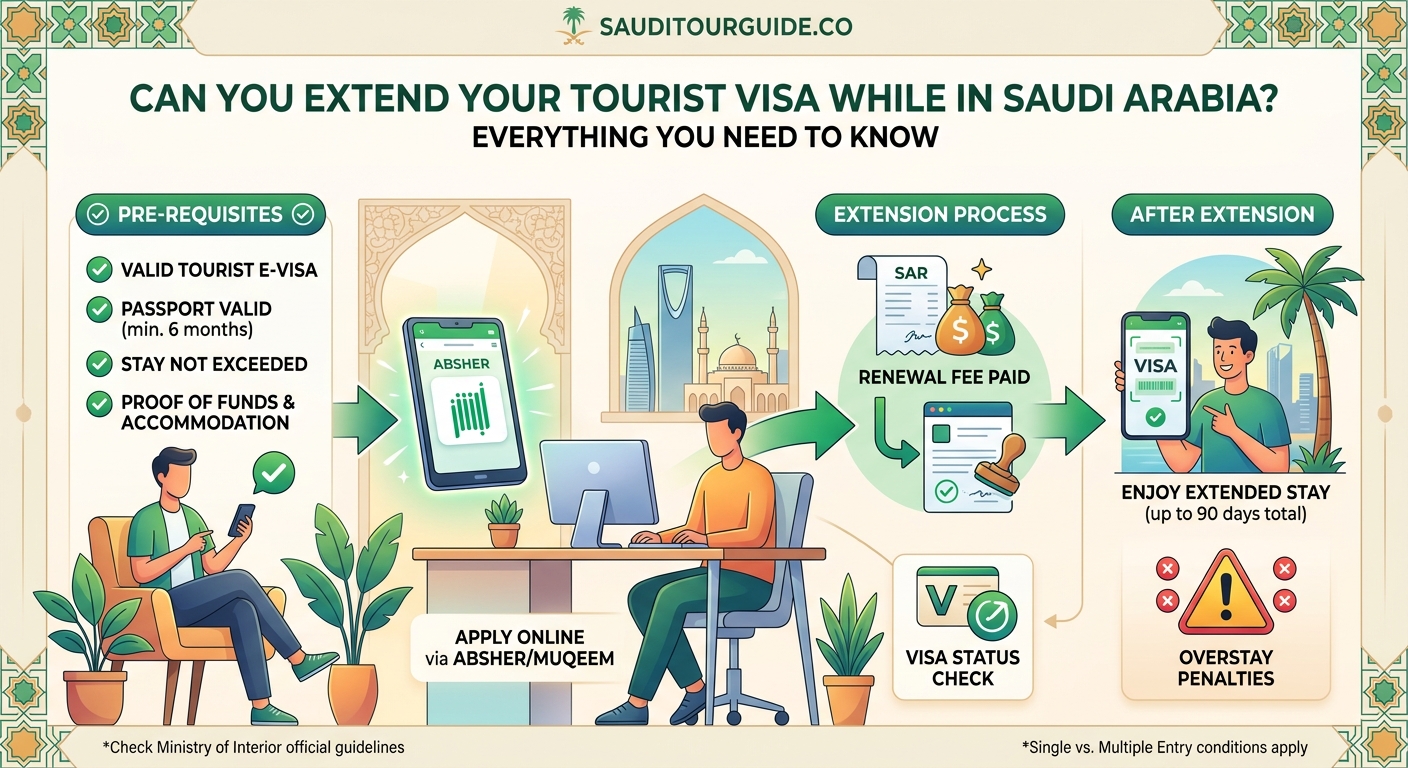
Not everyone qualifies for an extension. Your eligibility depends on several factors.
First, your nationality matters. Citizens from the 49 countries eligible for e-visas generally have the smoothest extension process. This includes most European nations, the United States, Canada, Australia, Japan, South Korea, and others. If you entered Saudi Arabia on a visa on arrival, you likely qualify as well.
Second, your visa must still be valid when you apply. You cannot extend an expired visa. If your 90 days are up, you’re technically overstaying, which triggers fines and potential legal issues.
Third, you need a clean record. Any violations during your stay, including traffic fines, overstays from previous visits, or other infractions, can disqualify you. Saudi authorities take compliance seriously.
Fourth, your passport must remain valid for at least six months beyond your intended extension period. If your passport expires soon, you’ll need to renew it first at your embassy or consulate in Saudi Arabia.
- Valid tourist visa with remaining days
- Passport validity of six months or more
- No violations or fines on record
- Proof of accommodation for extended period
- Valid travel insurance covering the extension period
- Sufficient funds to support your stay
Step by step process to extend tourist visa Saudi Arabia
The extension process happens entirely online through official government platforms. No need to visit immigration offices in person unless specifically requested.
Step 1: Gather your documents
Before you start, collect everything you’ll need. This includes your passport, current visa details, proof of accommodation (hotel bookings or rental agreements), and valid travel insurance that covers your extended dates.
Your insurance must meet Saudi Arabia’s minimum requirements. Many travelers purchase their original visa insurance for only 90 days and forget to extend coverage. Without updated insurance, your extension request will be rejected.
Step 2: Access the Enjaz platform
The official platform for visa extensions is Enjaz (enjazit.com.sa). This is the same system used for various visa and residency services in Saudi Arabia.
Create an account if you don’t have one. You’ll need your passport information and current visa number. The platform is available in both Arabic and English, though some sections translate awkwardly.
Step 3: Submit your extension request
Navigate to the tourist visa extension section. Fill out the application form with accurate information. Double-check every field. Errors can delay processing or trigger rejections.
Upload scanned copies of your passport bio page, current visa, updated insurance certificate, and accommodation proof. Files must be clear and in accepted formats, usually PDF or JPG.
Step 4: Pay the extension fee
The fee is 300 Saudi Riyals per month of extension. If you want 90 additional days, you’ll pay 900 SAR (approximately $240 USD). Payment happens through the platform using a credit or debit card.
Keep your payment receipt. You’ll need it if any issues arise.
Step 5: Wait for approval
Processing typically takes 24 to 48 hours, though it can stretch to five business days during peak seasons like holidays or major events. You’ll receive a notification via email and through the platform when your extension is approved or denied.
If approved, download and print your updated visa. Keep both digital and physical copies with you at all times. Immigration officers may ask to see proof of your legal status, especially if you’re traveling between cities.
Alternative extension method through Absher
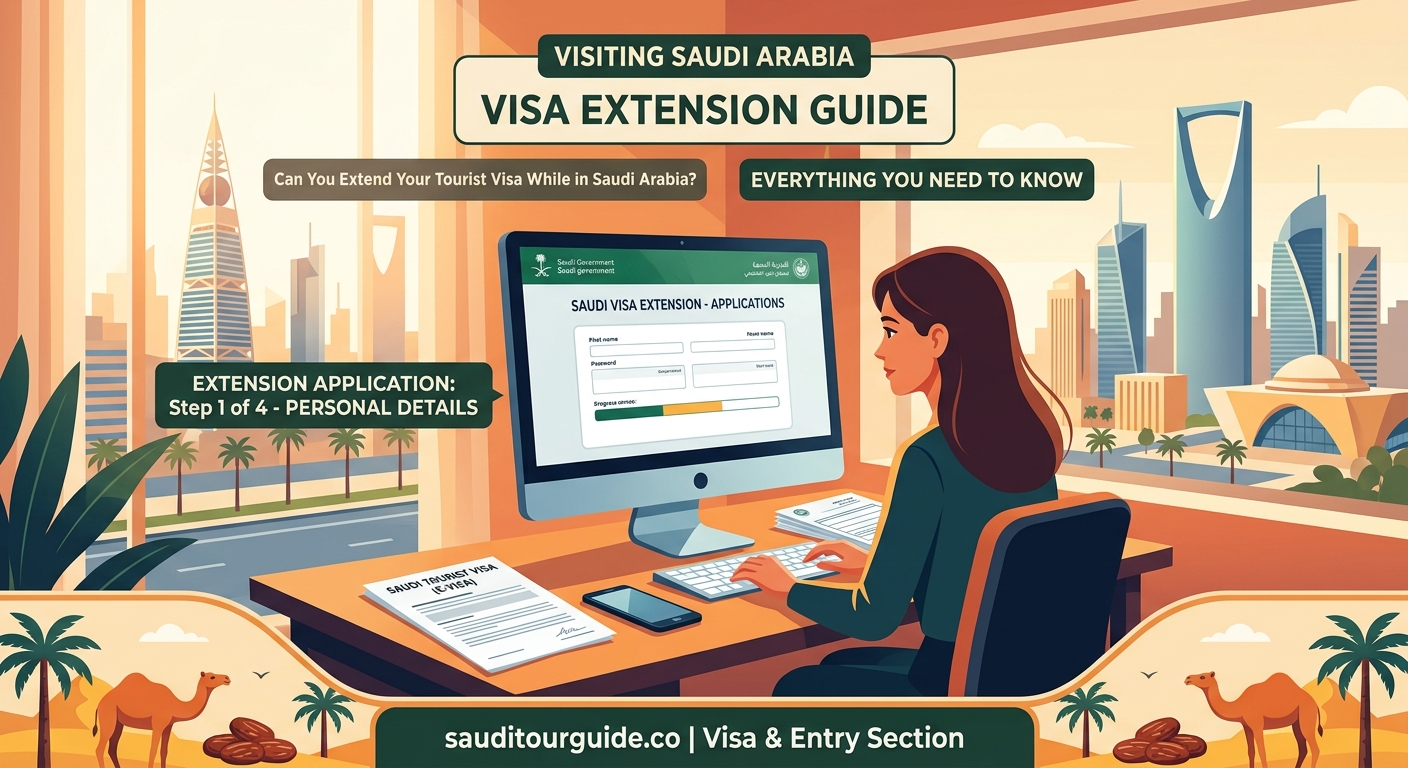
Some tourists report success using the Absher platform (absher.sa), which is primarily designed for Saudi residents but includes some visitor services.
The process is similar to Enjaz. Create an account, navigate to passport services, and select visa extension. Upload your documents and pay the fee.
However, Absher can be less intuitive for tourists. The interface assumes familiarity with Saudi administrative systems. If you’re comfortable with technology and Arabic-language interfaces, it’s worth trying. Otherwise, stick with Enjaz.
Extension fees and payment methods
Let’s break down the costs clearly.
| Extension Duration | Fee (SAR) | Fee (USD approx.) |
|---|---|---|
| 1 month | 300 | $80 |
| 2 months | 600 | $160 |
| 3 months (90 days) | 900 | $240 |
These fees are non-refundable. If your extension is denied, you don’t get your money back. That’s why confirming your eligibility before applying is crucial.
Payment must be made through the online platform using Visa, Mastercard, or Mada (the Saudi domestic card system). Cash payments are not accepted. Some travelers report issues with international cards being declined. If this happens, try a different card or contact your bank to authorize international transactions.
Common reasons for extension denials
Not every application gets approved. Understanding why helps you avoid pitfalls.
Insufficient passport validity is the most common issue. If your passport expires in four months and you’re requesting a three-month extension, the system will reject you. You need that six-month buffer.
Expired or inadequate insurance kills many applications. Your insurance must explicitly cover the extension dates and meet Saudi minimums. Generic travel insurance that doesn’t list Saudi Arabia specifically may not qualify.
Unpaid fines from traffic violations, parking tickets, or other infractions will block your extension. Check your record through the Absher app or at any traffic department office. Pay any outstanding amounts before applying.
Previous overstays create red flags. If you overstayed on a previous visit to Saudi Arabia or any GCC country, authorities may deny your extension as a precaution.
Incomplete applications with missing documents or incorrect information get automatically rejected. The system doesn’t give you a chance to fix mistakes. You’ll need to reapply and pay again.
What happens if your extension is denied
Receiving a denial notice is stressful, but you have options.
First, check the reason. The notification should explain why. If it’s something fixable like expired insurance or a minor document issue, you can reapply immediately after correcting the problem.
Second, consider leaving and re-entering. If you’re near a border with Bahrain, UAE, or Qatar, you could exit Saudi Arabia and return on a new 90-day entry. This resets your tourist visa. However, this only works if your one-year visa validity hasn’t expired. Also, be aware that frequent exits and re-entries can raise suspicions about your intentions.
Third, contact your embassy. Some consulates can provide letters of support or help clarify your situation with Saudi authorities. This is especially useful if you believe the denial was in error.
Fourth, prepare to leave before your current visa expires. Overstaying triggers daily fines of 100 SAR (about $27 USD) and can result in detention, deportation, and future entry bans. It’s not worth the risk.
“The key to a successful visa extension in Saudi Arabia is planning ahead. Don’t wait until your last week to apply. Give yourself at least two weeks before your visa expires so you have time to address any issues that arise.” — Experienced expat living in Riyadh
Extending your stay beyond 180 days
What if 90 days plus a 90-day extension still isn’t enough? Can you stay even longer?
Technically, no. The tourist visa system caps total stays at 180 days per year. After that, you must leave Saudi Arabia for a period before returning on a new visa.
Some travelers attempt to exit briefly to a neighboring country and return, but this strategy is risky. Immigration officers have discretion to deny entry if they suspect you’re abusing the tourist visa system or working illegally.
If you genuinely need to stay longer for legitimate reasons like medical treatment, family emergencies, or other special circumstances, you can apply for a different visa category. This requires sponsorship and involves a more complex process through the Ministry of Foreign Affairs.
Another option is converting to a business or work visa if you’ve received a job offer. This requires your employer to sponsor you and involves exiting the country to process the change. You cannot convert a tourist visa to a work visa while remaining in Saudi Arabia.
Tips for a smooth extension process
After helping dozens of travelers navigate this system, a few patterns emerge.
Apply early. Don’t wait until day 85 of your 90-day visa. Start the process at day 70 or earlier. This gives you cushion for delays, rejections, or document issues.
Keep physical copies. Saudi Arabia is increasingly digital, but having printed copies of your passport, visa, insurance, and extension approval prevents headaches. Hotel check-ins, car rentals, and random police checks all require documentation.
Update your insurance first. Before you even log into Enjaz, call your insurance provider and extend your coverage. Get the updated certificate emailed to you immediately. This single step prevents the majority of rejections.
Check your fine status. Download the Absher app and register. It shows any outstanding fines or violations. Clear these before applying for an extension.
Have a backup plan. Book a refundable flight out of Saudi Arabia for a few days after your visa expires. If your extension is denied, you can leave without scrambling for last-minute tickets.
Document everything. Screenshot every step of your application. Save confirmation emails. Note the date and time you submitted. If something goes wrong, this documentation helps when contacting support.
Comparing extension to exit and re-entry
Sometimes leaving and coming back makes more sense than extending.
If you’re already planning to visit Bahrain for a weekend or Dubai for shopping, timing that trip near the end of your 90 days gives you a fresh entry stamp. The cost of a short trip might be less than the 900 SAR extension fee, especially if you find cheap flights.
However, there are downsides. Each exit and re-entry uses one of your multiple entries (if your visa allows them). You also lose time traveling and going through immigration twice. And there’s always a small risk that re-entry could be denied if an officer questions your intentions.
For travelers who want to stay put and continue their journey without interruption, especially those exploring hidden gems in Saudi Arabia or spending extended time in places like the Asir region, the extension is usually the better choice.
Special considerations for different traveler types
Families with children: Each family member needs their own extension if they’re on separate passports. Infants and children included on a parent’s passport share that visa status. Make sure everyone’s insurance covers the extended period.
Solo travelers: You’ll need to show sufficient funds to support yourself for the additional months. Bank statements or credit card limits may be requested, though this isn’t always enforced.
Digital nomads: Remember, working on a tourist visa is illegal. If authorities suspect you’re conducting business, your extension can be denied and your visa revoked. Keep work activities discreet and don’t advertise your remote work situation.
Retirees and long-term travelers: If you’re planning to spend several months exploring Saudi Arabia as part of a longer journey, consider spacing your visits. Spend 90 days in Saudi Arabia, then 90 days in neighboring countries, then return for another 90 days. This avoids extension complications entirely.
How extension affects your future Saudi visits
One question many travelers ask is whether requesting an extension creates problems for future trips to Saudi Arabia.
Generally, no. A properly approved extension is a legal use of the visa system. It doesn’t flag your passport or create negative records. You can return to Saudi Arabia in future years without issue.
However, multiple extensions across different trips might raise questions. If you extend your stay every single time you visit, immigration officers could eventually question whether you should be applying for a different visa type instead.
Also, if you’ve ever overstayed (even by one day) or had an extension denied, those records remain in the system. They don’t automatically disqualify you from future visits, but they can trigger additional scrutiny.
Making the most of your extended time
If your extension is approved, you’ve just earned up to three more months in one of the world’s most rapidly changing countries.
Use that time wisely. Saudi Arabia is huge, and many visitors barely scratch the surface in 90 days. With an extension, you can slow down and experience the country more deeply.
Consider timing your extension to catch seasonal events you’d otherwise miss. Winter months (November through February) are perfect for desert safaris in the Empty Quarter, while summer might align with cultural festivals in different regions.
Budget travelers can use the extra time to reduce daily costs. Renting an apartment for a month costs far less per day than hotels. Learning to shop at local markets instead of tourist restaurants stretches your money further. For detailed cost planning, check out how much a week in Saudi Arabia really costs and multiply accordingly.
The extension also allows for slower, more meaningful cultural immersion. You can attend traditional coffee ceremonies, take Arabic language classes, or volunteer with local organizations. Three months gives you time to build relationships and understand Saudi culture beyond the tourist highlights.
Troubleshooting common extension problems
Even with perfect preparation, issues can arise.
Problem: Your payment goes through but you don’t receive a confirmation.
Solution: Check your spam folder first. Then log back into Enjaz and look under “My Applications” or “Payment History.” The system sometimes processes successfully but fails to send the email. If you still see nothing after 24 hours, contact Enjaz support through their help center.
Problem: Your insurance company won’t extend coverage while you’re already in Saudi Arabia.
Solution: Purchase new insurance from a Saudi-licensed provider. Several companies offer short-term policies specifically for visa extensions. These are available online and activate immediately.
Problem: You have an unpaid fine you didn’t know about.
Solution: Pay it immediately through Absher or at any traffic department office. Get a receipt showing zero balance. Wait 24 hours for the system to update, then reapply for your extension.
Problem: Your extension is approved but the dates are wrong.
Solution: Contact Enjaz support immediately. Do not travel or check into hotels until this is corrected. An error in the system could show you as overstaying even with an approved extension.
Problem: You applied through Enjaz but nothing happens for a week.
Solution: Try checking your application status through Absher as well. Sometimes the systems don’t sync perfectly. If you see approval in one but not the other, download proof from whichever shows the approval.
Planning your Saudi journey with extension in mind
If you’re still in the planning phase and think you might want to extend your stay, consider these strategies.
Book your initial trip with flexibility. Don’t schedule a return flight for day 89 of your visa. Leave room to adjust.
When you apply for your Saudi e-visa, purchase insurance that’s easy to extend or renew. Some policies include automatic extension options.
Plan your itinerary with natural break points. If you might extend, design your first 90 days to cover the must-see highlights. Save secondary destinations for the potential extension period. That way, if your extension is denied, you won’t feel like you missed the best parts.
Research accommodation options for longer stays. Many hotels offer monthly rates that are significantly cheaper than daily rates. Airbnb-style rentals become more economical for extended periods.
Budget for the extension fee from the start. Don’t spend your last 900 SAR on souvenirs, then realize you can’t afford to extend when you fall in love with the country.
Your extended Saudi adventure awaits
Getting approved to extend tourist visa Saudi Arabia isn’t complicated, but it does require attention to detail and advance planning. The system works smoothly for travelers who understand the requirements and submit complete applications with time to spare.
Think of the extension as insurance for falling in love with this country. You might arrive thinking 90 days is plenty, then find yourself wanting to experience Red Sea diving, attend a local wedding, or simply spend more time understanding a culture that’s opening up to the world in remarkable ways.
Start your trip with the extension option in your back pocket. Keep your documents organized, your insurance current, and your fines paid. When that moment comes where you’re standing in a centuries-old fort or sharing tea with new Saudi friends and you realize you’re not ready to leave, you’ll know exactly what to do.