
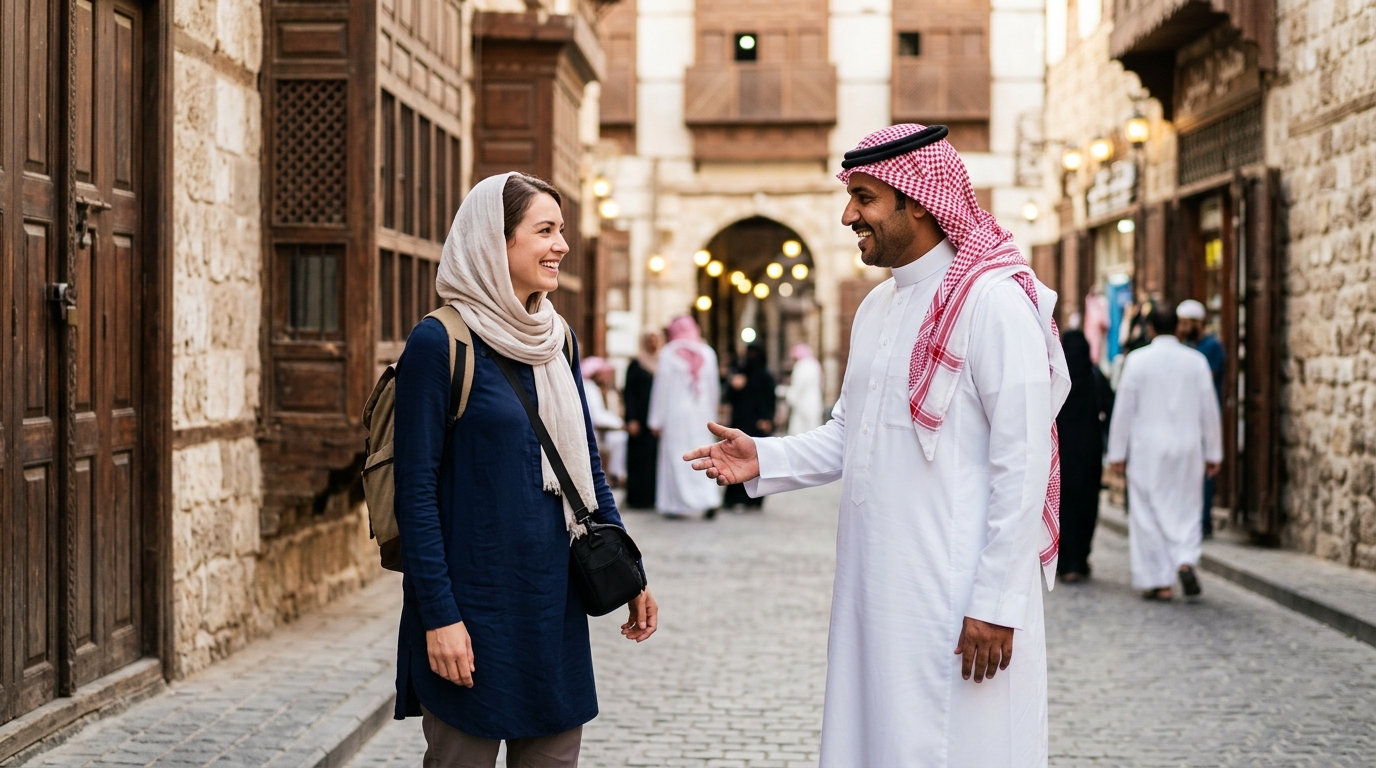
You’re about to land in Riyadh for a business meeting, and suddenly you realize you have no idea whether to shake hands, bow, or keep your distance. The person greeting you extends their hand, but you notice they’re not making direct eye contact. Did you do something wrong already?
Understanding Saudi Arabia social etiquette isn’t just about being polite. It’s about showing respect for a culture that values tradition while rapidly modernizing. Get it right, and doors open. Get it wrong, and you might unintentionally offend someone who was genuinely trying to welcome you.
Saudi social customs blend Islamic principles with Bedouin hospitality traditions. Men and women observe different greeting protocols, with handshakes common among same-gender interactions. Modesty, respect for privacy, and indirect communication define daily interactions. Coffee ceremonies, gift-giving customs, and prayer time awareness demonstrate cultural sensitivity. Understanding these norms helps visitors build genuine connections while avoiding common mistakes that could damage relationships or business opportunities.
Greeting customs that actually matter
The way you greet someone in Saudi Arabia depends entirely on gender, age, and your relationship with that person.
When meeting Saudi men, expect a handshake. It’s usually gentle, not the firm grip you might use in Western business settings. The handshake often lasts longer than you’re used to, sometimes continuing throughout the initial conversation.
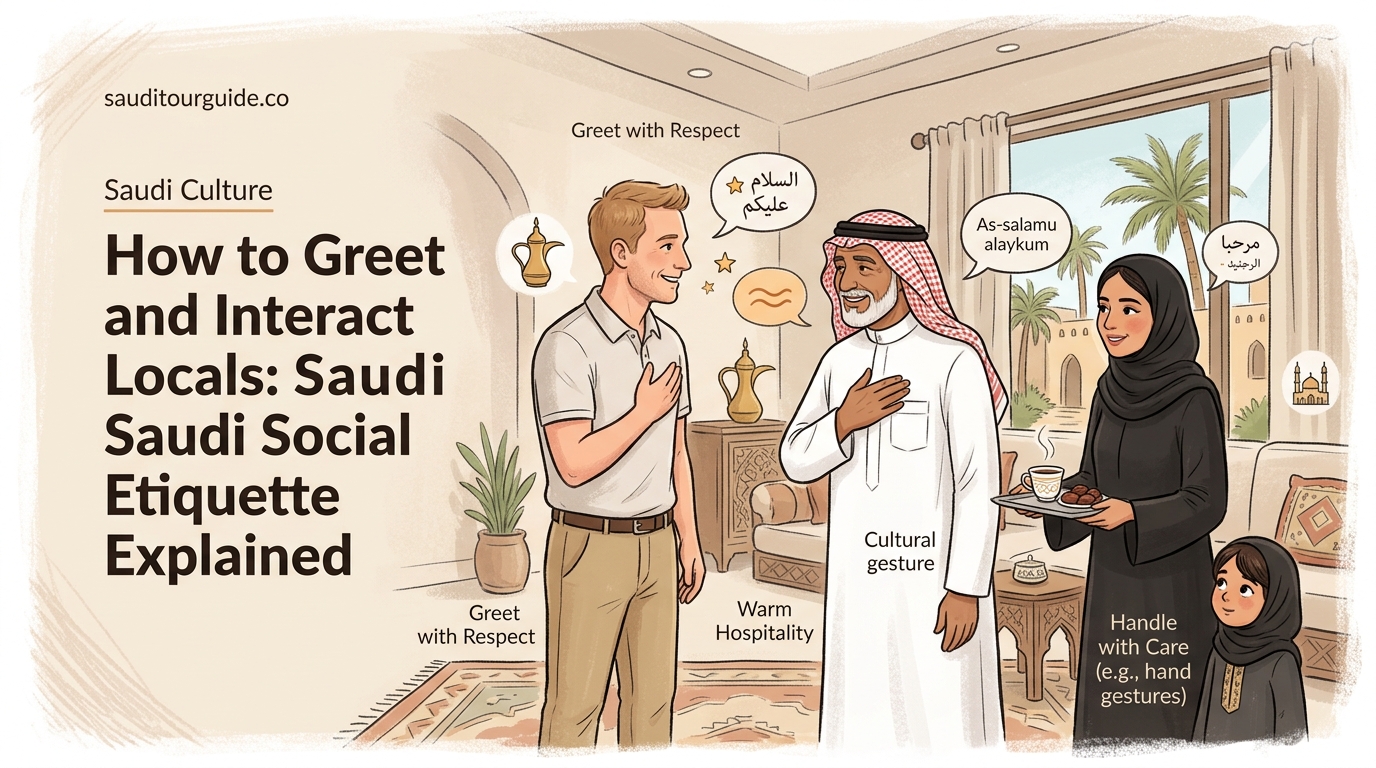
Some men will place their left hand over their heart after shaking hands. This gesture shows sincerity and respect. You can mirror this if it feels natural.
For women greeting women, handshakes are common, along with cheek kisses among friends and family. The number varies, usually two or three kisses on alternating cheeks.
Between men and women who aren’t related, things get more nuanced. Many Saudi women prefer not to shake hands with men outside their family. Wait for a woman to extend her hand first. If she doesn’t, a smile and a slight nod work perfectly.
“The golden rule in Saudi greetings is to let the Saudi person set the tone. If they extend their hand, shake it. If they don’t, respect that boundary without making it awkward.” — Cultural liaison for international businesses in Riyadh
Common Arabic greetings you should know:
- “As-salamu alaykum” (peace be upon you) is the standard greeting
- The response is “Wa alaykum as-salam” (and upon you be peace)
- “Marhaba” works as a casual hello
- “Sabah al-khair” means good morning
- “Masa al-khair” means good evening
The unwritten rules of Saudi hospitality
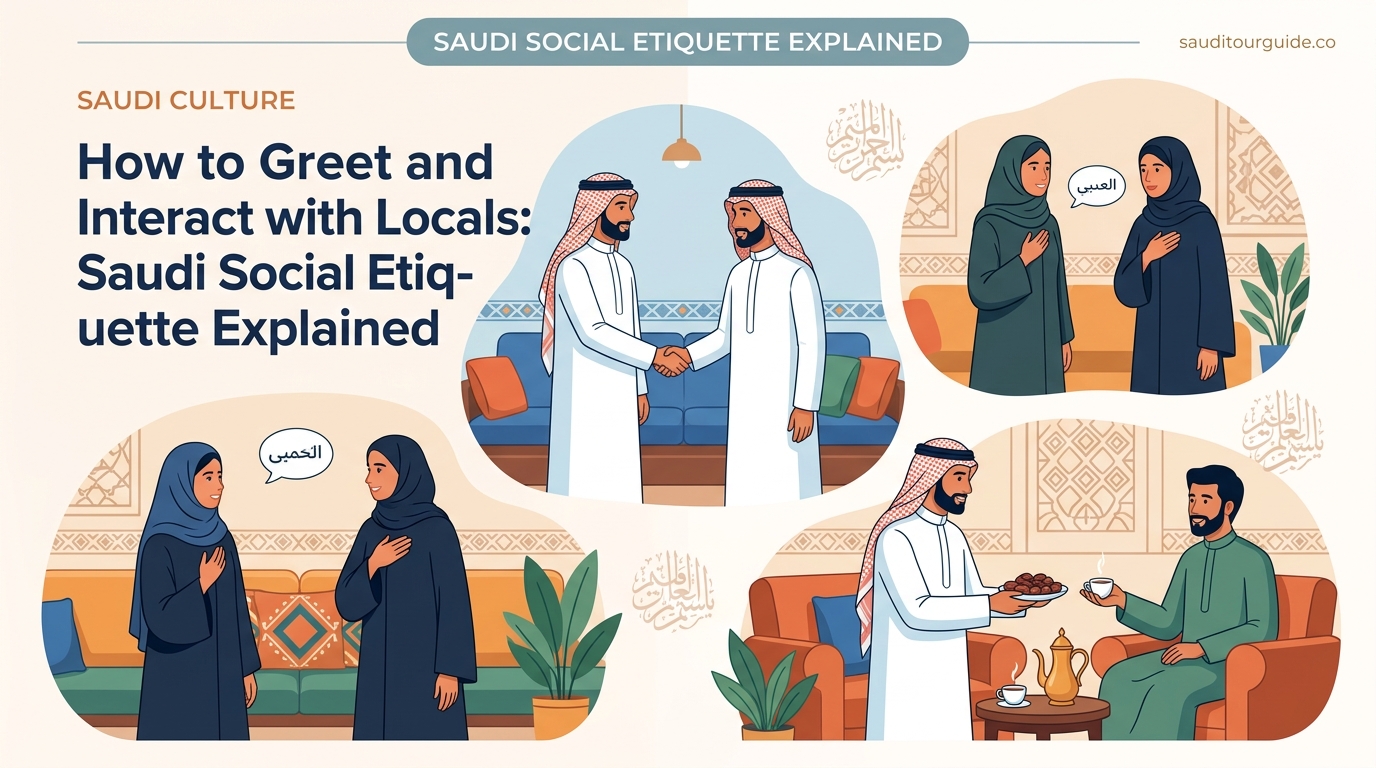
Hospitality in Saudi culture isn’t just being friendly. It’s a deeply rooted obligation.
If someone invites you for coffee or a meal, accept whenever possible. Declining without a strong reason can be seen as rude.
When you enter a Saudi home, remove your shoes unless your host insists otherwise. You’ll usually see a collection of shoes by the entrance as your cue.
Sit where your host directs you. The most honored guest typically sits farthest from the door. Don’t choose your own seat, especially in formal settings.
Accept food and drink when offered, even if just a small amount. Refusing entirely suggests you don’t value the host’s generosity. You can politely decline after the second or third offer if you’re genuinely not hungry.
Coffee service follows specific customs. The server pours small amounts into handleless cups. Drink it, then shake the cup gently side to side when you’ve had enough. If you just hand it back, they’ll refill it.
How to navigate conversations without offending anyone
Saudi communication style tends to be indirect compared to Western norms.
Criticism or disagreement rarely happens directly. People use softening phrases and may agree to your face while having reservations they’ll express later through other channels.
Personal questions that might seem invasive elsewhere are normal here. Saudis often ask about your family, marital status, and salary early in a relationship. These questions show genuine interest, not nosiness.
Topics to avoid in casual conversation:
- Politics, especially criticism of the government or royal family
- Religion, particularly comparisons or debates
- Israeli-Palestinian conflict
- Gender roles and women’s rights (unless the Saudi person brings it up)
- Alcohol or pork
Safe conversation topics include family, sports (especially soccer), travel, food, and business opportunities in the Kingdom.
When someone asks “How are you?” the expected response is positive, even if you’re having a terrible day. Complaining, especially to someone you don’t know well, violates social norms.
Prayer times and their impact on daily interactions
Five daily prayers structure Saudi life in ways visitors often don’t anticipate.
Shops close during prayer times, usually for 20 to 30 minutes. Restaurants stop serving. Business meetings pause.
Prayer times shift throughout the year based on the Islamic calendar:
- Fajr (dawn)
- Dhuhr (midday)
- Asr (afternoon)
- Maghrib (sunset)
- Isha (evening)
Don’t schedule important meetings right before prayer times. Your Saudi counterpart will be distracted, knowing they need to leave soon.
If you’re in a meeting when the call to prayer sounds, expect it to pause. Non-Muslims aren’t required to pray, but you should wait respectfully.
Walking in front of someone who’s praying is considered extremely rude. Give praying individuals a wide berth in public spaces.
Gender interaction guidelines for different settings
Saudi Arabia has made significant changes to gender segregation rules, but traditional norms still guide many interactions.
In traditional settings, men and women often socialize in separate spaces. A Saudi home might have a men’s sitting room and a women’s sitting room.
In modern restaurants and cafes, especially in major cities, mixed seating is increasingly common. Family sections remain available for those who prefer them.
When visiting someone’s home, you might not meet the female family members if you’re a male visitor. Don’t ask to meet them or inquire why they’re not present.
For business meetings, women professionals are increasingly common, particularly in cities like Riyadh and Jeddah. Treat them with the same professional respect you’d show anyone, while being mindful of physical boundaries.
Eye contact norms differ by gender. Prolonged eye contact between unrelated men and women can be seen as inappropriate. Brief, respectful eye contact during professional conversations is fine.
Dress code expectations beyond the basics
What you wear communicates respect for local values.
Men should wear long pants and shirts with sleeves in public. Shorts are acceptable at beaches and some resorts, but not in traditional areas or religious sites.
Women don’t need to wear an abaya anymore, but modest clothing is still expected. This means covering shoulders, cleavage, and knees at minimum.
In conservative areas and when visiting local homes, an abaya makes life easier even though it’s not legally required.
Clothing should be loose-fitting, not tight or revealing. Sheer fabrics that show skin underneath don’t count as modest.
For business settings, men typically wear suits or at least dress pants and a collared shirt. Women wear conservative business attire with long sleeves and long skirts or pants.
Gift-giving customs and what they reveal
Bringing a gift when invited to someone’s home shows appreciation and respect.
Appropriate gifts include:
- High-quality dates or chocolates
- Pastries from a reputable bakery
- Items from your home country
- Perfumes or oud (traditional Arabian fragrance)
- Books or educational items for children
Avoid these gifts:
- Alcohol (illegal in Saudi Arabia)
- Pork products (forbidden in Islam)
- Anything depicting dogs (considered unclean in Islamic tradition)
- Personal items like clothing for adults
- Anything overly expensive that might embarrass the recipient
Present gifts with your right hand or both hands, never the left hand alone. The left hand is considered unclean in Islamic culture.
Don’t be surprised if your gift isn’t opened immediately. Many Saudis set gifts aside to open later, avoiding any appearance of greed.
If you receive a gift, accept it graciously with both hands and thank the giver warmly.
Common gestures and what they actually mean
Body language in Saudi culture carries different meanings than you might expect.
The thumbs-up gesture is generally positive, similar to Western cultures. However, other hand gestures common in the West can be offensive here.
Pointing with your index finger at someone is rude. If you need to indicate a person, gesture with your whole hand, palm up.
Showing the soles of your feet or shoes is disrespectful. Keep your feet flat on the floor when sitting. Don’t cross your legs in a way that points your sole at someone.
The “OK” sign made with thumb and forefinger can be offensive in Saudi culture. Avoid it entirely.
Personal space is different here. Saudi men often stand closer during conversations than Westerners do. This isn’t aggressive; it’s normal.
Touching between same-gender friends is common. Men might hold hands or walk arm-in-arm. This indicates friendship, nothing more.
Dining etiquette for traditional and modern settings
Eating together is a key bonding activity in Saudi culture.
Traditional Saudi meals often involve sitting on the floor around a large communal platter. Food is eaten with the right hand, using bread to scoop rice and meat.
When eating communally, take food from the section directly in front of you, not from across the platter. Don’t reach over someone else’s space.
Your host might offer you choice pieces of meat. Accept them as a sign of honor.
In modern restaurants, Western utensils are standard. Table manners similar to European style apply.
Whether traditional or modern, these rules remain constant:
- Always use your right hand for eating
- Don’t blow your nose at the table
- Accept at least a little of everything offered
- Compliment the food
- Don’t start eating before the eldest or most honored guest begins
Meals often end with tea or coffee and dates. Stay for this unless you have a pressing reason to leave.
Business meeting protocols that build trust
Saudi business culture values relationships over transactions.
Expect meetings to start with extended small talk. Jumping straight to business suggests you only care about the deal, not the relationship.
Meetings rarely start exactly on time. Build buffer time into your schedule.
Decision-making often happens in layers. The person you’re meeting with might not have final authority. Patience is essential.
Business cards should be presented and received with your right hand. Take a moment to look at the card respectfully before putting it away.
Bring a local contact or intermediary when possible, especially for important deals. Personal connections matter more than cold approaches.
Friday is the Islamic holy day. The Saudi work week typically runs Sunday through Thursday. Don’t schedule meetings on Fridays.
Mistakes visitors make and how to avoid them
| Common Mistake | Why It’s Wrong | What to Do Instead |
|---|---|---|
| Using left hand for eating or greeting | Left hand is considered unclean | Always use right hand for social interactions |
| Refusing coffee or food completely | Suggests rejection of hospitality | Accept at least a small amount |
| Discussing religion or politics | Can create uncomfortable or dangerous situations | Stick to neutral topics unless host initiates |
| Photographing people without permission | Privacy is highly valued | Always ask before taking photos of people |
| Public displays of affection | Considered inappropriate and potentially illegal | Keep physical affection private |
| Criticizing Saudi customs | Seen as disrespectful and arrogant | Observe and respect even if you don’t understand |
Special considerations for different regions
Saudi Arabia isn’t culturally uniform. Regional differences affect social customs.
Jeddah, as a coastal city with long exposure to international visitors, tends to be more relaxed. You’ll see more mixed-gender socializing and modern entertainment.
Riyadh, the capital, balances traditional values with rapid modernization. Business culture here is more formal.
The Eastern Province, with its oil industry, has significant expat populations and more international influence.
The Asir region in the southwest has distinct cultural traditions, including different traditional dress and cuisine.
Rural and tribal areas maintain more conservative customs. Visitors should dress and behave more conservatively in these regions.
Ramadan etiquette for non-Muslim visitors
Ramadan, the Islamic holy month of fasting, transforms daily life in Saudi Arabia.
Muslims fast from dawn to sunset, abstaining from food, drink, and smoking. While non-Muslims aren’t required to fast, eating, drinking, or smoking in public during daylight hours is illegal.
Restaurants either close during the day or serve only takeaway from hidden areas. Hotels usually have screened sections where non-Muslims can eat discreetly.
Work hours typically shorten during Ramadan. Business slows down. People are often tired and less patient.
The evening meal breaking the fast, called iftar, is a special time. If invited to iftar, accept. It’s an honor.
After sunset during Ramadan, cities come alive. Restaurants fill up. Shopping areas get crowded. Social activity peaks.
Dress more conservatively during Ramadan. Be especially mindful of modest clothing and respectful behavior.
Building genuine connections beyond surface politeness
Following etiquette rules mechanically won’t build real relationships. Saudis value sincerity.
Show genuine interest in Saudi culture. Ask questions respectfully. People appreciate when visitors want to understand, not just comply.
Learn a few Arabic phrases beyond basic greetings. The effort matters more than perfect pronunciation.
Be patient with cultural differences that frustrate you. Saudi Arabia is changing rapidly, but some traditions run deep.
If you make a mistake, apologize sincerely. Most Saudis are gracious with visitors who show genuine respect and willingness to learn.
Share aspects of your own culture when appropriate. Cultural exchange goes both ways. Saudis are often curious about life in other countries.
Accept that some aspects of Saudi culture might remain opaque to you. You don’t need to understand everything to respect it.
When cultural norms meet modern Saudi Arabia
Saudi Arabia is transforming at a pace that sometimes leaves even Saudis uncertain about current norms.
Entertainment venues, concerts, and cinemas that didn’t exist a few years ago now operate openly. Gender mixing in these spaces is normal.
Young Saudis, especially in cities, often have different attitudes than older generations. They might be more casual about some traditional customs.
This creates situations where you’ll see different behaviors in the same setting. One family might be very traditional while the next table over is more relaxed.
When in doubt, err on the side of conservative behavior. It’s better to be overly respectful than too casual.
Watch how Saudis around you behave and follow their lead. Social cues matter more than rigid rules.
The country’s rapid development means etiquette is evolving. What’s true today might shift tomorrow.
Making Saudi social customs work for you
Understanding Saudi Arabia social etiquette isn’t about memorizing a list of dos and don’ts. It’s about recognizing the values behind the customs: respect, hospitality, modesty, and community.
Start with the basics. Greet people appropriately. Dress modestly. Show respect for prayer times. Accept hospitality graciously. These fundamentals will carry you through most situations.
Pay attention to the Saudis around you. They’re your best teachers. Watch how they interact, what they wear, how they navigate social situations.
Don’t stress about being perfect. Saudis generally appreciate when visitors make an effort, even if you occasionally stumble. A sincere apology fixes most mistakes.
The social customs that might seem restrictive at first often create unexpected moments of genuine connection. Sharing coffee in a Bedouin tent, being welcomed into someone’s home, or having a business contact become a real friend—these experiences happen when you respect the culture that makes them possible.
Before you know it, you’ll find yourself naturally waiting for others to start eating, using your right hand without thinking about it, and actually enjoying those long coffee ceremonies that once seemed inefficient. That’s when Saudi Arabia stops feeling foreign and starts feeling like a place where you belong.