
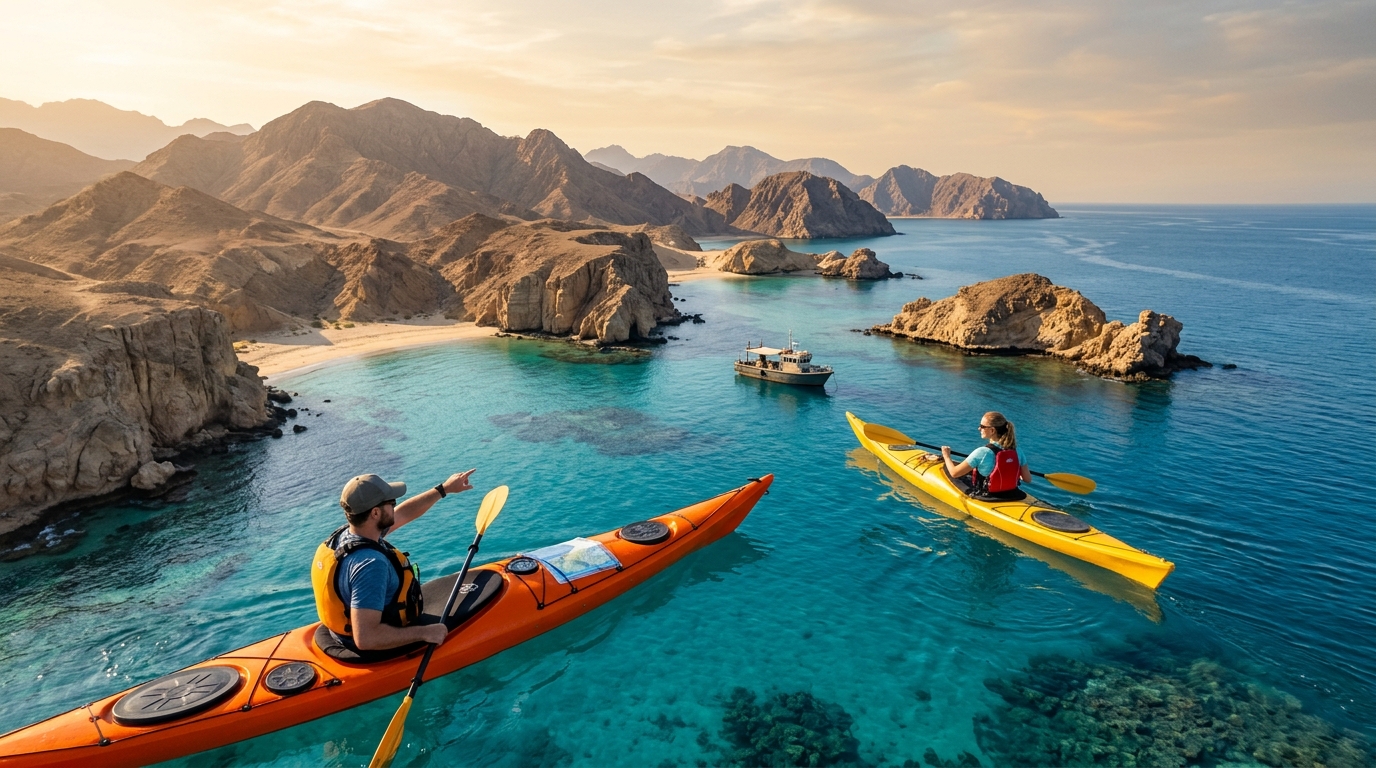
The Red Sea coastline stretches over 1,800 kilometers along Saudi Arabia’s western edge, offering some of the most pristine and unexplored sea kayaking territory in the world. Crystal clear waters, untouched coral reefs, and desert landscapes that plunge directly into turquoise bays create conditions that rival any paddling destination globally.
Most kayakers have never considered Saudi Arabia for their next expedition. That’s changing fast.
Planning a Red Sea kayaking expedition requires securing permits through local authorities, choosing routes based on skill level and season, and understanding coastal access points. October through April offers optimal conditions. Multi-day trips demand careful water planning, emergency protocols, and knowledge of protected marine zones. Hidden gems include the Farasan Islands, Umluj archipelago, and northern stretches near Haql.
Understanding Saudi Arabia’s Red Sea kayaking regulations
Saudi Arabia opened its doors to tourism in 2019. The kayaking permit landscape is still evolving.
You need a tourist visa first. The e-visa process takes less than ten minutes for most nationalities. Once you arrive, kayaking in open waters requires coordination with local authorities.
For coastal paddling near major cities like Jeddah or Yanbu, no special permits exist yet. You can launch from public beaches without paperwork. But multi-day expeditions into remote areas require notification to the Saudi Border Guard.
Contact the nearest Coast Guard office at your intended launch point at least 72 hours before departure. Provide your itinerary, emergency contact information, and expected return date. They’ll log your trip and may assign a tracking number.
Protected marine areas around the Farasan Islands require additional permits from the National Center for Wildlife. Apply through their website or visit their office in Jizan. Processing takes five to seven business days.
Camping permits depend on your location. Beaches fall under different jurisdictions. Some are managed by municipalities, others by environmental agencies. The safest approach is to ask your accommodation provider or tour operator to facilitate camping permissions.
Choosing your Red Sea kayaking route
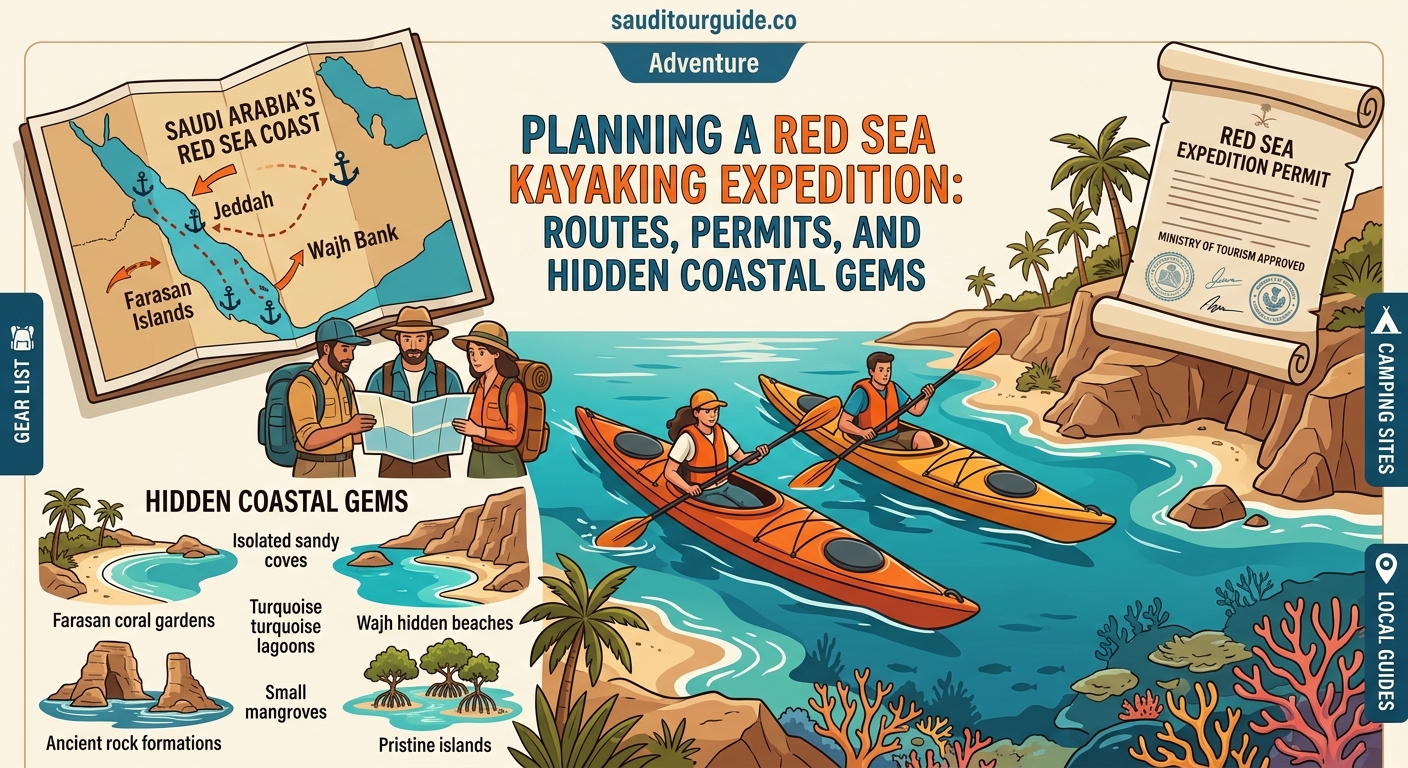
Route selection depends on three factors: your skill level, the season, and your goals.
Northern routes (Haql to Sharma)
This section offers dramatic mountain backdrops meeting the sea. The coastline is rugged with fewer protected bays. Winds can be strong, especially in summer. Best paddled between November and March.
Launch points include Haql town beach and several spots along the coastal road south. The 80-kilometer stretch to Sharma features limestone cliffs, sea caves, and excellent snorkeling reefs. Expect open water crossings between headlands.
Water sources are scarce. Plan to carry all drinking water or arrange resupply drops.
Central routes (Umluj archipelago)
Umluj is called the “Maldives of Saudi Arabia” for good reason. Over 100 islands create a protected paddling paradise. Distances between islands range from 500 meters to 5 kilometers.
This area suits intermediate kayakers perfectly. Island hopping allows flexible daily distances. Most islands have sandy beaches suitable for camping.
Launch from Umluj town harbor. Local fishermen can provide weather updates and reef locations to avoid. The archipelago extends roughly 60 kilometers north to south.
Fresh water is available in Umluj town only. Carry sufficient supplies or return to town every three days.
Southern routes (Farasan Islands)
The Farasan archipelago lies 40 kilometers offshore from Jizan. Access requires a ferry from Jizan port. The crossing takes 90 minutes and runs twice daily.
Once there, you’ll find Saudi Arabia’s richest marine biodiversity. Protected status means pristine reefs and abundant marine life. The main island group spans about 30 kilometers.
Strong currents between islands demand advanced skills. Tidal planning is essential. The best paddling season runs from October to February.
Several islands have small villages with basic supplies. Camping is permitted on designated beaches only.
| Route Section | Skill Level | Best Season | Key Challenge | Highlight |
|---|---|---|---|---|
| Haql to Sharma | Advanced | Nov-Mar | Open crossings | Mountain scenery |
| Umluj Islands | Intermediate | Oct-Apr | Navigation | Island hopping |
| Farasan Islands | Advanced | Oct-Feb | Strong currents | Marine life |
| Yanbu to Umluj | Intermediate | Nov-Mar | Distance | Remote beaches |
| Jizan Coast | Beginner | Oct-Apr | Heat | Mangrove channels |
Essential gear for Red Sea expeditions
Your standard sea kayaking kit needs modifications for desert coastal conditions.
Sun protection becomes critical. The combination of direct sun and reflection off water creates extreme exposure. Bring a wide-brimmed hat that secures under your chin, SPF 50+ sunscreen, and long-sleeve UV shirts. Paddling gloves prevent hand burns.
Water capacity determines your range. Plan for 4-5 liters per person per day in cooler months, 6-7 liters in warmer periods. Collapsible water containers save space when empty.
Navigation equipment should include both GPS and paper charts. Cell coverage exists near major towns but disappears quickly offshore. Download offline maps before departure. A compass and waterproof chart case are mandatory backups.
Safety gear specific to this region:
- VHF marine radio (Channel 16 is monitored by Coast Guard)
- Personal locator beacon or satellite messenger
- First aid kit with rehydration salts and heat illness supplies
- Repair kit for both kayak and paddle
- Flares and signal mirror
Camping equipment needs to handle sand and wind. Freestanding tents work better than stake-dependent designs. Bring extra stakes anyway. A ground cloth under your tent prevents sand infiltration.
The Red Sea rarely gets cold, but nights can be cool between December and February. A lightweight sleeping bag rated to 10°C handles most conditions.
For cooking, bring a reliable camp stove. Driftwood is scarce on many beaches. Fuel availability in Saudi Arabia favors white gas or canister stoves. Stock up in major cities.
Best launch points and access logistics
Getting yourself and your kayak to the water requires planning.
Jeddah area
Jeddah serves as the main international gateway. King Abdulaziz International Airport receives flights from around the world. Several beaches south of the city allow kayak launching.
Obhur Creek, 30 kilometers north, offers protected waters for testing gear before heading offshore. Public beach access exists, though parking can be challenging on weekends.
Kayak rentals are limited. Bringing your own boat is recommended. Some dive shops in Jeddah can connect you with kayaking guides.
Yanbu
This industrial city has excellent infrastructure and serves as a good base for central coast expeditions. The corniche has multiple beach access points.
Yanbu lies 350 kilometers north of Jeddah. Domestic flights connect the cities daily. Renting a car gives you flexibility for reaching remote launch points.
Umluj
The town itself is small but growing rapidly. A new airport opened in 2022 with limited domestic service. Most visitors drive from Yanbu (130 kilometers) or Tabuk (250 kilometers).
The harbor area has boat ramps suitable for kayak launching. Local fishermen are friendly and helpful with local knowledge.
Haql
This northern town sits near the Jordanian border. Access by road only, either from Tabuk (200 kilometers) or through the coastal route. The drive offers stunning scenery.
Limited accommodation exists in Haql. Most kayakers camp. Stock up on supplies in Tabuk before heading north.
Jizan
The southern gateway to the Farasan Islands. Regular domestic flights connect Jizan to Jeddah and Riyadh. The ferry terminal is 10 kilometers from the airport.
Ferry schedules change seasonally. Confirm times before finalizing your expedition dates. The ferry accommodates kayaks for a small additional fee.
Hidden coastal gems worth paddling to
Beyond the main routes, several spots rarely see visitors.
Ras Baridi
This rocky peninsula 40 kilometers south of Umluj creates a natural harbor on its eastern side. The western face takes the full force of Red Sea swells, creating dramatic conditions for experienced paddlers.
A small fishing village occupies the protected bay. Locals occasionally offer fresh fish and strong Arabic coffee to passing kayakers.
The reef system here rivals anything in the Farasan Islands. Visibility often exceeds 30 meters.
Al Wajh Bank
Technically offshore rather than coastal, this massive reef complex lies 60 kilometers from Al Wajh town. Only accessible to advanced kayakers with support boats.
The bank creates a shallow lagoon system spanning hundreds of square kilometers. Inside the reef, conditions are calm and clear. Marine life density is exceptional.
Arrange access through dive operators in Al Wajh. They can provide safety support and local expertise.
Sharma Bay
The northern terminus of many expeditions, Sharma Bay offers excellent camping and a small community. The bay itself is well protected, making it a good rest point.
Just south of Sharma, a series of unnamed coves provide world-class snorkeling. Each cove requires paddling around a headland, keeping them isolated and pristine.
Fresh water is available in Sharma village. Stock up before continuing north or turning back.
Duba Islands
Between Umluj and Haql, the small archipelago near Duba town sees almost no kayak traffic. Three main islands and several smaller ones create interesting paddling.
The islands sit close to shore, making them accessible even in moderate winds. Camping is possible on the largest island’s southern beach.
Duba town has basic supplies and fuel. The coastal road provides easy access.
“The Red Sea’s northern Saudi coast offers expedition kayaking comparable to Baja California, but with warmer water and virtually no crowds. The biggest challenge is logistics and self-sufficiency rather than technical paddling difficulty.” — Ahmed Al-Ghamdi, Saudi adventure sports guide
Weather patterns and seasonal considerations
Timing your expedition correctly makes the difference between enjoyment and suffering.
October through December
This period offers the best overall conditions. Daytime temperatures range from 25-30°C. Water temperature stays around 26-28°C. Winds are generally light to moderate from the north.
Occasional weather systems from the Mediterranean can bring stronger winds and rare rain. These typically last 24-48 hours.
This season sees the most kayaking activity. Book accommodations and ferry tickets in advance.
January through March
Cooler air temperatures (20-25°C) make paddling comfortable. Water remains warm enough for swimming without wetsuits.
Wind patterns become less predictable. Strong northerlies can blow for several days, making northward progress difficult.
This period works well for southern routes where prevailing winds help rather than hinder.
April and May
Transition months with increasing heat. Mornings remain pleasant, but afternoons can be hot. Water temperature climbs toward 30°C.
Winds tend to be light. Good for shorter trips or island hopping where you can rest during peak heat.
June through September
Too hot for most kayakers. Daytime temperatures regularly exceed 40°C. Humidity increases, especially in the south.
Only consider this period if you have extensive hot-weather paddling experience. Dawn and dusk paddling becomes necessary.
Some experienced kayakers target this season specifically for solitude. You’ll have the coast entirely to yourself.
Water sources and resupply strategies
Water management determines your expedition length and route options.
Carrying capacity in a sea kayak typically ranges from 15-25 liters depending on your boat’s storage. This gives you 3-5 days of autonomy in cooler months.
Resupply options:
-
Return to towns: Umluj, Yanbu, Haql, and other coastal towns have reliable water sources. Plan loops that touch civilization every few days.
-
Cache drops: If you have support crew, arrange water caches at accessible beach points. Mark locations precisely with GPS coordinates. Use sturdy containers that can handle sun exposure.
-
Local villages: Small fishing communities dot the coast. Most will share water if asked respectfully. Offer to pay or trade supplies. Learn basic Arabic greetings to facilitate interactions. The guide on how to greet locals helps with these encounters.
-
Desalination: Some kayakers carry portable desalination pumps. These work but are slow and require significant effort. Better as emergency backup than primary source.
Never count on finding water on uninhabited islands or beaches. Assume you must carry everything.
Safety protocols and emergency planning
Remote coastlines demand thorough safety planning.
File a detailed float plan with someone reliable back home. Include:
- Daily intended positions with GPS coordinates
- Expected camping locations
- Check-in schedule
- Emergency contact procedures
- Date you’ll consider the trip overdue
Check in via satellite messenger or phone when possible. If you miss two consecutive check-ins, your contact should alert authorities.
Carry a VHF marine radio and monitor Channel 16 during daylight hours. The Saudi Coast Guard monitors this frequency but response times in remote areas can be long.
Medical considerations:
- Heat illness is the primary risk. Know the signs of heat exhaustion and heat stroke.
- Jellyfish are present but rarely dangerous. Vinegar treats most stings.
- Sea urchins are common on reefs. Wear water shoes when exploring.
- Scorpions and snakes exist on shore. Check your tent and shoes before use.
Your first aid kit should include:
- Rehydration salts
- Broad-spectrum antibiotics
- Pain relievers
- Antihistamines
- Wound care supplies
- Sunburn treatment
- Seasickness medication
Emergency extraction:
In serious emergencies, the Coast Guard can coordinate helicopter rescue. Your satellite messenger or VHF radio initiates contact.
For non-life-threatening issues, you may need to paddle to the nearest road access and arrange ground transport. Having emergency cash and a charged phone helps.
Travel insurance that covers adventure sports is essential. Verify it includes sea kayaking and emergency evacuation from remote areas.
Cultural considerations and local interactions
Saudi Arabia’s coastal communities are welcoming but conservative.
Dress modestly when on shore. Men should wear shirts and shorts that cover the knees. Women should cover shoulders and wear loose-fitting pants or long skirts. While paddling offshore, normal kayaking attire is acceptable.
If you camp near villages, introduce yourself to local residents. Explain your plans and ask permission to camp. This simple courtesy prevents misunderstandings.
Friday is the holy day. Expect reduced services and more family activity on beaches. Plan accordingly.
Photography requires sensitivity. Always ask permission before photographing people, especially women. Military installations and ports are strictly off-limits for photography.
The concept of hospitality is strong. If invited for tea or coffee, accepting shows respect. You’ll likely be offered traditional Arabic coffee and dates. The Saudi coffee traditions guide explains proper etiquette.
Alcohol is illegal throughout Saudi Arabia. Don’t bring it or ask about it.
During Ramadan, eating, drinking, or smoking in public during daylight hours is disrespectful. If your trip coincides with Ramadan, read up on visiting during the holy month.
Combining kayaking with other Saudi adventures
Many kayakers extend their trips to experience more of Saudi Arabia.
The Red Sea diving scene offers world-class underwater experiences. Many dive sites are accessible by kayak, letting you combine both activities.
After paddling, consider exploring inland destinations. AlUla’s ancient sites provide dramatic contrast to coastal landscapes.
The Asir region’s mountains offer hiking and cooler temperatures if you’ve had enough heat and sun.
Jeddah’s historic district makes an excellent pre or post-expedition stop. The city provides all the supplies and services you need while offering cultural immersion.
For those interested in broader exploration, the road trip guide along the Red Sea coast covers driving routes that complement kayaking expeditions.
Common mistakes to avoid
Learning from others’ errors saves you trouble.
| Mistake | Consequence | Solution |
|---|---|---|
| Underestimating heat | Dehydration, heat illness | Carry extra water, paddle early/late |
| Skipping permit coordination | Coast Guard intervention | Contact authorities 72+ hours ahead |
| Ignoring wind forecasts | Dangerous conditions, slow progress | Check multiple forecast sources daily |
| Inadequate sun protection | Severe burns, trip-ending injury | SPF 50+, protective clothing, shade breaks |
| Poor Arabic communication prep | Difficulty with locals, permits | Learn basic phrases, use translation app |
| Overambitious daily distances | Exhaustion, missed experiences | Plan 15-20km days, build rest days in |
The biggest mistake is treating the Red Sea like other kayaking destinations. The combination of heat, remoteness, and developing tourism infrastructure requires extra preparation.
Don’t assume you can buy specialized gear locally. Bring everything you need from home or major Saudi cities.
Avoid paddling alone unless you’re extremely experienced. The remoteness makes solo incidents potentially serious.
Connecting with the local kayaking community
Saudi Arabia’s paddling community is small but growing.
Social media groups on Facebook and Instagram connect local kayakers. Search for “Saudi sea kayaking” or “Red Sea paddling” to find active communities.
Several adventure tour companies in Jeddah and Yanbu now offer kayaking trips. Connecting with them provides local knowledge and potential paddling partners.
The Saudi Sports for All Federation promotes outdoor activities. Their website lists events and contacts for various adventure sports.
Dive shops along the coast often know kayakers. Stop in and ask around. The diving and kayaking communities overlap significantly.
Universities in coastal cities sometimes have outdoor clubs. Reaching out through their websites can connect you with enthusiastic local paddlers.
Documenting your expedition
The Red Sea’s beauty deserves documentation, but protecting your gear requires planning.
Waterproof camera housings are essential. Dry bags alone aren’t sufficient for valuable electronics. Pelican cases provide maximum protection.
Drone photography is legal in Saudi Arabia with restrictions. Register your drone through the General Authority of Civil Aviation app before flying. Avoid flying near military areas, airports, or government buildings.
The best light for photography occurs during the golden hours after sunrise and before sunset. Plan rest breaks during these times to capture images.
GoPro-style action cameras work well for on-water footage. Mount them securely. The combination of waves and sun creates harsh conditions for equipment.
Keep backup batteries in a cool, shaded part of your kayak. Heat degrades battery performance rapidly.
Consider keeping a written journal. Years later, you’ll appreciate the details that photos can’t capture.
Making your Red Sea kayaking dream happen
Planning a Red Sea kayaking expedition takes more effort than booking a trip to established paddling destinations. The rewards justify the extra work.
Start planning at least three months before your intended departure. This allows time for visa processing, permit coordination, and gear acquisition.
Build a detailed budget. Factor in flights, domestic transport, accommodation before and after the expedition, food, water, permits, and emergency contingency funds. Expect to spend more than comparable trips to more developed kayaking regions.
Physical preparation matters. Train with loaded kayak camping trips. Practice self-rescue techniques. Build heat tolerance if you’re from cooler climates.
Connect with others who’ve paddled the Red Sea. Online forums and social media groups provide current information about conditions, regulations, and logistics.
The Saudi tourism infrastructure improves monthly. What’s difficult to arrange now may be easier next year. Stay flexible and patient with the planning process.
Your expedition will likely introduce you to coastline that few paddlers have experienced. The combination of world-class marine environments, dramatic desert scenery, and genuine cultural exchange creates something special.
The Red Sea has been a crossroads of civilizations for millennia. Now it’s opening to a new wave of adventurers. Your kayak gives you the perfect vessel to experience this historic waterway at its own pace, on its own terms.
Start planning today. The turquoise waters and empty beaches are waiting.