
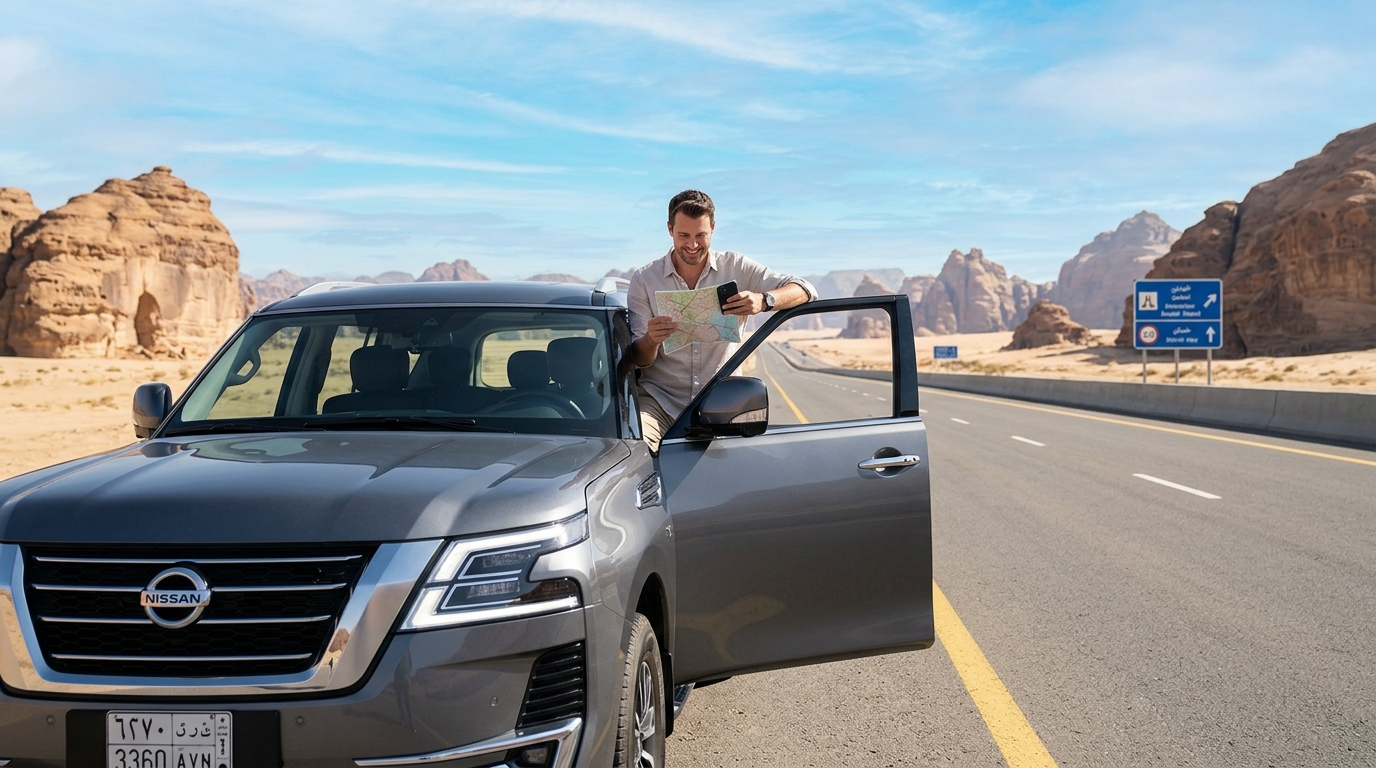
Renting a car in Saudi Arabia gives you freedom that no tour bus can match. You can stop at desert viewpoints whenever you want. You can change plans on a whim. You can reach places that aren’t on any organized itinerary.
But the process comes with specific requirements that catch many visitors off guard.
Foreign tourists can rent cars in Saudi Arabia using an International Driving Permit alongside their home license. Major rental companies operate at airports and cities. Insurance coverage is mandatory. Road conditions are generally excellent, but driving culture differs significantly from Western countries. Budget 150 to 400 SAR daily depending on vehicle type. GPS navigation is essential, and fuel is remarkably cheap at around 2.33 SAR per liter.
What you need before booking your rental
Your home country driver’s license won’t work alone. Saudi Arabia requires an International Driving Permit (IDP) for all foreign visitors.
Get your IDP before you leave home. Most countries issue them through automobile associations. The process takes about 15 minutes and costs between $15 and $25. The document translates your license into multiple languages, including Arabic.
You’ll need both documents at the rental counter. Keep them together throughout your trip because police checkpoints are common.
Age requirements matter too. Most rental companies require drivers to be at least 21 years old. Some luxury or larger vehicles require you to be 25 or older.
Your credit card needs sufficient available credit. Rental companies place holds ranging from 1,500 to 5,000 SAR depending on the vehicle class. This hold releases after you return the car undamaged.
Choosing between rental companies
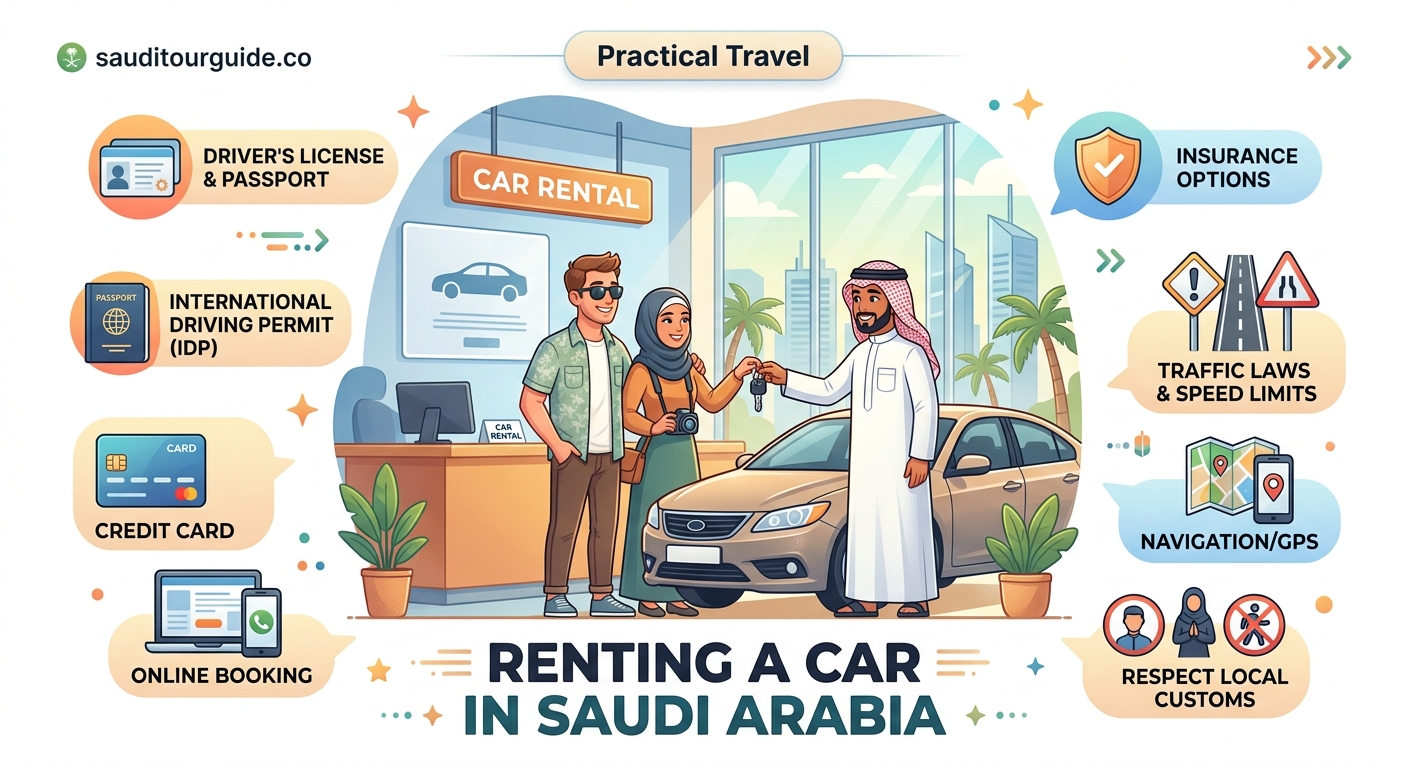
International chains like Hertz, Budget, Avis, and Europcar operate throughout Saudi Arabia. You’ll find them at every major airport and in city centers.
Local companies like Theeb and Lumi Rental often offer better rates. Their customer service quality varies more than international chains, but many travelers report excellent experiences.
Book online before arrival. Walk-up rates at airport counters run 30 to 50 percent higher than advance bookings. You can cancel most reservations for free up to 24 hours before pickup.
Compare these factors when choosing:
- Insurance coverage details and deductibles
- Mileage limits (unlimited is standard but confirm)
- Additional driver fees if traveling with others
- Pickup and drop-off locations and hours
- Vehicle age and condition guarantees
- Roadside assistance availability
Airport pickups cost more but save hassle. City center locations require taxi rides but charge lower daily rates.
Understanding insurance requirements
Saudi law mandates third-party liability insurance for every vehicle. This coverage is automatically included in your rental rate.
But that basic coverage won’t protect you from major expenses if something goes wrong.
Collision Damage Waiver (CDW) reduces your financial responsibility for vehicle damage. Without it, you’re liable for the full repair cost. CDW typically adds 40 to 80 SAR per day but caps your liability at the deductible amount (usually 1,500 to 3,000 SAR).
Theft protection works similarly. It costs an additional 30 to 50 SAR daily.
Personal accident insurance covers medical expenses for you and passengers. Check whether your travel insurance already includes this before paying extra.
Many credit cards offer rental car insurance as a benefit. Call your card issuer before your trip to understand what’s covered. Most cards require you to decline the rental company’s CDW and charge the full rental to that card.
Saudi roads are safe overall, but driving styles differ dramatically from Western countries. Lane discipline is loose, speeds are high, and aggressive driving is common. Full insurance coverage provides peace of mind that’s worth the cost for most visitors.
The rental pickup process step by step
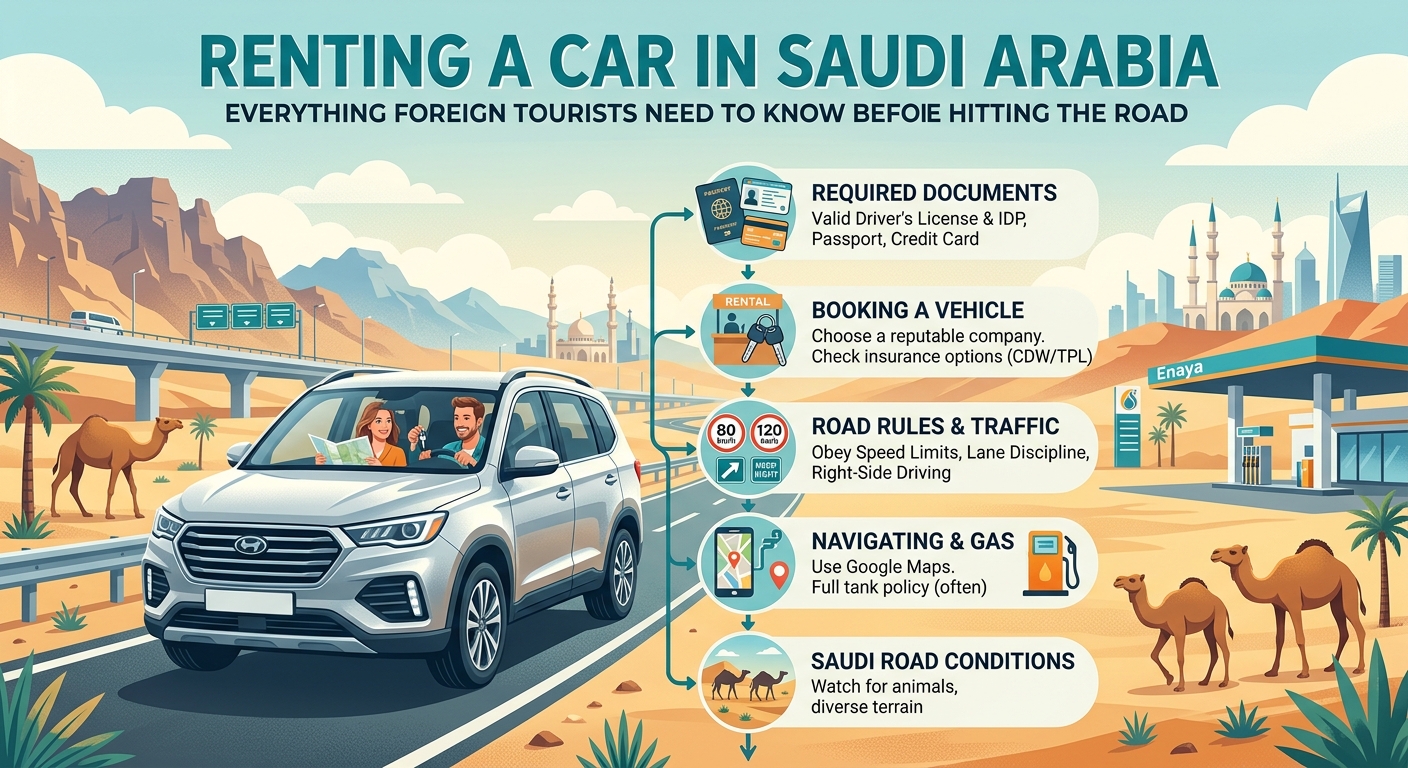
Arrive prepared with these documents:
- Your passport
- Your home country driver’s license
- Your International Driving Permit
- The credit card used for booking
- Your booking confirmation (digital or printed)
The agent will verify everything and create a rental agreement. Read it carefully before signing. Confirm the return date, time, and location. Verify the total cost including all fees and insurance.
Inspect the vehicle thoroughly before leaving the lot. Walk around the entire car with the agent. Document every scratch, dent, and mark on the condition report. Take photos or videos with your phone showing all four sides, the roof, and the interior.
Check these items specifically:
- Tire condition and spare tire presence
- Jack and tire iron location
- Fuel level (should match the contract)
- Warning triangle and first aid kit
- All lights and signals function properly
- Air conditioning works (crucial in Saudi heat)
- GPS or phone mount availability
Ask the agent to demonstrate the GPS system if you’re renting one. Confirm how to reach roadside assistance.
What driving in Saudi Arabia actually feels like
Saudi drivers are confident and fast. Highway speed limits reach 120 km/h, but many drivers travel significantly faster.
The right lane is for slower traffic. The left lane is for passing. Flash your high beams to signal that you want to pass someone ahead. This is standard practice, not considered rude.
Traffic in Riyadh and Jeddah during rush hours (7 to 9 AM and 4 to 7 PM) becomes intensely congested. Plan around these times when possible.
Most road signs appear in both Arabic and English. Highway signage is excellent. City streets can be confusing because many areas are new and GPS maps haven’t caught up.
Parking is generally easy outside of downtown areas. Many malls and attractions offer free parking. Street parking in older neighborhoods can be chaotic.
Speed cameras are everywhere. They’re clearly marked with warning signs. Fines arrive by text message if the car is registered to a local resident, or the rental company charges your card and adds an administrative fee.
Road conditions across different regions
Major highways between cities are world class. The roads connecting Riyadh, Jeddah, Dammam, and other major centers rival anything in Europe or North America.
Desert highways are straight, well maintained, and often empty for long stretches. The monotony can be dangerous. Take breaks every two hours.
Mountain roads in the Asir region feature dramatic switchbacks and steep grades. These roads are paved and safe but require focused driving. Fog can appear suddenly at higher elevations.
Off-road driving requires a 4×4 vehicle and experience. Don’t attempt desert tracks without proper preparation. Many hidden locations require four-wheel drive access.
Sandstorms occasionally reduce visibility to nearly zero. If you encounter one, pull completely off the road, turn off your lights, and wait it out. Never stop on the highway with lights on because other drivers may use your lights as a guide and crash into you.
Fuel, costs, and practical budgeting
Gasoline in Saudi Arabia costs about 2.33 SAR per liter (roughly $0.62 USD). Diesel is even cheaper. Fuel expenses will be minimal compared to other trip costs.
Gas stations appear regularly along highways. Most accept credit cards. Some older stations are cash only, so keep some riyals handy.
Rental rates vary by season and vehicle type:
| Vehicle Category | Daily Rate (SAR) | Best For |
|---|---|---|
| Economy sedan | 150 to 200 | Solo travelers, couples, city driving |
| Mid-size sedan | 200 to 280 | Small families, longer trips |
| SUV | 280 to 400 | Families, mountain regions, comfort |
| Luxury sedan | 400 to 800 | Business travel, special occasions |
| 4×4 off-road | 350 to 600 | Desert adventures, remote areas |
Prices drop significantly for weekly rentals. A seven-day booking often costs only five times the daily rate.
Additional costs to budget:
- GPS rental: 25 to 40 SAR per day (or use your phone)
- Additional driver: 30 to 50 SAR per day
- Child seat: 20 to 35 SAR per day
- Toll roads: Minimal (few toll roads exist)
- Parking: Free to 20 SAR per hour in premium areas
Navigation and staying connected
Google Maps works perfectly in Saudi Arabia. Download offline maps for your route before leaving WiFi.
Waze is popular among locals and provides real-time traffic updates and speed camera warnings.
Cell coverage is excellent in cities and along major highways. It becomes spotty in remote desert areas.
Buy a local SIM card at the airport or any mobile shop. Tourist SIM packages with 20 to 50 GB of data cost 50 to 150 SAR and last 30 days. Major providers include STC, Mobily, and Zain.
Your phone’s GPS works without cellular data, but you won’t get traffic updates or route changes.
Common mistakes tourists make
Underestimating distances is the biggest error. Saudi Arabia is massive. Riyadh to Jeddah is 950 km and takes 9 to 10 hours. Plan realistic daily driving distances.
Driving in sandals or flip-flops is technically illegal. Wear proper closed-toe shoes.
Forgetting to check fuel before entering remote areas can leave you stranded. Fill up whenever you’re below half a tank outside cities.
Not understanding right-of-way at roundabouts causes confusion. Traffic already in the roundabout has priority. Enter when there’s a clear gap.
Assuming Western driving norms apply leads to frustration. Saudi driving culture is different. Adapt rather than fight it.
Photographing government buildings, military installations, or palaces without permission can result in detention. When in doubt, don’t photograph it.
Rules of the road you must follow
Seat belts are mandatory for all passengers. Police enforce this strictly with on-the-spot fines.
Phone use while driving is illegal unless you’re using hands-free. The fine is 500 SAR for first offense.
Drinking any alcohol and driving results in immediate arrest, vehicle impoundment, and potential deportation. Saudi Arabia has zero tolerance. The limit is literally zero.
Children under four must use appropriate car seats. Children under ten cannot sit in the front seat.
You must stop for pedestrians at marked crosswalks. This rule is increasingly enforced in cities.
Traffic violations and their typical fines:
- Speeding: 300 to 2,000 SAR depending on how much over
- Running a red light: 1,000 SAR
- Illegal parking: 100 to 150 SAR
- Not wearing seatbelt: 150 SAR
- Using phone while driving: 500 SAR
- Reckless driving: 500 to 3,000 SAR
What to do if something goes wrong
For emergencies, call 911 for police or 997 for ambulance. English speakers are available.
Minor accidents require you to exchange information with the other driver. Take photos of all vehicles, license plates, and damage. Call your rental company immediately.
Major accidents require a police report. Don’t move vehicles until police arrive unless they’re blocking traffic dangerously.
If your car breaks down, call the rental company’s roadside assistance number. It’s on your contract and usually available 24/7. They’ll send a replacement vehicle or arrange repairs.
Keep your rental agreement and insurance documents in the car always. Police may ask to see them at checkpoints.
Planning your road trip itinerary
Start with manageable distances. Your first day of driving in a new country shouldn’t be eight hours long.
The Riyadh to AlUla route (1,050 km) makes an excellent road trip split over two days with a stop in Hail. You’ll pass through dramatic landscape changes.
Coastal drives along the Red Sea from Jeddah north toward Tabuk offer stunning views and world-class diving opportunities.
The Empty Quarter requires serious preparation. Don’t attempt multi-day desert safaris without a guide unless you’re an experienced desert driver.
Budget your overall trip costs carefully. Car rental is affordable, but accommodation and activities add up.
Returning your vehicle without surprises
Return the car with the same fuel level as pickup. Rental companies charge 3 to 4 times the pump price for refueling.
Arrive 15 minutes before your scheduled return time. This gives you buffer for unexpected delays.
The agent will inspect the vehicle. They’ll compare its condition to the initial report. This is why your pickup photos matter.
Minor wear and tear is expected. Small stone chips on the windshield or light scratches usually don’t trigger charges. Dents, scrapes, or damage to wheels will.
Get a receipt showing zero balance due before leaving the rental location. Check your credit card statement a week later to confirm the deposit hold released.
Making the most of your driving freedom
Renting a car transforms how you experience Saudi Arabia. You’re not bound by tour schedules or limited to major cities.
You can stop at roadside fruit stands selling fresh dates. You can photograph sunset over desert dunes. You can visit local coffee shops in small towns where tourism hasn’t arrived yet.
The country is changing rapidly. Futuristic developments are rising alongside ancient heritage sites. Having your own wheels lets you witness this transformation at your own pace.
Remember to secure your visa before booking your rental car. Understand local dress expectations before you arrive. These basics ensure your driving adventure starts smoothly.
Your road awaits
Renting a car in Saudi Arabia is straightforward once you understand the requirements. Get your International Driving Permit before you travel. Book your rental in advance for better rates. Choose full insurance coverage for peace of mind.
The roads are excellent. The fuel is cheap. The country is safe.
Your biggest challenge won’t be the logistics. It will be deciding which direction to point your car first.
The kingdom has opened its doors to the world. Now you can drive through them at your own speed, on your own schedule, creating the exact adventure you want to remember.