
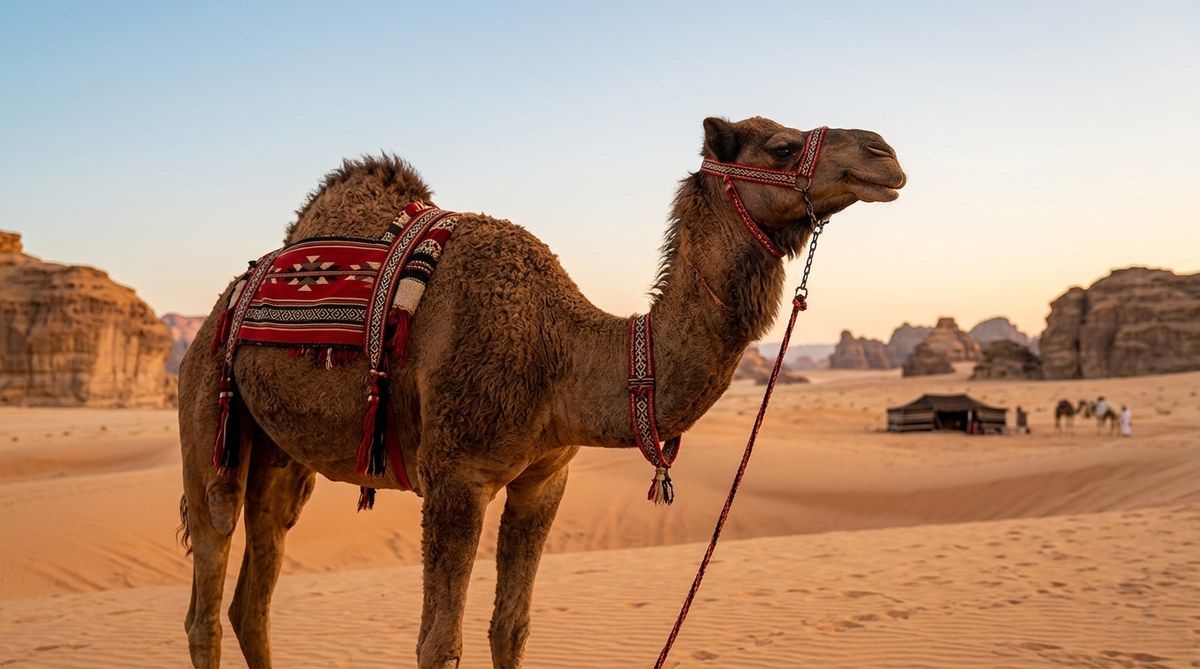
If you glance at a Saudi passport, you will see a line of camels crossing the desert dunes. That image is not just decoration. It tells a story of survival, generosity, and pride that runs through every layer of Saudi life. Camels have carried people, goods, and entire civilizations across the Arabian Peninsula for thousands of years. Today they remain one of the most powerful symbols of Saudi culture, connecting modern Saudis to their Bedouin roots and to the harsh yet beautiful land they call home.
The camel in Saudi culture represents far more than a mode of transport. It is a symbol of resilience, hospitality, wealth, and spiritual reflection. From ancient poetry to modern festivals, the camel remains a living bridge between Saudi Arabia’s past and its ambitious future, and understanding this symbolism unlocks a deeper appreciation of the Kingdom’s heritage.
## The Camel as a Lifeline in the Desert
Long before oil was discovered, the camel was the engine of Arabian life. Bedouin tribes depended on camels for everything. Their milk was a staple food, their hair was woven into tents and clothing, their dung was burned as fuel, and their meat was reserved for special occasions. Most importantly, camels could travel for days without water, carrying heavy loads across sand that would swallow any other animal.
This practical dependence gave rise to a deep bond. A Bedouin knew each camel by name and could read its mood from the angle of its neck or the twitch of its ear. Camels were not tools; they were partners in survival. When a tribe moved to find pasture, the camel carried not just belongings but also the tribe’s identity. The phrase “ship of the desert” was not a romantic invention. It described a literal lifeline.
Over centuries, this reliance transformed into reverence. The camel became the standard of wealth. A man’s status was measured in camels. Giving a camel as a gift was the highest form of honor. The animal’s ability to thrive in extreme conditions made it a symbol of endurance, patience, and loyalty. Even today, when a Saudi family hosts a guest, the offering of camel milk or meat carries that same ancient weight of generosity.
## Symbols of Wealth, Status, and Generosity
In traditional Saudi society, camels were the primary form of currency and status. A man’s herd size reflected his tribe’s power and his own success. A bride’s dowry often included camels. A peace agreement between warring tribes was sealed with the exchange of prized camels. The animal became a living bank account, walking on four legs.
This economic role shaped the Arabic language. The word for “wealth” (mal) and “camel” (ibil) were often used interchangeably in classical Arabic. Ancient poets compared a beautiful woman’s neck to that of a camel. The most generous leaders gave camels to poets, warriors, and visiting dignitaries. This tradition continues today: Saudi kings and princes regularly gift camels to tribal leaders and foreign guests as a mark of respect.
> “The camel is the most generous gift a Saudi can give. It says, ‘I value you enough to part with my greatest treasure.'” Dr. Hind Al-Mutairi, King Saud University
The camel also symbolizes the virtue of hospitality. In Bedouin culture, a host would slaughter a camel to feed unexpected guests. This act of sacrifice was the ultimate expression of generosity. The guest’s honor was directly linked to the size of the animal offered. A camel feast meant the visitor was truly welcomed.
### Camels in Saudi Poetry and Language
Arabic poetry is filled with references to camels. The pre-Islamic poet Al-Mutanabbi compared his own endurance to that of a she-camel crossing the desert. The word “naqa” (she-camel) appears in hundreds of classical odes. Poets used camel imagery to describe strength, loyalty, and beauty.
Linguistically, Arabic has over 10,000 words related to camels. There are separate terms for camels of different ages, colors, temperaments, and uses. A “dhalul” is a riding camel. A “bahim” is a black camel. A “wud” is a camel that gives abundant milk. This richness shows just how deeply the animal was embedded in everyday life. Learning a few of these words can open a window into the Saudi worldview.
## Camels in Religion and Spirituality
The camel holds a special place in Islam, which is the foundation of Saudi culture. The Quran directly invites believers to reflect on the camel as a sign of God’s creation.
### The Camel in the Quran
Surah Al-Ghashiyah (88:17) says: “Do they not look at the camels, how they are created?” This verse calls people to observe the camel’s design as proof of divine wisdom. The camel’s ability to store water, its padded feet that walk on sand, its long eyelashes that protect against storms — all these features are seen as signs of a Creator.
The Prophet Muhammad himself owned a famous she-camel named Al-Qaswa. She carried him during his migration from Mecca to Medina, a journey that marks the beginning of the Islamic calendar. When Al-Qaswa stopped at a certain spot in Medina, the Prophet declared that land would be the site of his mosque. That mosque, Al-Masjid an-Nabawi, is one of the holiest sites in Islam. The camel’s choice was considered divinely guided.
In Islamic tradition, the she-camel of the Prophet Salih (peace be upon him) is another key story. She was a miracle sent to the people of Thamud. Her mistreatment led to their destruction. This story reinforces the camel’s status as a sacred creature not to be harmed.
## Modern Camel Culture in Saudi Arabia
Camels remain central to Saudi identity even as the country modernizes. The government has declared 2024 the “Year of the Camel” to honor this heritage. Festivals, museums, and competitions celebrate the animal across the Kingdom.
### The King Abdulaziz Camel Festival
Every year, thousands of camel owners gather in the desert near Riyadh for the King Abdulaziz Camel Festival. This is not just a beauty pageant. Camels are judged on their purity of lineage, the shape of their humps, the length of their necks, and the color of their coats. Prize money can reach millions of Saudi riyals. Winners earn massive prestige for their tribes.
The festival also features camel races, poetry competitions, and traditional markets. It is a living museum of Bedouin culture. For travelers, attending this festival offers an authentic glimpse into Saudi life. It is one of the best times to see camel symbolism in action.
If you plan to visit, you can check our [guide to Saudi Arabia’s domestic flights](https://sauditourguide.co/the-complete-guide-to-saudi-arabia-s-domestic-flights-routes-airlines-and-booking-hacks/) to reach Riyadh easily.
### The Camel Club and Year of the Camel
In 2023, the Saudi government established the International Camel Organization and designated 2024 as the Year of the Camel. This initiative promotes camel research, breeding, and tourism. It also helps preserve the cultural knowledge that risks being lost as younger generations move to cities.
The Camel Club in Riyadh is a dedicated center for camel enthusiasts. It organizes events, publishes research, and supports camel owners. The club’s existence shows that camels are not just a relic of the past. They are a living part of Saudi Arabia’s future under Vision 2030.
For a deeper look at modern Saudi entertainment and culture, see our list of [7 entertainment destinations proving Saudi Arabia is the new fun capital of the Middle East](https://sauditourguide.co/7-entertainment-destinations-proving-saudi-arabia-is-the-new-fun-capital-of-the-middle-east/).
## Practical Ways to Experience Camel Culture as a Traveler
You can connect with camel symbolism during your visit to Saudi Arabia. Here is a simple three-step process to make the most of it.
1. **Visit a camel market or festival.** The biggest camel market is in Al Haraj, near Riyadh. You can walk among hundreds of camels, watch auctions, and talk to owners. The King Abdulaziz Camel Festival is even more immersive. Entry is usually free, but plan ahead because the dates change each year.
2. **Try camel milk and meat.** Many cafes and restaurants in Riyadh and Jeddah serve camel milk lattes. Camel meat burgers are available at some high-end eateries. It is a tasty way to understand why Saudis value these animals. For a complete food journey, read about [traditional Saudi cuisine beyond Kabsa](https://sauditourguide.co/traditional-saudi-cuisine-beyond-kabsa-12-dishes-you-must-try/).
3. **Take a desert safari with camel riding.** Several tour operators offer half-day or full-day trips from Riyadh, Jeddah, and AlUla. Riding a camel across the dunes gives you a fraction of the experience that shaped Saudi identity. It is not luxury, but it is authentic. Pair it with a visit to the [Edge of the World](https://sauditourguide.co/is-hiking-the-edge-of-the-world-worth-the-hype-a-complete-first-timer-s-guide/) for a full day of adventure.
## Common Misconceptions About Camels in Saudi Culture
Let’s clear up some frequent misunderstandings that travelers have.
| Misconception | Reality |
| — | — |
| Camels are only used for transportation. | Camels provide milk, meat, wool, and status. Their role is cultural and economic, not just practical. |
| All camels are the same. | There are dozens of breeds, each prized for different traits like speed, endurance, or milk yield. |
| Camel racing is cruel. | Modern races use robotic jockeys, and welfare standards are high in official events. |
| Camels are stubborn animals. | Camels are intelligent and form strong bonds with owners. They remember kindness and mistreatment equally well. |
| Camel symbolism is fading. | Festivals, the Year of the Camel, and the International Camel Organization prove the tradition is thriving. |
If you are planning a longer trip, consider our [Ultimate 7-Day Itinerary Combining Riyadh, AlUla, and the Edge of the World](https://sauditourguide.co/the-ultimate-7-day-itinerary-combining-riyadh-alula-and-the-edge-of-the-world/) to include camel experiences in your route.
## The Living Symbol of Saudi Identity
The camel is not a museum piece. It walks through modern Saudi Arabia in ways both visible and invisible. You see it in the passport design, in the logo of the Saudi Arabian Airlines, in the bronze statues that decorate public squares. You hear it in poetry that still echoes in classrooms. You taste it in a cup of camel milk served at a hotel breakfast.
Understanding what the camel symbolizes in Saudi culture helps you connect with the country on a deeper level. It explains the warmth of Saudi hospitality, the pride in Bedouin roots, and the careful balance between tradition and progress. The next time you see a camel in Saudi Arabia, stop for a moment. Watch how it moves. Think about the thousands of years it has carried this land on its back. That moment of reflection is itself a small journey into the heart of Saudi identity.
And if you want to bring that journey home, consider visiting one of the [8 ultra-modern museums and cultural centers that showcase Saudi Arabia’s artistic renaissance](https://sauditourguide.co/8-ultra-modern-museums-and-cultural-centers-that-showcase-saudi-arabia-s-artistic-renaissance/) to see camel imagery in contemporary art.
Happy travels!