
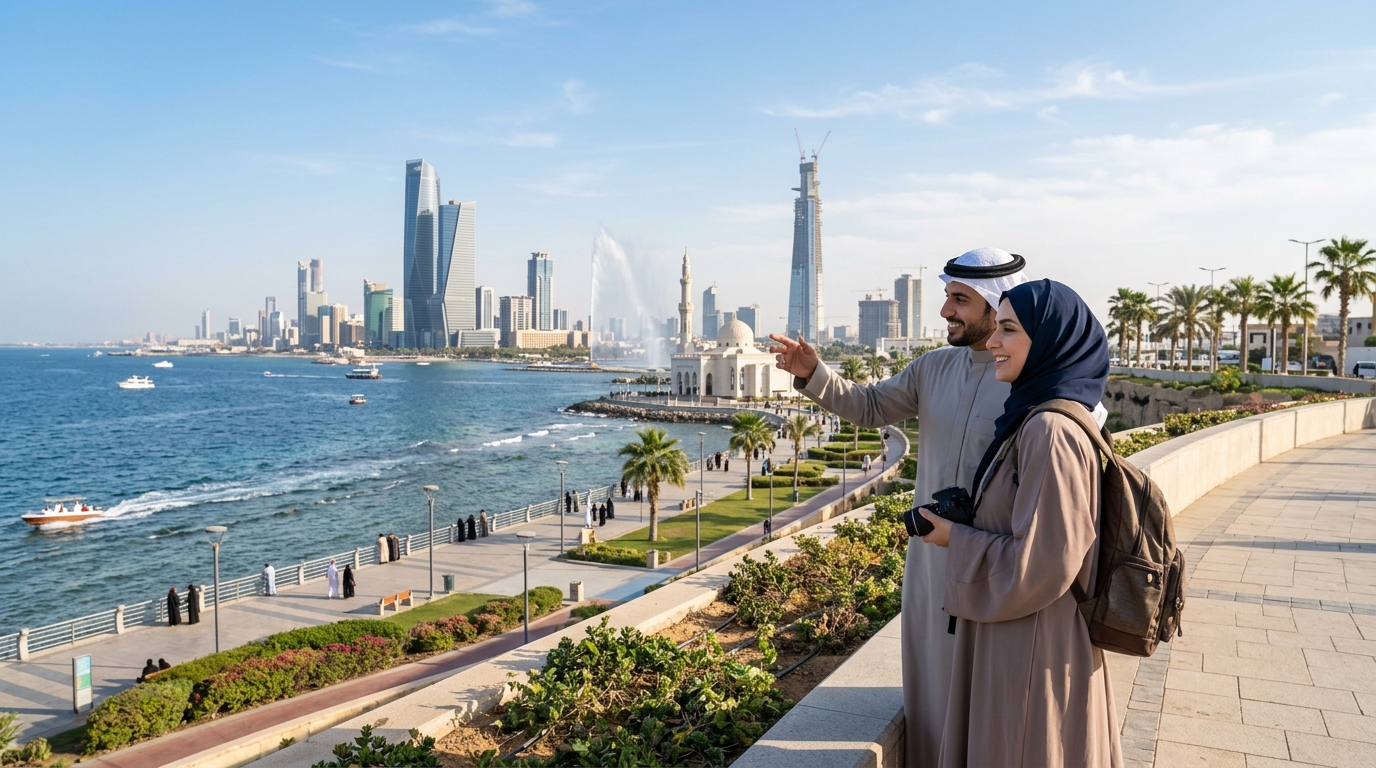
You’ve just completed Umrah, and your heart feels full. But your flight home isn’t for a few more days. Jeddah sits right there, waiting to be experienced. The question is whether it’s worth staying, and what you should actually do with that extra time.
Jeddah offers pilgrims a rewarding extension after Umrah, blending Islamic heritage sites like Al-Balad’s historic mosques with modern attractions along the Red Sea Corniche. Most visitors need two to three days to experience the city’s cultural landmarks, local cuisine, and waterfront activities. The city provides modest accommodations, halal dining, and respectful environments that align with pilgrim values while showcasing Saudi Arabia’s evolving tourism landscape.
Why Jeddah Makes Sense for Post-Umrah Travel
Jeddah isn’t just a transit hub. It’s Saudi Arabia’s second-largest city and the historic gateway for pilgrims arriving by sea.
The city has a distinct character. Unlike Makkah’s spiritual focus or Riyadh’s administrative formality, Jeddah feels more relaxed and coastal. You’ll find families strolling along the waterfront at sunset, art installations dotting public spaces, and a food scene that reflects centuries of trade connections.
For pilgrims, the transition feels natural. You’re already in Saudi Arabia. Your visa covers tourism. The infrastructure caters to Muslim travelers. And the city offers experiences that complement rather than compete with your spiritual journey.
Many pilgrims report that spending time in Jeddah helps them decompress before returning to daily life. It creates a bridge between the intensity of Umrah and the routine waiting at home.
Historic Al-Balad and Its Living Heritage
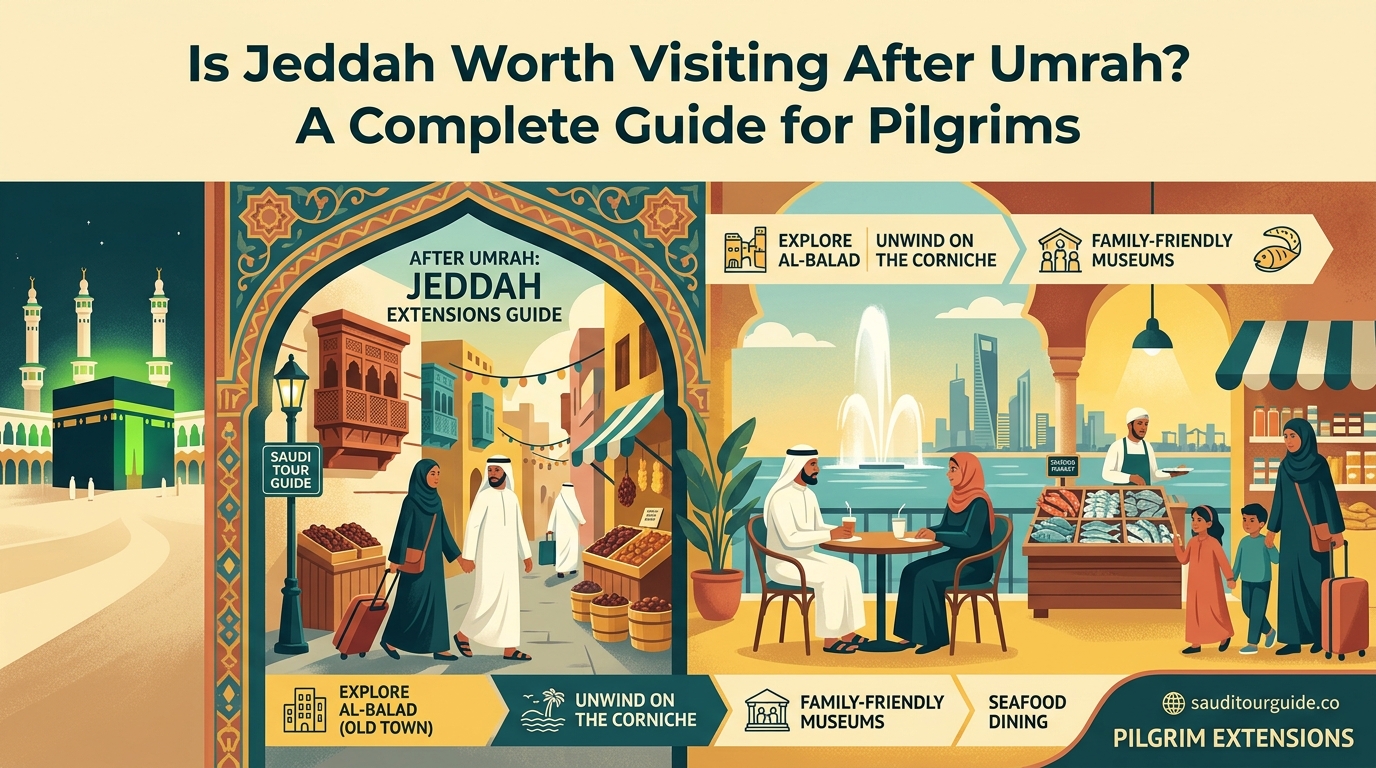
Al-Balad is Jeddah’s old town, a UNESCO World Heritage site that dates back to the 7th century.
The district’s coral stone buildings rise four or five stories high, their wooden balconies (rawasheen) jutting over narrow alleyways. These latticed windows allowed women to see the street while maintaining privacy, a design solution that’s both practical and beautiful.
Walking through Al-Balad feels like stepping into another era. The buildings lean slightly, their plaster cracked in places, but restoration efforts have been ongoing. You’ll find small museums, traditional coffee shops, and artisan workshops tucked into ground-floor spaces.
Key Sites in Al-Balad
Start at Beit Nassif, a seven-story merchant house turned museum. The building showcases traditional Hijazi architecture and hosts cultural exhibitions. Entry is free, and the rooftop offers views across the district.
Makkah Gate is one of the few remaining city gates. It once marked the entrance for pilgrims traveling from the port to Makkah. The gate has been restored and lit at night, making it a popular photo spot.
Souq Al-Alawi runs through the heart of Al-Balad. The market sells everything from spices and dates to traditional clothing and incense. Prices are negotiable, and vendors expect some back-and-forth. The atmosphere is busy but not aggressive.
Several historic mosques dot the district, including Al-Shafei Mosque and Akash Mosque. These remain active places of worship, so visit outside prayer times and dress modestly.
“Al-Balad isn’t a museum. People still live here, work here, pray here. That’s what makes it special. You’re not just observing history; you’re walking through a neighborhood that has served pilgrims for over a thousand years.” — Local heritage guide
Red Sea Corniche and Waterfront Activities
Jeddah’s Corniche stretches for miles along the Red Sea, offering a completely different vibe from the old town.
The waterfront is where locals gather in the evenings. Families picnic on the grass. Joggers follow the paved paths. Food trucks sell everything from grilled corn to ice cream.
The Corniche has several distinct sections. The North Corniche tends to be quieter, with fishing spots and smaller beaches. The Central Corniche features the King Fahd Fountain, which shoots water 312 meters into the air (though it’s not always running). The South Corniche has more restaurants and entertainment options.
Beach Access and Water Activities
Several public beaches line the Corniche. Most are free to access, though some private beach clubs charge entry fees in exchange for amenities like loungers and showers.
Swimming is possible year-round, though summer temperatures can be intense. The water stays warm, and the beaches are generally clean. Women should wear modest swimwear; full-coverage options are widely available in local shops.
For those interested in Red Sea diving experiences, several dive centers operate out of Jeddah. The nearby reefs host colorful coral formations and diverse marine life. Day trips typically include equipment, instruction, and lunch.
Sunset boat tours leave from the Corniche Marina. These usually last 90 minutes to two hours and provide views of the city skyline from the water. Some tours include dinner or refreshments.
Museums and Cultural Centers Worth Your Time
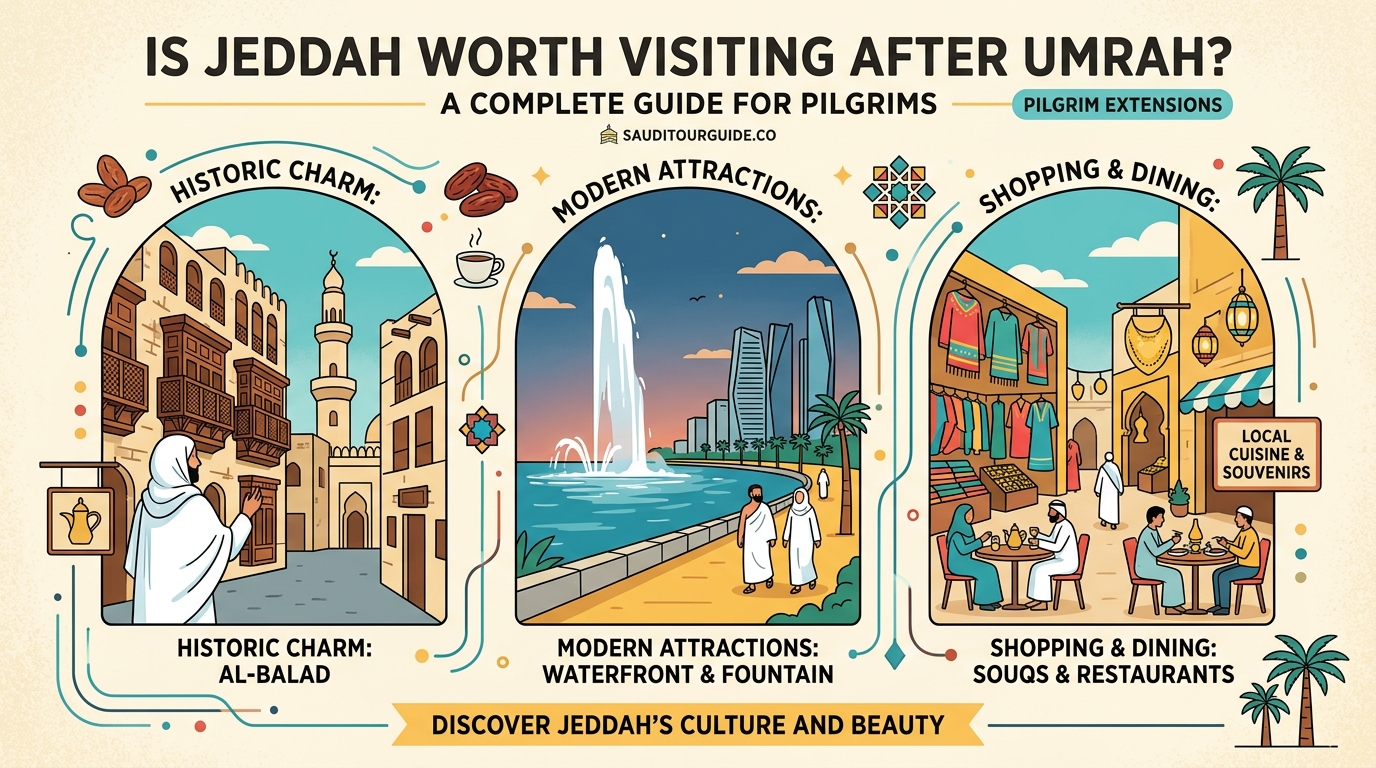
Jeddah has invested heavily in cultural infrastructure over the past decade.
Tayebat Museum sits in a replica of a traditional Hijazi house. The collection spans Islamic art, manuscripts, pre-Islamic artifacts, and ethnographic displays showing traditional life in the region. The museum is large, so plan for at least two hours.
The National Museum of Saudi Arabia has a branch in Jeddah focusing on maritime history and the city’s role in trade routes. Exhibits cover shipbuilding, pearl diving, and the evolution of the port.
Athr Gallery showcases contemporary Saudi art. The space hosts rotating exhibitions featuring both established and emerging artists. Entry is free, and the gallery often has English-speaking staff who can provide context.
For those interested in understanding Saudi culture beyond the pilgrimage context, these spaces offer valuable perspective. They show a society grappling with modernization while maintaining connections to tradition.
Food Experiences That Tell Jeddah’s Story
Jeddah’s food scene reflects its position as a historic port city.
You’ll find influences from Yemen, Egypt, India, and beyond. The local specialty is “Saleeg,” a creamy rice dish usually served with chicken. It’s comfort food, simple but satisfying.
Street food is everywhere. Shawarma stands operate on nearly every corner. Falafel shops draw crowds throughout the day. For breakfast, try “ful medames” (stewed fava beans) with fresh bread and pickles.
Where to Eat in Jeddah
Al-Baik is a local fast-food chain that has achieved cult status. The fried chicken is genuinely good, and prices are extremely low. Expect lines, especially in the evenings.
For traditional Saudi cuisine, Najd Village offers a more formal setting with dishes from across the kingdom. The restaurant’s decor mimics a traditional Najdi house, and staff wear traditional dress.
Albaik aside, the Red Sea Mall and Mall of Arabia food courts provide dozens of halal dining options, from international chains to local concepts.
Saudi coffee traditions are worth experiencing properly. Traditional coffee shops serve “qahwa” (Arabic coffee) with dates. The coffee is lighter and more aromatic than Turkish or espresso styles, often flavored with cardamom.
Planning Your Days in Jeddah
Most pilgrims find that two to three days in Jeddah provides enough time to see the main attractions without feeling rushed.
Here’s a practical framework:
- Dedicate one morning to Al-Balad. Start early before the heat builds. Spend three to four hours walking the district, visiting museums, and browsing the souq.
- Reserve one afternoon and evening for the Corniche. Visit during the golden hour before sunset, then stay for dinner at one of the waterfront restaurants.
- Use remaining time for museums, shopping, or day trips to nearby sites like the Floating Mosque or Jeddah Sculpture Park.
Practical Logistics
Getting around Jeddah requires either taxis or ride-hailing apps. Uber and Careem both operate in the city. Public transportation is limited, though a metro system is under construction.
Most attractions are spread out, so plan your days geographically to minimize travel time. Group Al-Balad with the Central Corniche, as they’re relatively close. Museums and malls tend to be further north or east.
Friday is the main prayer day, and many businesses close or operate on reduced hours. Plan accordingly, perhaps using Friday for outdoor activities or beach time.
If you’re considering extending your stay beyond Jeddah, check whether your visa allows it. Tourist visas typically permit travel throughout Saudi Arabia, but Umrah visas have restrictions. The visa extension process is straightforward if you need more time.
Dress Code and Cultural Considerations
Saudi Arabia has relaxed some social restrictions in recent years, but certain expectations remain.
Women are no longer required to wear abayas, but modest clothing is still expected. This means covering shoulders, arms to at least the elbow, and legs to the ankle. Loose-fitting clothes work better in the heat anyway.
Men should avoid shorts in most settings, though they’re acceptable at beaches and resorts. Tank tops and sleeveless shirts are generally inappropriate outside beach areas.
For detailed guidance on appropriate attire throughout your trip, refer to what to wear in Saudi Arabia.
Prayer times are observed throughout the city. Shops and restaurants close for 20 to 30 minutes during each prayer call. Plan your schedule around these breaks rather than fighting against them.
Photography is generally fine in public spaces, but always ask permission before photographing people, especially women. Some government buildings and military sites prohibit photography.
Shopping Beyond the Souq
Jeddah has embraced mall culture enthusiastically.
Red Sea Mall is one of the largest, with hundreds of stores ranging from international brands to local boutiques. The mall includes a large supermarket, making it a good stop for snacks or supplies.
Mall of Arabia focuses more on entertainment, with a large food court, cinema, and family entertainment center. The mall’s architecture incorporates traditional design elements, making it more interesting than typical shopping centers.
For those interested in luxury shopping in Jeddah, the Stars Avenue mall caters to high-end tastes with boutiques from European and American luxury brands.
Gold souqs operate in several districts. Gold is sold by weight, with minimal markup for craftsmanship on simpler pieces. Prices are competitive, and the quality is generally good. Just ensure you’re buying from established shops rather than street vendors.
Day Trips from Jeddah
If you have extra time, several sites lie within a few hours of the city.
Taif sits in the mountains about two hours east. The city offers cooler temperatures, rose farms, and historic sites. The drive itself is scenic, climbing from sea level to over 1,700 meters.
The Farasan Islands are accessible by ferry from Jizan, which is about six hours south of Jeddah. The islands offer pristine beaches and excellent snorkeling. This is better suited for travelers with four or more days.
For those interested in Saudi Arabia’s diverse landscapes, the Asir region offers mountain scenery and traditional villages, though it requires more extensive planning.
Closer to Jeddah, the Floating Mosque (Al Rahma Mosque) appears to sit directly on the Red Sea during high tide. The mosque is beautiful and photogenic, especially at sunset. It’s about 30 minutes from central Jeddah.
Cost Considerations for Extended Stays
Jeddah can accommodate various budgets.
Budget hotels near Al-Balad start around 150 to 200 SAR per night (roughly 40 to 55 USD). These are basic but clean, often catering to pilgrims and budget travelers.
Mid-range hotels along the Corniche run 300 to 500 SAR per night. These typically include breakfast and have better amenities like pools and fitness centers.
Luxury options exist near the waterfront and in business districts, ranging from 800 to 2,000 SAR per night.
Food costs are reasonable. Street food meals cost 15 to 30 SAR. Restaurant meals run 40 to 80 SAR per person. Groceries are affordable if you’re staying somewhere with kitchen access.
Transportation via ride-hailing apps is inexpensive. Most trips within the city cost 15 to 40 SAR.
For a detailed breakdown of expenses across different travel styles, check how much a week in Saudi Arabia costs.
Common Mistakes to Avoid
| Mistake | Why It Matters | Better Approach |
|---|---|---|
| Visiting Al-Balad in afternoon heat | Temperatures exceed 40°C in summer; walking becomes miserable | Go early morning (7-10 AM) or late afternoon (4-6 PM) |
| Not checking prayer times | Shops close suddenly; you waste time waiting | Download a prayer time app; plan around closures |
| Overdressing for the weather | Jeddah is hot and humid; heavy clothing causes discomfort | Choose lightweight, breathable modest clothing |
| Skipping water | Dehydration happens fast in the heat | Carry water always; drink before you feel thirsty |
| Assuming everything is walkable | Distances are deceptive; walking in heat is exhausting | Use ride-hailing apps; budget for transportation |
When Jeddah Might Not Be Worth It
Honesty matters. Jeddah isn’t for everyone.
If you’re exhausted from Umrah and just want to go home, that’s completely valid. There’s no obligation to extend your trip. Rest and recovery have value.
If you have limited time and want to see more of Saudi Arabia, other destinations might offer more distinct experiences. The hidden gems throughout the country provide alternatives worth considering.
If you’re traveling with elderly family members or young children, the heat and walking requirements in Jeddah can be challenging. The city isn’t particularly stroller-friendly in historic areas.
If you’re on an extremely tight budget, the costs of accommodation and activities might not justify the extension. Sometimes it makes more financial sense to return home and save for a dedicated tourism trip later.
Making the Most of Your Extended Journey
The decision to stay in Jeddah after Umrah should align with your energy levels, interests, and resources.
For many pilgrims, the city offers a gentle reentry to secular life. You’re still in a Muslim-majority country where prayer calls structure the day and halal food is everywhere. But you’re also engaging with art, history, and leisure activities that differ from the pilgrimage experience.
The key is managing expectations. Jeddah isn’t going to provide the spiritual intensity of Makkah and Madinah. It’s not trying to. Instead, it offers a chance to see another facet of Saudi Arabia, one that’s rapidly evolving while maintaining connections to its past.
If you decide to stay, approach it with the same openness you brought to Umrah. Talk to locals. Try unfamiliar foods. Walk through neighborhoods without a specific agenda. Some of the best experiences come from unplanned moments.
And if you decide to skip Jeddah this time, that’s fine too. Saudi Arabia isn’t going anywhere. The country is investing billions in tourism infrastructure. Future trips will offer even more options. Perhaps you’ll return when you can plan a longer itinerary that includes multiple cities.
Your Journey Continues Beyond the Haram
Completing Umrah is an achievement worth celebrating. How you choose to transition back to regular life is personal.
For some pilgrims, extending the trip to see Jeddah adds richness to the journey. You return home with stories beyond the spiritual experience, with a broader understanding of Saudi Arabia and its people.
For others, heading straight home preserves the purity of the pilgrimage. Both choices are valid.
What matters is making the decision consciously, based on your own needs and circumstances rather than pressure or assumptions. Jeddah will welcome you if you stay. Your home will welcome you if you return. The choice is yours to make.