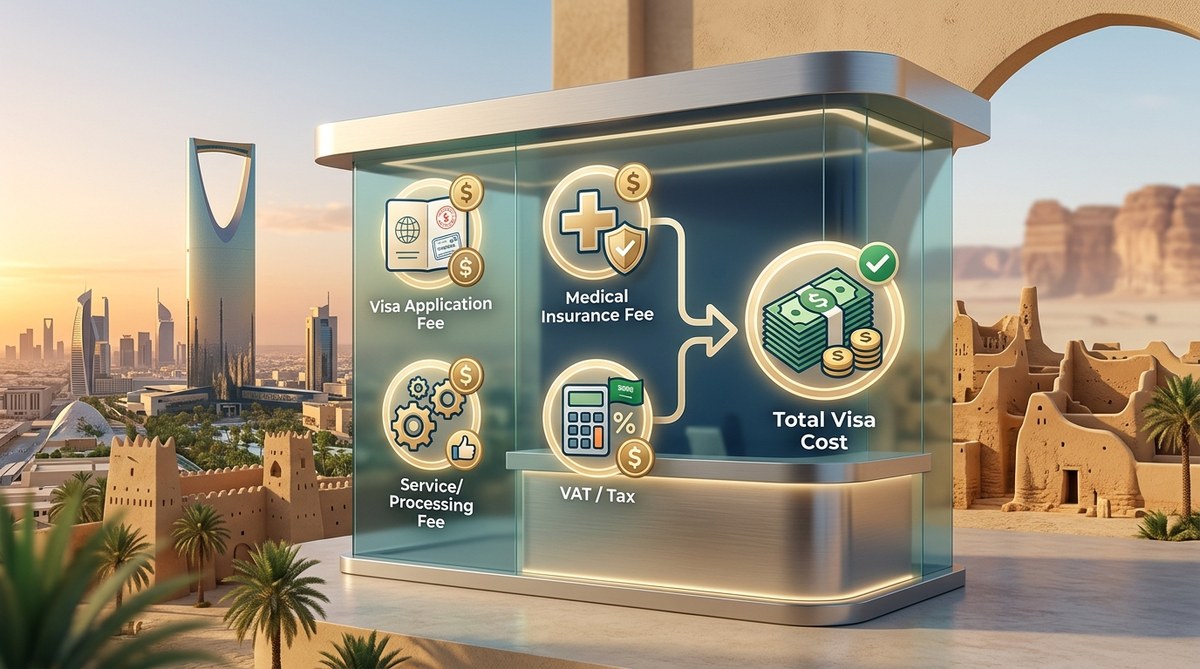
Planning a trip to Saudi Arabia in 2026 means dealing with one big question upfront: how much does the visa actually cost? The answer is more straightforward than you might think, but there are a few surprises that can catch travelers off guard. Whether you are visiting Riyadh for business, heading to Jeddah for a weekend in Al-Balad, or making your way to Makkah for Umrah, knowing the exact fees before you apply saves you time, stress, and money. The Kingdom has made huge strides in simplifying its visa system over the last few years, and 2026 is no different. Let me walk you through every fee, every category, and every hidden charge so you can budget with confidence.

<div style="border:1px solid #c8b88a; background:#fbf7ea; padding:20px; border-radius:14px; margin-bottom:30px;">
  <div style="font-weight:700; margin-bottom:10px; color:#856404;">Key Takeaway</div>
  <p style="margin:0;">In 2026, a standard Saudi tourist e-visa costs SAR 535 (around $143 USD) including mandatory health insurance and processing. Visa on arrival at the airport costs the same. Business visas, Umrah visas, and transit visas each have different price tags. Always apply through the official Saudi portal or at authorized visa offices to avoid scams and extra charges. Budget an additional $20 to $50 for incidentals like photo services, expedited processing, or agency fees.</p>
</div>

## Breaking Down the Fees for 2026

The Saudi visa system has several categories, and each one comes with a different price. The good news is that the tourist e-visa covers almost all leisure travel needs. It also doubles for short business visits and even allows you to perform Umrah outside of the Hajj season. Let me show you exactly what each visa type costs this year.

| Visa Type | Fee (SAR) | Fee (Approx. USD) | Includes Health Insurance? | Validity |
|------|------|------|------|------|
| Tourist e-Visa (single/multiple entry) | 535 | $143 | Yes | 1 year, up to 90 days stay |
| Tourist Visa on Arrival | 535 | $143 | Yes | Same as e-Visa |
| Business Visa (single entry) | 500 | $133 | No | 90 days |
| Umrah Visa (during non-Hajj season) | 300 | $80 | Yes | 30 days |
| Transit / Stopover Visa | 300 | $80 | No | 96 hours |
| Family Visit Visa | 300 | $80 | Optional | 90 days |

The table above covers the main categories most travelers use. If you are flying in as a tourist, the SAR 535 fee is your number. That one price includes everything: the visa itself, biometric processing, and a mandatory health insurance policy that covers you during your stay. No hidden add-ons at the counter.

## Step-by-Step Application Process

Getting your Saudi visa in 2026 is a digital process for most nationalities. Here is how to do it without paying a cent more than you need to.

1. Go to the official Saudi Visa portal (KSA Visa) or use the "Visit Saudi" mobile app. Both are run by the Ministry of Foreign Affairs.
2. Select your nationality and travel purpose. The system will show you exactly which visa type applies to you.
3. Fill out the online form with your passport details, travel dates, and accommodation information. Double-check every field before you submit.
4. Upload a digital passport photo that meets the strict Saudi photo guidelines. Many rejections happen because of poorly lit or incorrectly sized photos.
5. Pay the visa fee plus the mandatory health insurance premium using a credit card or debit card. The total for a tourist visa is SAR 535.
6. Receive your e-Visa by email within minutes in most cases. Some nationalities may face a 24 to 72 hour processing window.
7. Print a copy of the e-Visa and keep a digital version on your phone. You will need to show it at the airline check-in counter and upon arrival in Saudi Arabia.

For a more detailed walkthrough of each screen and field, check out my guide on [how to apply for your Saudi Arabia e-visa in under 10 minutes](https://sauditourguide.co/how-to-apply-for-your-saudi-arabia-e-visa-in-under-10-minutes/). It covers the exact steps with screenshots.

## What the Fee Actually Covers

A lot of first-time visitors assume the visa fee is just an entry stamp. In Saudi Arabia, that SAR 535 includes several components that make it good value.

- **Visa issuance fee:** This is the government charge for processing your application and issuing the electronic permit.
- **Biometric enrollment fee:** Covers the digital fingerprint and photo capture at the airport or at a visa center.
- **Health insurance:** A mandatory medical policy valid for the duration of your stay. It covers emergency care, hospitalization, and even COVID-related treatment if needed.
- **Platform service fee:** A small charge for using the online portal or mobile app.

The health insurance part alone is worth noting. If you booked travel insurance separately, you might be doubling up. Some travelers choose to keep both layers of coverage for extra peace of mind. If that sounds like a good idea, take a look at the [best travel insurance options for Saudi Arabia in 2026](https://sauditourguide.co/best-travel-insurance-options-for-saudi-arabia-in-2026/).

## Who Gets Visa-Free or Visa on Arrival

Not everyone needs to pre-apply. Saudi Arabia has expanded its visa waiver and visa on arrival programs significantly in recent years. Here is a breakdown of who can skip the e-Visa application.

- Citizens of the United States, United Kingdom, and Schengen Area countries can get a visa on arrival at any international airport. The fee is the same SAR 535.
- Holders of valid US, UK, or Schengen visitor visas (used at least once) are also eligible for visa on arrival in many cases.
- Nationals of GCC countries (Bahrain, Kuwait, Oman, Qatar, UAE) enter Saudi Arabia without a visa.
- Citizens of 49 countries can apply for the e-Visa online without visiting an embassy. This includes Australia, Canada, Japan, South Korea, Malaysia, Singapore, and most European nations.

If your country is not on the eligible list, you will need to apply for a visa through a Saudi embassy or consulate in your home country. That process takes longer and the fees may vary slightly depending on local service charges.

For the full country list and any last-minute changes in 2026, read the detailed breakdown on [Saudi Arabia visa-free entry: which 49 countries qualify for visa on arrival](https://sauditourguide.co/saudi-arabia-visa-free-entry-which-49-countries-qualify-for-visa-on-arrival/).

## Hidden Costs to Watch For

The official fee is SAR 535, but there are a few extra expenses that can creep into your budget. Knowing them upfront helps you avoid surprises.

**Agency and service fees.** If you apply through a third-party visa agency instead of the official portal, you may pay $20 to $50 extra for their handling. Some travelers prefer this if they feel unsure about the online process. Just make sure the agency is reputable and registered with the Saudi Ministry of Tourism.

**Photo services.** Your passport photo must meet specific Saudi requirements: white background, no shadows, ears visible, and a specific aspect ratio. If your existing photo does not work, a local photo shop or an airport kiosk may charge $5 to $15 for a new one.

**Expedited processing.** Most e-Visas come through within minutes. But if you need a visa faster than the standard time and you are applying at an embassy, rush processing can cost $30 to $60 extra.

**Printing and copying.** You will need a printed copy of your e-Visa and possibly a copy of your passport photo. Airport printing stations often charge $2 to $5 per page.

**Travel insurance top-up.** The mandatory insurance that comes with the visa is basic. If you want coverage for trip cancellation, lost luggage, or high-end medical evacuation, you will need to buy a separate policy.

> **Expert advice from a frequent Saudi traveler:** Always carry a physical copy of your e-Visa and your passport. I have seen travelers held up at immigration because their phone battery died. Also, keep a screenshot of your visa PDF in your email inbox so you can access it from any device. The SAR 535 fee is non-refundable even if you decide not to travel, so only apply when your plans are solid.

## Common Mistakes That Cost You More

Even experienced travelers make errors that lead to extra charges or rejected applications. Here are the most frequent ones I see.

| Mistake | Why It Happens | How It Costs You |
|------|------|------|
| Applying with less than 6 months passport validity | Saudi rules require 6 months of validity from your entry date | Application rejected; fee lost |
| Uploading a low-quality or incorrect photo | Photo fails the biometric standards | Delay or rejection; new photo fees |
| Choosing the wrong visa type | Selecting tourist visa when you need business visa | Forced to reapply and pay again |
| Booking flights before visa approval | Assumes approval is guaranteed | Non-refundable flight costs if visa is denied |
| Ignoring the health insurance requirement | Not realizing it is mandatory in the fee | Application cannot be processed |

Avoiding these pitfalls starts with reading the official requirements before you fill out any form. I cover the full list of entry rules in my guide on [what documents do you actually need at Saudi immigration](https://sauditourguide.co/what-documents-do-you-actually-need-at-saudi-immigration-a-checkpoint-guide/). It helps you prepare for the checkpoint before you even book your ticket.

For those who are still worried about making a mistake, the article on [5 visa mistakes that could get you denied entry to Saudi Arabia](https://sauditourguide.co/5-visa-mistakes-that-could-get-you-denied-entry-to-saudi-arabia/) goes deeper into each error and how to fix it.

## How Long Your Visa Lasts and What It Allows

The standard tourist e-Visa in 2026 is valid for one year from the date of issuance. It grants multiple entries, and each stay can last up to 90 days. That means you can leave the country and come back as many times as you want within that year, as long as you do not exceed 90 days total per visit.

This flexibility is a game changer for travelers who want to [plan the perfect road trip along Saudi Arabia's Red Sea coast](https://sauditourguide.co/how-to-plan-the-perfect-road-trip-along-saudi-arabia-s-red-sea-coast/) or combine multiple regions in one trip. You could fly into Jeddah, drive to AlUla, cross over to Riyadh, and then fly home from Dammam. All on the same visa.

If you need more than 90 days in one stretch, you may be able to extend your stay. The rules around extensions changed in 2025, and 2026 has brought even more clarity. For current details, check the guide on [how long can you actually stay in Saudi Arabia on a tourist visa](https://sauditourguide.co/how-long-can-you-actually-stay-in-saudi-arabia-on-a-tourist-visa/).

Business travelers should note that the tourist visa does allow you to attend meetings, conferences, and networking events. You cannot take up employment or work for a Saudi employer on a tourist visa. If your trip involves paid work, you need a proper business visa or a work visa.

## US Citizens Need to Know This

For American travelers, the process is especially smooth in 2026. US citizens can get a Saudi e-Visa online in minutes or simply purchase a visa on arrival at any Saudi airport. The fee is the same SAR 535, about $143 USD at current exchange rates. You do not need to visit an embassy or mail your passport anywhere.

One important detail: your passport must be valid for at least six months from your date of arrival in Saudi Arabia. This is a strict rule and there are no exceptions. If your passport expires in less than six months, renew it before you apply.

For a complete walkthrough written specifically for US passport holders, see the dedicated guide on [Saudi Arabia visa for US citizens: requirements, fees, and processing times in 2026](https://sauditourguide.co/saudi-arabia-visa-for-us-citizens-requirements-fees-and-processing-times-in-2026/).

## What About Umrah and Pilgrim Visas

If you are traveling to Saudi Arabia specifically for Umrah, your visa options have expanded. The tourist e-Visa now permits Umrah during all months except the Hajj season. This means you can buy the standard SAR 535 tourist visa, perform Umrah, and then spend the rest of your trip exploring the country.

If you prefer a dedicated Umrah visa, those cost around SAR 300 ($80 USD) and are valid for 30 days. They do not allow travel outside the Makkah and Madinah areas. Many pilgrims find the tourist visa more flexible because it lets them visit other places like [Jeddah's historic Al-Balad district](https://sauditourguide.co/complete-weekend-guide-to-exploring-jeddah-s-historic-al-balad-district/) or even head to the Asir highlands.

For those who want to extend their pilgrimage into a full vacation, my guide on [budget-friendly ways to extend your pilgrimage and explore Saudi Arabia](https://sauditourguide.co/budget-friendly-ways-to-extend-your-pilgrimage-and-explore-saudi-arabia/) offers practical tips and sample itineraries.

## When to Apply and How to Save

Timing your visa application can save you money and stress. Here are a few pointers.

**Apply at least two weeks before travel.** Even though e-Visas often come through in minutes, national holidays and system upgrades can cause delays. Giving yourself a buffer avoids last-minute panic.

**Avoid third-party agencies unless necessary.** The official portal is simple to use and charges the exact government fee. Agencies add $20 to $50 for basic services you can do yourself.

**Check if your country qualifies for visa on arrival.** If you can get your visa at the airport, you save the effort of applying online. The cost is the same, but you pay when you land.

**Use the same visa for multiple trips.** Since the tourist e-Visa is valid for a full year, plan multiple visits within that window. One fee covers all your entries.

**Book refundable flights until your visa is approved.** This protects you if there is a delay or denial. A refundable ticket costs a little more but saves you from losing hundreds of dollars.

If you are planning a longer stay and want to see beyond the main cities, the [ultimate 7-day itinerary combining Riyadh, AlUla, and the Edge of the World](https://sauditourguide.co/the-ultimate-7-day-itinerary-combining-riyadh-alula-and-the-edge-of-the-world/) shows you exactly how to maximize your time and your visa investment.

## Your Real Total Cost for a Saudi Visit

Beyond the visa fee, you should budget for transportation, accommodation, food, and activities. Here is a realistic estimate for a one-week trip in 2026.

- Visa (tourist e-Visa): SAR 535 ($143)
- Accommodation (mid-range hotel, 7 nights): SAR 2,100 to SAR 3,500 ($560 to $933)
- Meals (mix of local restaurants and cafes): SAR 700 to SAR 1,200 ($187 to $320)
- Local transport (ride-sharing, metro, or rental car): SAR 400 to SAR 800 ($107 to $213)
- Attractions and activities: SAR 300 to SAR 700 ($80 to $187)
- Miscellaneous (snacks, souvenirs, tips): SAR 200 to SAR 500 ($53 to $133)

The total for a comfortable week in Saudi Arabia lands somewhere between $1,130 and $1,930, not including your international flight. The visa itself is a small fraction of that, so do not let the fee be the deciding factor.

## Planning Your Budget Around the Visa Fee

The SAR 535 tourist visa is a fixed cost that applies to almost every leisure traveler in 2026. It includes health insurance, which is a nice bonus that many other countries charge separately for. The e-Visa system is fast, reliable, and easy to use if you follow the official steps. By applying directly through the KSA Visa portal or the Visit Saudi app, you avoid unnecessary fees and put that extra $20 to $50 toward something better: maybe a meal of traditional kabsa in Riyadh or a ticket to see AlUla's ancient tombs at sunrise.

Now that you know exactly what the visa costs, take the next step and start planning your itinerary. The Kingdom is more open and more welcoming than ever, and your visa is the key. Apply early, keep a digital and printed copy with you, and get ready for a trip that will surprise you at every turn.