
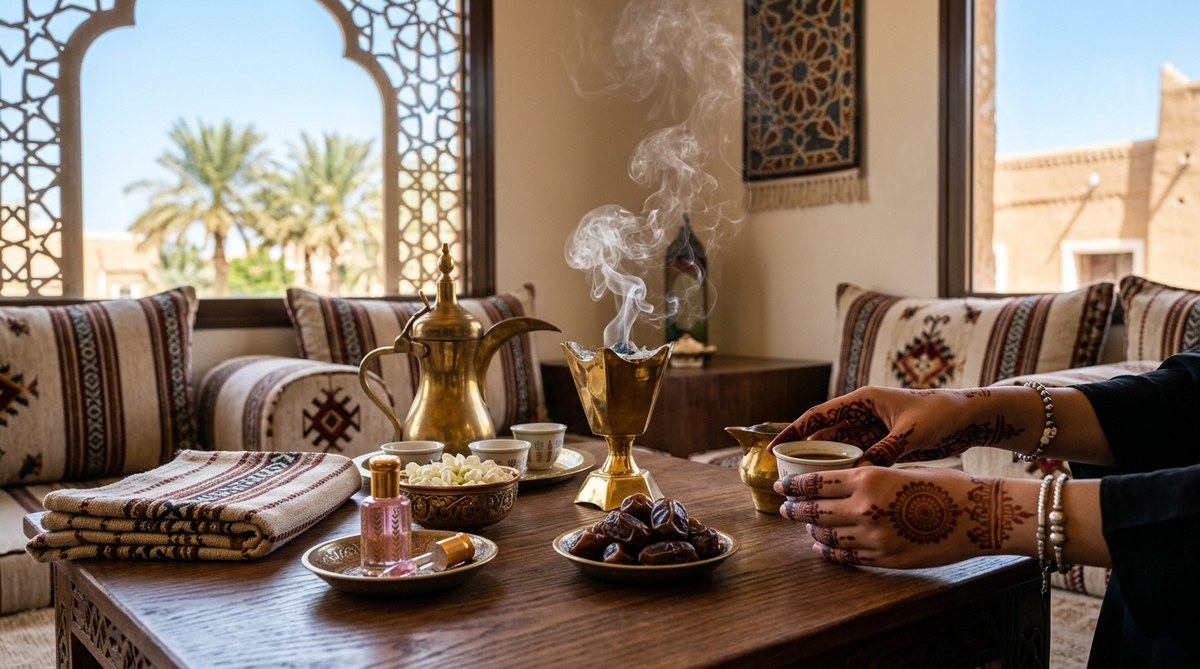
The first time you step into a Saudi home, you might wonder if you have walked into a royal palace. The warmth hits you before you even sit down. A host appears with a smile, a tray of dates, and a small cup of bitter coffee. Within seconds, the air fills with the scent of burning oud wood. This is not a performance. This is a deeply rooted cultural code. In Saudi Arabia, welcoming a guest is not just polite behavior. It is an honor. The tradition goes back centuries, shaped by Bedouin values where a traveler in the desert was offered shelter, food, and protection without a single question. Today, those same values greet you in modern Riyadh apartments, Jeddah villas, and desert camps in AlUla.
Traditional Saudi welcome customs engage all seven senses to make a guest feel valued and respected. The ritual begins with incense and coffee, moves through scent, taste, touch, and sound, and ends with henna and gifts. Understanding these practices helps travelers connect with locals on a deeper level and avoid awkward cultural missteps during their visit.
The Seven Senses of a Saudi Welcome
Saudi hospitality is not a single gesture. It is a sequence of sensory experiences, each one intentional. The goal is to make the guest feel like the most important person in the room. Let us walk through each sense and the custom attached to it.
1. Scent: Oud and Incense
The first thing you notice when entering a Saudi home is the smell. It is not a candle or a plug-in air freshener. It is oud, a fragrant agarwood resin that has been burned in the Arabian Peninsula for centuries. The host walks around the room holding a small burner called a mubkhara, fanning the smoke toward each guest.
You will see guests gently waft the smoke toward their faces. This is not just for show. They are inviting the scent into their clothes and hair as a sign of respect. If someone offers you the incense burner, cup your hands around it to catch the smoke, then bring your hands to your face. This small gesture shows you understand the culture.
“The incense ritual is the first handshake in Saudi culture. It says, ‘You are clean, you are welcome, and you are protected under my roof.'” – Faisal Al Ghamdi, cultural heritage guide in Jeddah
2. Taste: Dates and Arabic Coffee
No Saudi welcome is complete without qahwa and dates. The coffee is light, pale brown, and spiced with cardamom, saffron, and sometimes cloves. It is served in a small handleless cup called a finjan. The host pours with their left hand holding the pot and their right hand supporting the wrist. This is a sign of humility.
Dates are offered alongside the coffee. They provide natural sweetness to balance the bitterness of the qahwa. You will typically be served three dates, but eating one is perfectly fine. The important rule is this: do not refuse the first offer. Even if you do not want coffee, accept the cup and hold it for a moment. Returning it full is considered rude.
The number of cups you drink sends a message. One cup is polite. Two cups is a compliment. Three cups means you are truly enjoying the hospitality. If you are finished, gently tilt the cup from side to side and hand it back. That signals the host to stop pouring.
3. Touch: The Handshake and the Nose Greeting
Handshakes in Saudi Arabia are softer than the firm grip Americans are used to. A limp handshake is not a sign of weakness here. It is a sign of gentleness and respect. Use your right hand only. The left hand is considered unclean in Islamic tradition.
For close friends or family members, you might see the nose-to-nose greeting called mukhadama. This involves touching noses while shaking hands. Do not attempt this unless you are very close with the person or they initiate it. For most travelers, a warm right-handed handshake with a smile is the safest approach.
Men should wait for a woman to extend her hand first. Many Saudi women prefer not to shake hands with men who are not relatives. If she places her hand over her heart instead, that is her way of greeting you. Return the gesture by placing your own hand over your heart.
4. Sight: The Majlis and the Seating Order
The room where guests are received is called the majlis. It is usually a large open space with floor cushions or low sofas lining the walls. The seating arrangement is not random. The most honored guest sits in the center or at the head of the room. The host sits closest to the door so they can attend to everyone’s needs.
Do not sit immediately when you enter. Wait for the host to gesture where you should sit. Shoes are usually removed at the entrance of the majlis, though some homes keep them on in carpeted areas. Watch what the host does and follow their lead.
The majlis is designed for conversation. Phones are set aside. Eye contact is maintained. This is a space where the guest is the center of attention, and distractions are discouraged.
5. Sound: The Call to Hospitality
The sound of a Saudi welcome is not loud. It is the gentle clink of coffee cups, the soft hiss of the incense burner, and the host’s repeated invitations to eat, drink, and relax. You will hear the phrase tafaddal (meaning “please, go ahead”) many times during a visit. The host says it with genuine insistence.
A unique sound you might encounter is the zaghrouta, a high-pitched trilling sound made by women during celebrations. If you are invited to a wedding or a festive gathering, this joyful noise will fill the room when you arrive. It is the highest form of vocal welcome.
6. Taste (Part Two): The Generous Meal
If you are invited to stay for a meal, expect abundance. Saudi hosts consider it shameful if a guest leaves hungry. The table will be covered with dishes: kabsa (spiced rice with meat), jareesh (crushed wheat), mandi (slow-cooked lamb), and fresh salads.
Eating is done with the right hand. Use the thumb and first two fingers to scoop food. Bread is used to pick up meats and dips. Do not eat from the side of the plate that belongs to someone else. Each person has an invisible boundary.
The host will keep offering more food even after you say you are full. This is part of the ritual. If you truly cannot eat another bite, place your hand over your plate or cup and say alhamdulillah (praise be to God) to signal gratitude and fullness. The host will stop insisting.
7. Scent and Touch: Henna and Farewell Gifts
At the end of the visit, the host may offer henna to female guests. The intricate designs are painted on the hands and feet as a blessing. Henna symbolizes joy, good fortune, and protection. If you are offered henna, accept it. Even a small dot on the palm is a meaningful gesture.
Men might receive a small gift like a bottle of oud oil, a prayer bead set, or a scarf. This is not expected, but it is common. Accept the gift with both hands and thank the host warmly. Refusing a gift can cause embarrassment.
The farewell is as important as the welcome. The host will walk you to the door, sometimes all the way to your car. They will wait until you drive away before going back inside. This is a final act of respect, ensuring the guest departs safely.
A Practical Guide to Responding as a Guest
Knowing how to respond to these customs makes you a better guest. Here is a numbered list of steps to follow during a traditional Saudi welcome:
- Enter with your right foot first. It is a sunnah (tradition of the Prophet Muhammad) and considered auspicious.
- Greet everyone in the room with as-salamu alaykum (peace be upon you). Say it to each person individually.
- Accept the coffee and dates when offered. Hold the cup in your right hand.
- Compliment the host. Say masha’Allah (God has willed it) when you see something beautiful in their home.
- Wait for the host to invite you to eat before reaching for food.
- Stay seated until the host stands up. That signals the end of the visit.
- Thank the host three times: once at the table, once at the door, and once in a follow-up message the next day.
Common Mistakes and How to Avoid Them
Even well-meaning guests can slip up. Here are the most frequent mistakes travelers make, and how to handle them correctly.
| Mistake | Why It Happens | The Right Way |
|---|---|---|
| Refusing coffee or dates | Guest thinks they are being polite by declining | Accept the first offer. Hold the cup for a moment even if you do not drink. |
| Using the left hand to eat or hand over a gift | Left hand is used for hygiene tasks | Always use the right hand for eating, shaking hands, and passing objects. |
| Pointing the bottom of your foot at someone | Feet are considered unclean | Sit cross-legged or tuck your feet under you. Never stretch your legs toward anyone. |
| Showing the soles of your shoes | Same logic as feet | Keep shoes pointed away from people when sitting. |
| Leaving immediately after eating | Guest thinks the meal is the end of the visit | Stay for tea or conversation. The host expects you to linger. |
| Asking personal questions about female family members | Privacy is highly valued | Stick to general topics: travel, food, work, or Saudi landmarks. |
How to Prepare for a Saudi Welcome Before You Arrive
If you have a visit planned, take these steps to show you care about the culture.
- Learn a few Arabic phrases. Even a simple shukran (thank you) goes a long way. For a full list, read our guide on 15 Arabic phrases that will transform your Saudi Arabia travel experience.
- Dress modestly. Men should wear long pants and a collared shirt. Women should cover their shoulders, arms, and knees. A headscarf is not required for non-Muslim women, but having one ready shows respect. Check our what to wear in Saudi Arabia guide for full details.
- Bring a small gift. Dates, high-quality chocolate, or a souvenir from your home country are safe choices. Avoid alcohol or anything containing pork.
- Remove your shoes before entering. If you see a pile of shoes at the door, add yours to it.
- Silence your phone. The majlis is a place of connection, not notifications.
How the Welcome Differs Across the Kingdom
Not every region of Saudi Arabia welcomes guests in exactly the same way. Here is a quick breakdown of regional differences.
| Region | Unique Custom | What to Expect |
|---|---|---|
| Najd (Riyadh area) | Extra emphasis on qahwa. The coffee is stronger and served in very small quantities. | You may be served three rounds of coffee minimum. |
| Hejaz (Jeddah, Makkah) | Heavier use of perfumes and incense. The welcome is more elaborate. | Expect multiple types of incense and rose water sprinkled on guests. |
| Eastern Province (Dammam, Khobar) | Influence from Gulf neighbors. Dates are often stuffed with almonds or cream. | The welcome may include chocolate-covered dates. |
| Asir (Abha, Khamis Mushait) | The welcome includes traditional dances like the ardah. | If you are invited to a festival, expect sword dances and drumming. |
| Northern Province (Tabuk, Ha’il) | More reserved but deeply sincere. Hospitality is offered with quiet dignity. | The host may speak less but serve more. |
For a deeper look at one of the most unique regions, read about why the Asir region should be your next Saudi adventure destination.
What to Do If You Are Invited to a Saudi Wedding
Weddings are the ultimate expression of Saudi hospitality. If you receive an invitation, consider it a great honor.
- The event is usually gender-segregated. Men and women celebrate in separate halls.
- Dress formally. Men wear a suit or a traditional thobe. Women wear an elegant gown or an abaya.
- Do not expect to see the bride. The bride’s entrance is often the only moment she is visible.
- Prepare for a late night. Weddings can start after 10 PM and last until dawn.
- Bring a cash gift or a gold coin. It is customary to give money rather than physical gifts.
- Do not take photos without permission. Many Saudi weddings have strict no-phone policies.
If you want to understand more about these ceremonies, our guide on Saudi wedding traditions covers everything from the engagement to the final farewell.
How Saudi Hospitality Connects to the Bigger Picture
The customs you experience in a Saudi home are the same values that shape the country’s tourism industry. When you book a tour, stay at a hotel, or visit a heritage site, you are interacting with a culture that prioritizes the guest above all else. This is why Saudi Arabia is investing heavily in experiences that mirror traditional hospitality, from luxury desert camps to guided tours of the Jeddah historic Al-Balad district.
Understanding the welcome customs gives you more than just good manners. It gives you access. Locals will open doors for you, share stories, and invite you into spaces that most tourists never see. The effort you put into learning these traditions is repaid tenfold in genuine human connection.
Your Next Step: Practice Before You Go
You do not need to wait until you land in Saudi Arabia to start practicing. Find an Arabic coffee shop in your city. Order a cup of qahwa and a few dates. Sit with it. Notice the bitterness, the sweetness, the ritual of the pour. Practice holding the cup in your right hand. Say shukran to the barista.
If you know any Saudi expats in your community, ask them about their family traditions. Most Saudis love talking about their culture and will appreciate your curiosity. You might even get an invitation to a real majlis before your trip.
For more practical travel advice, including how to get your visa sorted, read our guide on how to apply for your Saudi Arabia e-visa in under 10 minutes. And if you are planning a longer trip, check our ultimate 7-day itinerary combining Riyadh, AlUla, and the Edge of the World.
Making the Welcome Last Beyond Your Visit
The best part about learning Saudi welcome customs is that they do not end when you leave the country. The spirit of generosity stays with you. You might find yourself offering coffee to a guest in your own home the Saudi way. You might start your own incense ritual on special occasions. That is the power of this tradition. It transforms how you see hospitality itself.
So go ahead. Book that trip. Knock on that door. Accept that cup of qahwa. And when the incense smoke curls toward you, lean in. Breathe deep. You are welcome here.