
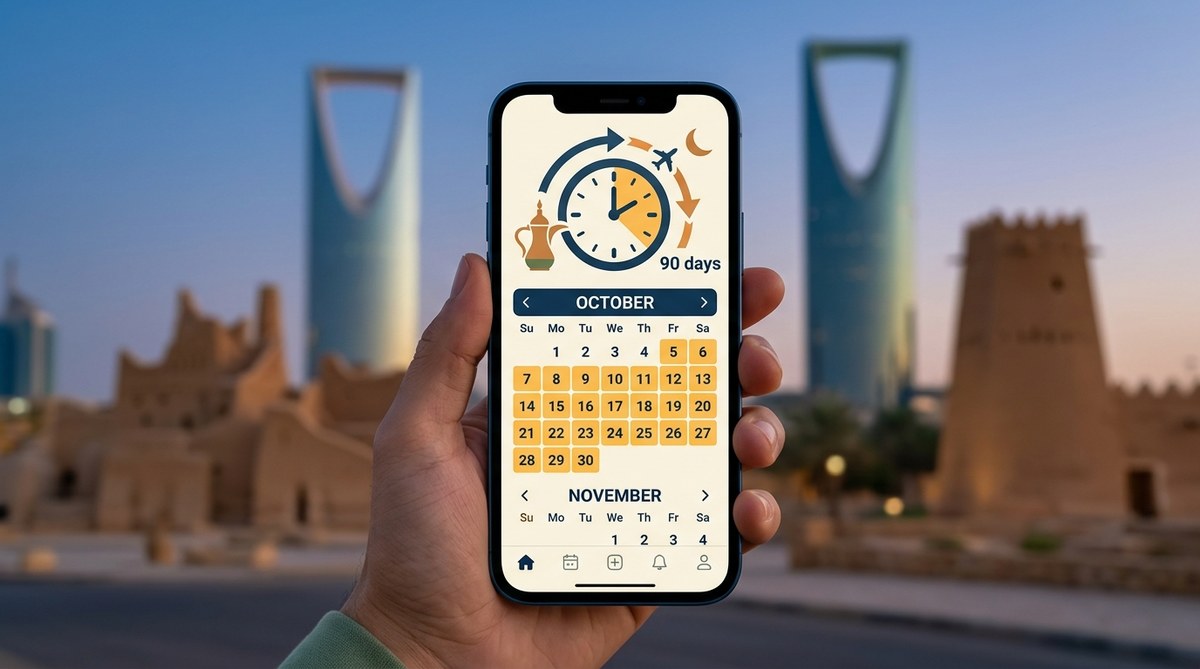
Planning a trip to Saudi Arabia means understanding exactly how much time you have to experience everything from the ancient tombs of AlUla to the modern skyline of Riyadh. The Kingdom opened its doors to international tourists in 2019, and the visa rules are more generous than many travelers realize.
Saudi Arabia’s tourist visa grants you 90 days per visit within a one-year validity period. You can enter multiple times during that year, but each stay cannot exceed 90 consecutive days. The visa costs approximately $130 USD and can be extended for another 90 days while you’re in the country, giving you up to 180 days total if approved.
Understanding the Saudi tourist visa duration
The Saudi tourist visa is a multiple-entry document valid for one year from the date of issue.
You get 90 days maximum per visit.
That means you could theoretically leave and return multiple times within that year, as long as each individual stay doesn’t exceed 90 days. Most travelers use their visa for a single trip, but having the flexibility to return within 12 months is valuable if you fall in love with the country or need to come back for business that qualifies under tourist activities.
The 90-day period starts counting from your arrival date stamped at immigration, not from when you applied for the visa. If you apply for your Saudi Arabia e-visa in January but don’t travel until March, your one-year validity starts in January, but your 90-day stay period starts in March.
Keep your entry stamp clearly visible in your passport. Immigration officers check this when you exit, and overstaying can result in fines, deportation, or future entry bans.
How the 90-day limit actually works
The 90 days are consecutive calendar days, not business days or some other calculation.
If you arrive on February 1st, your 90th day falls on May 1st. You need to exit the country by midnight on April 30th to avoid overstaying.
Here’s what counts toward your 90 days:
- The day you arrive counts as Day 1
- Weekends and Saudi public holidays count
- Time spent in hotels, with friends, or anywhere else in the Kingdom counts
- Day trips to nearby countries reset your 90 days only if you formally exit and re-enter
Some travelers assume they can take a weekend trip to Bahrain or the UAE and reset their counter. That works only if you go through full exit and entry procedures. Simply crossing a land border and returning the same day doesn’t restart your 90-day clock in most cases.
“The 90-day period is strictly enforced. I’ve seen travelers at King Khalid International Airport scrambling to change flights because they miscounted their days. Always build in a buffer.” — Immigration consultant based in Riyadh
Multiple entry privileges explained
Your tourist visa allows unlimited entries during its one-year validity.
This feature makes Saudi Arabia attractive for people who want to visit multiple times or combine tourism with regional travel.
You could spend three weeks in Saudi Arabia in April, leave for Europe, then return in September for another month. As long as each visit stays under 90 days and you’re within the one-year validity window, you’re compliant.
Business travelers who attend conferences or events find this particularly useful. You can attend a trade show in Riyadh, return home, then come back a few months later for a different event without needing a new visa.
The one-year validity period is fixed from issue date. If your visa was issued on March 1, 2026, it expires on February 28, 2027, regardless of how many days you actually spent in Saudi Arabia during that time.
Extending your stay beyond 90 days
You can request a visa extension while you’re in Saudi Arabia.
Extensions grant an additional 90 days, potentially giving you 180 days total in the country.
Here’s how to request an extension:
- Visit the nearest Muqeem portal office or use their online platform before your current 90 days expire
- Submit your passport, entry stamp documentation, proof of accommodation, and return flight details
- Pay the extension fee (typically around 500 SAR, roughly $133 USD)
- Wait for approval, which can take 3-7 business days
Extensions aren’t guaranteed. Saudi authorities evaluate your reason for staying longer, your financial means, and your travel history. Tourists who can demonstrate they’re actively visiting different regions and have sufficient funds tend to get approved more easily.
Don’t wait until day 89 to apply. Start the process at least two weeks before your 90 days expire to account for processing time and potential requests for additional documentation.
If you need more details about the extension process, check out our guide on extending your tourist visa while in Saudi Arabia.
Common mistakes that lead to overstaying
Travelers make predictable errors when calculating their stay duration.
| Mistake | Why It Happens | How to Avoid It |
|---|---|---|
| Counting from visa issue date | Confusing validity period with stay duration | Count from your actual arrival stamp |
| Forgetting the arrival day counts | Assuming only full days count | Day 1 is your arrival date, not the next day |
| Relying on airline staff | Flight crew don’t track visa expiry | Calculate independently and set phone reminders |
| Assuming automatic extensions | Thinking 90 days is flexible | Extensions require formal approval before expiry |
| Miscounting during Ramadan | Travel fatigue during the holy month | Use a calendar app with Saudi holidays marked |
One American traveler I spoke with assumed his 90 days started the day after arrival. He overstayed by one day and faced a 1,000 SAR fine plus a three-hour delay at the airport while paperwork was processed.
Set a reminder on your phone for day 80. That gives you 10 days to either plan your exit or start the extension process.
Planning your trip length strategically
Ninety days is enough time to see most of Saudi Arabia thoroughly.
You could spend two weeks in the western region visiting Jeddah, Mecca’s surrounding mountains (non-Muslims cannot enter Mecca itself), and the Red Sea coast. Then head north to AlUla and Tabuk for another two weeks. Follow that with time in Riyadh and the central region, then finish in the Eastern Province.
If you’re combining tourism with a pilgrimage, you might convert your Umrah visa to a tourist visa and use the remaining time to visit places like the historic Al-Balad district in Jeddah.
Most first-time visitors spend 10-14 days in Saudi Arabia. That’s enough to hit the major sites without feeling rushed:
- 3-4 days in Riyadh
- 3 days in AlUla
- 2-3 days in Jeddah
- 2 days for the Edge of the World and surrounding desert areas
- 1-2 days in Taif or the Asir region
If you have more time, consider a road trip along the Red Sea coast or visiting hidden gems most tourists miss.
What happens if you overstay
Overstaying your Saudi tourist visa triggers immediate consequences.
Fines start at 500 SAR for the first day and increase progressively. If you overstay by more than a week, you could face 1,000-3,000 SAR in penalties plus potential deportation.
Saudi Arabia maintains a database of visa violations. An overstay can result in:
- Entry bans ranging from 6 months to several years
- Difficulty obtaining visas for other GCC countries
- Detention until fines are paid and travel arrangements are made
- Mandatory escort to the airport by immigration officials
These aren’t theoretical. The Kingdom has invested heavily in modernizing its immigration tracking systems since opening to tourism. Every entry and exit is logged digitally.
If you realize you’re going to overstay due to a medical emergency, flight cancellation, or other legitimate reason, contact the nearest Muqeem office immediately. They can sometimes issue emergency extensions or waive penalties if you have documentation proving the circumstances were beyond your control.
Documents you need at immigration
When you arrive in Saudi Arabia, immigration officers verify your visa and check specific documents.
Having everything ready speeds up the process and prevents issues.
Bring these items in physical and digital form:
- Your passport with at least 6 months validity remaining
- Printed copy of your e-visa approval
- Proof of accommodation (hotel bookings or invitation letter)
- Return flight ticket or onward travel confirmation
- Travel insurance certificate (recommended but not always mandatory)
Immigration may ask about your itinerary or how long you plan to stay. Answer honestly and consistently with what you wrote on your visa application.
For a complete breakdown of what to expect at the immigration checkpoint, read our guide on documents you actually need at Saudi immigration.
Special cases and exceptions
Some travelers have unique situations that affect their visa duration.
GCC residents: If you hold residency in another Gulf Cooperation Council country (UAE, Kuwait, Bahrain, Qatar, or Oman), you might qualify for different entry procedures. Some GCC residents can get visa-on-arrival with different duration rules.
Visa-free nationals: Citizens from 49 countries can enter Saudi Arabia without a pre-approved visa. They get the same 90-day duration but receive their visa stamp on arrival. Check if your country is on the visa-free entry list.
Umrah and Hajj pilgrims: Religious visas have different rules. Umrah visas typically allow 30 days, though this can vary. You cannot use a tourist visa to perform Umrah or Hajj. However, after completing Umrah, you can convert to a tourist visa to extend your stay.
Business activities: The tourist visa technically allows some business activities like attending conferences, meetings, or site visits, but not formal employment. If you’re planning extensive business activities, consult with Saudi authorities about whether you need a business visa instead.
Making the most of your 90 days
Three months in Saudi Arabia is substantial time if you plan well.
Consider slow travel instead of rushing through every major city. Spend a week in the Asir region experiencing the green highlands and cooler temperatures. Take time to understand local coffee traditions and social etiquette.
The Kingdom has invested billions in tourism infrastructure, but it’s still developing. Some regions have limited accommodation options, so booking ahead for popular destinations like AlUla is essential.
If you’re visiting during Ramadan or major celebrations like Saudi National Day, factor in how these events affect operating hours and availability.
Adventure travelers can fill 90 days easily with activities like Red Sea diving, desert safaris in the Empty Quarter, and hiking in remote mountain regions.
Getting your timing right
Your 90-day allowance gives you flexibility most other Middle Eastern destinations don’t offer.
The one-year validity means you can plan a return trip if your first visit leaves you wanting more. Many travelers do exactly that, spending two weeks on their first visit to see if Saudi Arabia matches their expectations, then returning for a longer stay once they know which regions they want to prioritize.
Keep a simple spreadsheet or use your phone’s calendar to track your days. Mark your entry date, count forward 90 days, and set alerts at the 60-day and 80-day marks. This simple system prevents the miscounting errors that lead to overstays.
If you’re planning an extended stay, research accommodation options beyond international hotel chains and understand the real costs of spending time in the Kingdom.
Remember that your visa validity and your stay duration are two different things. You have one year to use your visa, but only 90 consecutive days per visit. Understanding this distinction helps you plan multiple trips or a single extended journey with confidence.
Most importantly, avoid the common visa mistakes that could get you denied entry by double-checking your dates, keeping your documents organized, and staying aware of your remaining days throughout your trip.