
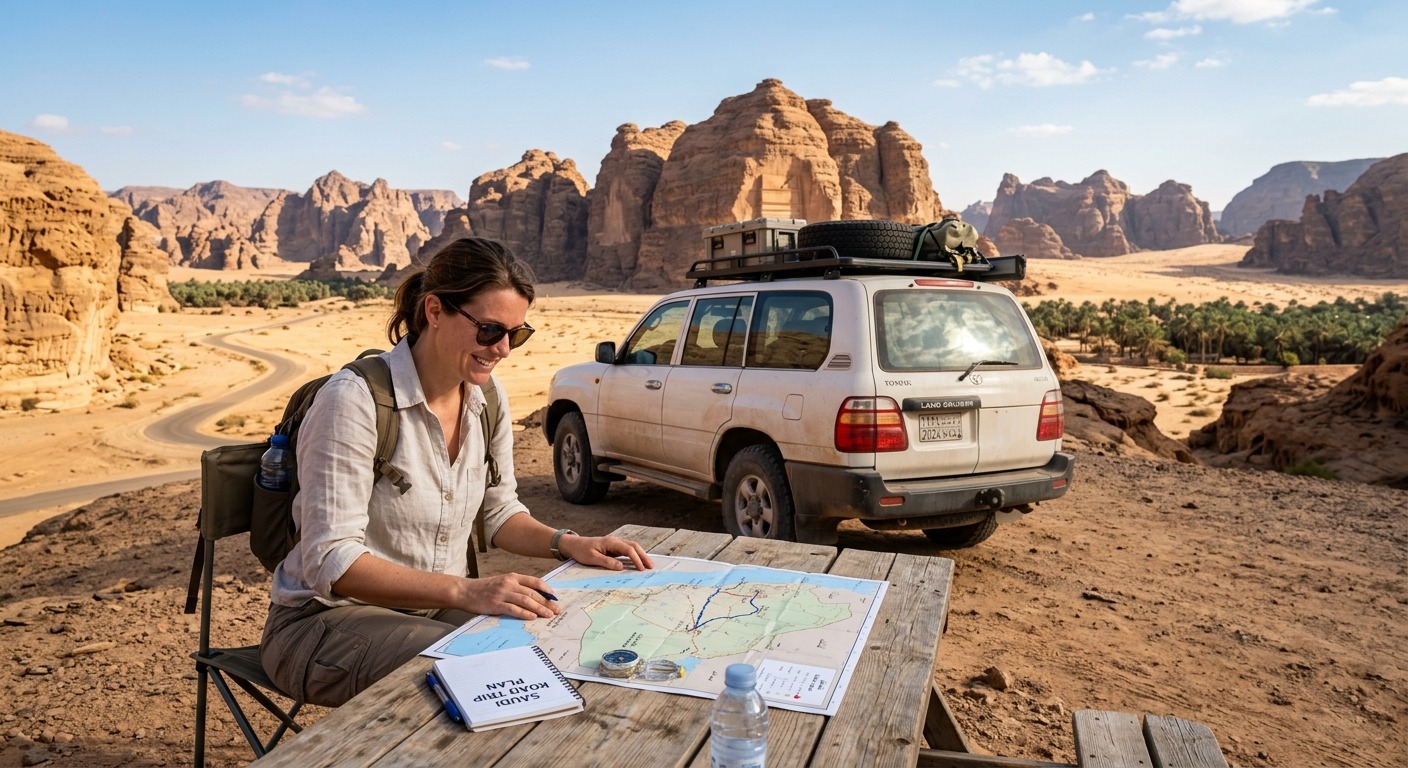
The sun is already hot at 7 a.m. when you pull onto the empty highway heading northwest from Riyadh. The city fades in the rearview mirror. Ahead, the road cuts through ochre desert that stretches further than the eye can follow. No other cars. Just you, the air conditioning, a tank of cheap fuel, and roughly 1,400 kilometers of some of the most dramatic landscape on the planet waiting to be driven. That is what a Saudi Arabia road trip feels like at its best. And it is far more accessible than most first-time visitors expect.
Trip Snapshot
Independent road travel in Saudi Arabia is genuinely achievable for first-time foreign visitors, and the logistics are more manageable than the destination’s reputation suggests.
- Tourist e-visas are available online for citizens of over 50 countries, with most approvals arriving by email within minutes of submitting the form.
- Roads are modern and signed in both Arabic and English, fuel is among the cheapest in the world, and rental cars are easy to arrange at major airports.
- A handful of cultural and logistical checkpoints, including sorting connectivity for remote stretches before you fly, make the difference between a smooth drive and an avoidable headache.
The Tourist E-Visa That Opens the Door
Saudi Arabia launched its tourist e-visa in 2019, and the process is refreshingly simple. Citizens from more than 50 countries can apply online before departure or on arrival at major international airports. The visa covers up to 90 days of cumulative stay within a 12-month period and includes basic travel insurance bundled into the application. Most applicants receive approval by email within minutes of paying and submitting the online form.
The visa carries no geographic restrictions. You can design your own route freely: drive from Riyadh up to AlUla, loop south through Asir, finish in Jeddah’s historic quarter, and do all of it on a single entry. There is no need to declare an itinerary or stick to pre-approved corridors. For the current list of eligible nationalities and official application steps, the Saudi Ministry of Tourism’s portal is the authoritative starting point.
Timing Your Drive Around the Climate
Saudi Arabia’s sheer size means its climate varies significantly by region, and getting the timing right shapes the entire experience. The central rule for road trippers is simple: avoid the interior desert regions between June and August. Temperatures in Riyadh and across the northwest plateau can exceed 45 degrees Celsius in July. Driving is still possible in an air-conditioned car, but stopping anywhere outdoors becomes genuinely uncomfortable and, during the midday hours, hazardous.
October through March is the window most independent drivers aim for. Daytime temperatures across Riyadh, the desert plateau, and the AlUla region sit between 15 and 28 degrees Celsius during these months. That range is ideal for hiking, roadside camping, and long driving days with frequent stops at viewpoints. The Asir highlands in the southwest stay cooler and greener throughout the year, making them a reasonable option even in April and May when the rest of the country is already heating up.
Ramadan adds a different texture to any trip. Restaurants operate on reduced daytime hours, and eating or drinking openly in public requires discretion. The evenings, though, transform into something worth experiencing in their own right. Iftar, the meal that breaks the fast at sunset, turns city streets into celebrations, and the generosity extended to foreign visitors during the holy month tends to be exceptional.
The Routes That Make the Drive Worth It
Riyadh to AlUla: The Desert Classic
The route from Riyadh northwest toward AlUla covers roughly 1,100 kilometers and passes through landscapes that shift from flat sand desert to volcanic rock fields to sandstone canyons. Most road trippers break the journey at Hail, a city with comfortable hotels and a strong local food scene sitting at approximately the midpoint. The second leg from Hail into AlUla is where the terrain becomes genuinely dramatic, with the highway threading between enormous eroded formations that look like something from a different planet entirely.
AlUla anchors the northern route for good reason. The Hegra archaeological site contains more than 100 Nabataean tombs carved directly into sandstone cliff faces, a location recognised as Saudi Arabia’s first World Heritage listing by UNESCO. Access is managed and ticketed, with guided experiences available in multiple languages. During peak months, timed entry slots fill quickly, and booking ahead is a practical necessity rather than an optional extra.
The Asir Highlands: Green Arabia
Most visitors to Saudi Arabia don’t expect mountains, juniper forests, and cool morning mist. The Asir region in the far southwest delivers exactly that. The highlands around Abha sit above 2,000 meters of elevation, and the air carries a freshness that feels genuinely surprising after the aridity of the central plateau.
The drive from Jeddah south toward Abha along the escarpment road ranks among the most dramatic drives in the country. The highway climbs from sea level to over 2,000 meters through a tight series of switchbacks, with views dropping into the Tihama coastal plain far below. Abha itself has cable cars spanning the valleys, a restored heritage village, and trailheads into Asir National Park for hiking through landscapes that feel unlike anything else on the Arabian Peninsula.
The Edge of the World Near Riyadh
Jebel Fihrayn, known informally as the Edge of the World, sits around 75 kilometers northwest of Riyadh and earns its name without exaggeration. A vast sandstone escarpment drops several hundred meters in a sheer cliff face, and from the rim, the view extends to an unbroken horizon in every direction. There is nothing between the edge and the desert floor below except empty air.
Reaching it requires a 4WD vehicle. The track is unmarked for most of its length, though GPS coordinates are well-documented across travel forums and driving apps. Riyadh-based tour operators run guided half-day trips from the city for those who prefer company or a guide to lead the way. Visiting on a weekday outside of public holidays means you may have the rim largely to yourself, and that solitude is a large part of what makes the place memorable.
Fuel, Roads, and Driving Realities
Saudi Arabia’s highway network is one of the trip’s practical advantages. Major roads between cities are wide, well-maintained, and often empty for long stretches in both directions. Speed limits are enforced by a camera system rather than police checkpoints, so the rules are consistent and worth respecting throughout.
Fuel is among the cheapest in the world by any international measure. Filling a standard SUV costs roughly the equivalent of USD 15 to 20 at current prices. Petrol stations appear at regular intervals on main routes, but on more remote stretches between smaller towns you should treat the half-tank mark as a refill signal. Waiting for the gauge to drop further is a risk not worth taking in terrain where the next station may be 150 kilometers away.
A valid international driving permit is required alongside your home country licence. All major international car rental companies operate at Riyadh, Jeddah, and Medina airports, and advance booking during peak travel months is practical rather than optional. Driving is on the right-hand side of the road. Road signage uses both Arabic and English across the entire country, which makes navigation on main routes manageable for non-Arabic speakers from the first day.
Staying Connected Across Desert Stretches
Long gaps between towns are part of what gives a Saudi Arabia road trip its character. They are also the stretches where navigation apps, translation tools, and the ability to reach emergency contacts matter most. Saudi Arabia’s telecoms infrastructure is strong in cities and along major highways, but coverage thins noticeably in remote areas. The volcanic lava fields north of Medina, the back roads of the Asir escarpment, and the empty plateau between Hail and AlUla all have patches where a weak signal becomes no signal at all.
Relying on roaming from your home network can work in bursts, but data costs and coverage gaps both tend to catch travelers off guard. Picking up a Saudi Arabia eSIM before your flight is the tidiest fix available. You activate it on your phone before boarding, it runs alongside your existing home SIM, and you land with a working data connection already in place. No queuing at an airport counter after a long flight, no hunting for a local SIM shop in an unfamiliar city, no dead zone on a desert highway with no backup plan. For a trip covering multiple regions across a country this size, having that data connection working from the moment you arrive through to the day you depart is worth sorting in the week before you fly.
Cultural Etiquette Checkpoints Westerners Often Miss
Saudi Arabia has changed rapidly under Vision 2030, and many assumptions held by Western visitors are based on a version of the country that no longer exists. Mixed-gender socializing in restaurants, live concerts, cinema screenings, and women traveling independently are all part of daily life now. The dress code for tourists is practical rather than strict: modest clothing is appropriate, particularly at religious sites and in conservative towns, but Riyadh and Jeddah are cosmopolitan cities where the atmosphere is noticeably relaxed compared to a decade ago.
Photography is one area where first-timers sometimes get caught out. Photographing government buildings, military infrastructure, or individuals without asking permission can create real problems. The polite default is to ask before pointing a camera at anyone, particularly women. Drones require advance permits and face restrictions around cities, airports, and heritage sites. Bringing one and assuming you can fly it freely is a mistake best corrected before you pack.
Alcohol is prohibited nationwide, and this applies equally to visitors. The hospitality, on the other hand, is exceptional. Offering tea, coffee, and dates to a guest is a genuine cultural gesture, and declining repeatedly can feel dismissive to a Saudi host. Accept warmly the first time and you will be on solid ground.
Friday mornings follow a different rhythm to the rest of the week. Most businesses, restaurants, and tourism sites operate on shorter hours during Friday prayer time, which runs roughly from 11 a.m. to 1:30 p.m. Planning your driving schedule to be on the road during that window rather than trying to stop for a sit-down meal is a small adjustment that makes the day go considerably more smoothly.
The Road Rewrites What You Thought You Knew
Saudi Arabia rewards independent road travelers in a way that no guided tour can fully replicate. The scale of the country only becomes real after you have driven it. The silence between Riyadh and Hail, where the highway stretches ahead without another vehicle in sight. The moment the Asir escarpment road begins to climb and the air changes around you. The first time you stand at the rim at Jebel Fihrayn and realize there is genuinely nothing below you for hundreds of meters except still air.
Decades of limited inbound tourism have left Saudi Arabia’s sites comparatively peaceful. Locations that would be crowded in other countries are quiet here. Locals who encounter foreign visitors traveling independently are often curious and warmly welcoming rather than indifferent. That hospitality is one of the things that stays with road trippers long after they fly home.
The practical side of the trip is more manageable than the destination’s unfamiliarity might suggest. The e-visa is online. The roads are in excellent condition. Fuel costs almost nothing. The cultural learning curve is real, but it is not steep. With the right timing, a route that balances the desert classics with the highland surprises, and data that keeps working whether you are in Riyadh or on a remote highland track, the whole journey comes together more naturally than most first-timers anticipate. Saudi Arabia is not a difficult destination. It is simply an unfamiliar one. And that changes from the moment you start driving.